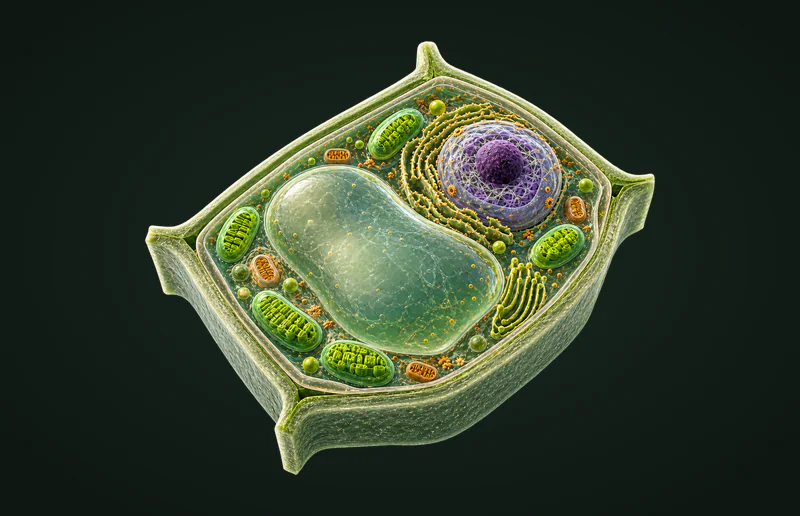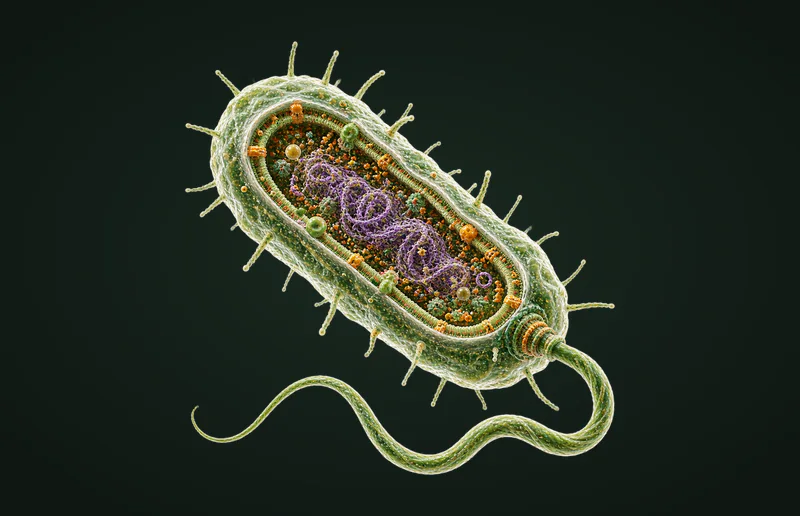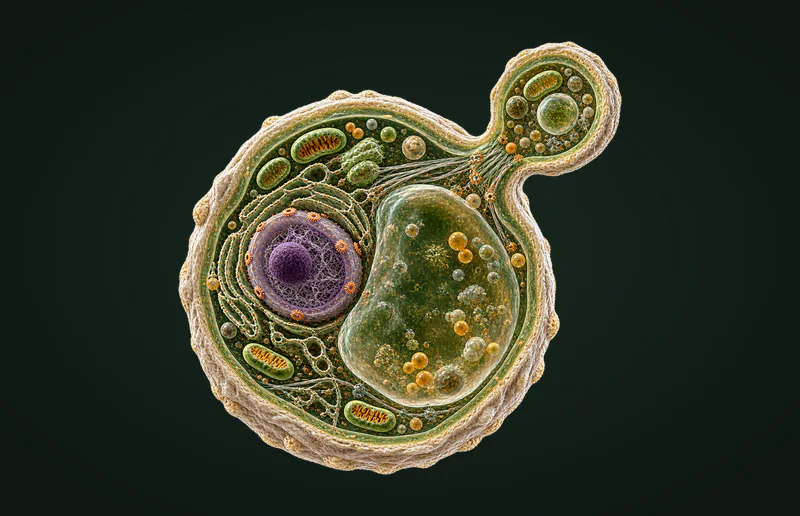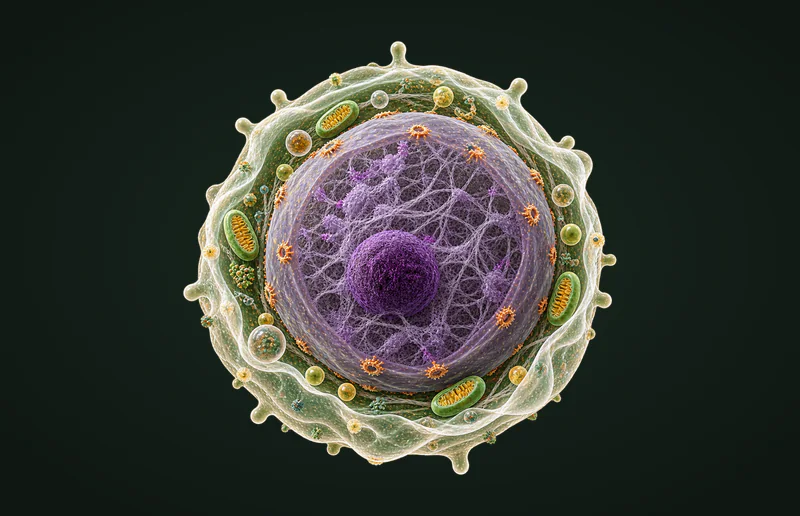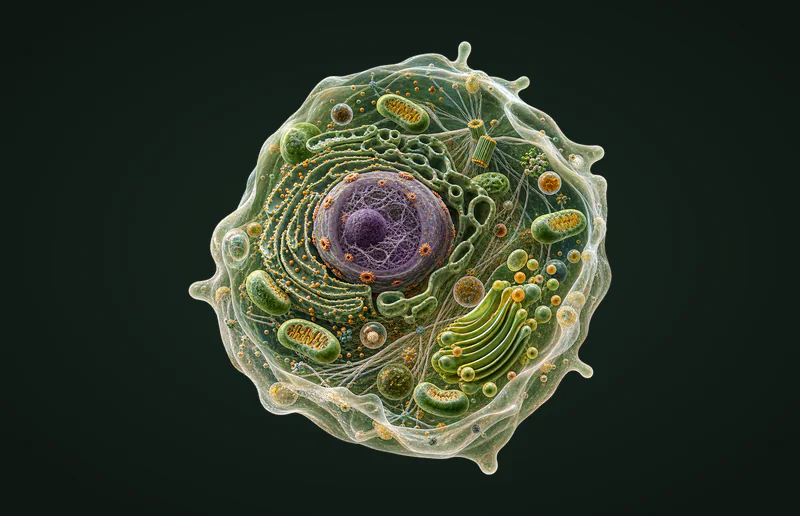
An animal cell is the basic unit of every animal body — a eukaryotic cell with a true nucleus and a crew of membrane-bound organelles, but no cell wall, so it stays soft and flexible.
Your body is built from roughly 37 trillion of these, in over 200 specialized types. Despite the variety, they share the same toolkit, which is what this page lays out.
Structure
An animal cell is wrapped only in a flexible cell membrane — there is no rigid wall, which is why animal cells take on so many shapes. The membrane is a phospholipid bilayer studded with proteins, and it is selectively permeable: it decides what crosses, in which direction, and at what cost in ATP.
Inside, the cytoplasm holds the organelles you can rotate in the 3D model above:
- The nucleus — the control center, storing the DNA behind a double membrane pierced by nuclear pores.
- Mitochondria — where ATP is generated by oxidative phosphorylation.
- The endoplasmic reticulum and ribosomes — the protein and lipid factory; rough ER (ribosome-studded) makes secreted and membrane proteins, smooth ER makes lipids and detoxifies.
- The Golgi apparatus — sorting, glycosylating, and shipping.
- Lysosomes — acidic recycling bags full of hydrolytic enzymes.
Holding it all in shape is the cytoskeleton: microfilaments, intermediate filaments, and microtubules that brace the cell, move cargo, and pull chromosomes apart in mitosis. Animal cells also keep a pair of centrioles near the nucleus, which organize that spindle.
What an animal cell lacks is just as diagnostic. There is no cellulose cell wall, no chloroplasts, and no single large vacuole — three features that define the plant cell instead.
Function
The animal cell is a self-contained chemical city, and the secretory pathway is its assembly line. The nucleus issues instructions as mRNA; ribosomes on the rough ER translate them; the protein folds and gets tagged in the ER lumen, ships to the Golgi in vesicles for final processing, and leaves in a secretory vesicle that fuses with the membrane. Meanwhile mitochondria burn glucose to power the whole operation, and lysosomes clear the waste.
Because there is no wall to brace it, the animal cell manages water carefully. It cannot rely on turgor pressure the way a plant cell does, so it uses the membrane's Na⁺/K⁺ pump — burning roughly a quarter of the cell's resting ATP — to keep solute concentrations, and therefore water, in balance. Drop a red blood cell into pure water and it swells and bursts (lysis); the pump is what normally holds that line.
That same wall-free flexibility is an advantage. It lets animal cells crawl, change shape, engulf particles by phagocytosis, and pack tightly into tissues — which underpins everything from muscle contraction to immune defense to the way a wound closes.
In the exam
- AP Bio (Unit 2, Cell Structure and Function): The classic free-response task is to compare animal and plant cells. Lead with what plants add (wall, chloroplasts, central vacuole) and what animals keep that plants downplay (centrioles, prominent lysosomes). Examiners want the functional consequence, not just a checklist — for example, "no wall, so the cell osmoregulates with membrane pumps."
- IB HL / A-Level: Be ready to label a transmission electron micrograph and to explain why "eukaryotic" means a true membrane-bound nucleus plus membrane-bound organelles. The contrast with a bacterium — compartmentalization versus one open compartment — is the point being tested.
- MCAT (Foundational Concept 2): Expect the secretory pathway (nucleus → rough ER → Golgi → vesicle → membrane) in a question stem, often with a mutation that blocks one step. Trace where the protein gets stuck.
- A-Level (OCR/AQA): The magnification and "actual size = image size ÷ magnification" calculation is regularly anchored to an animal-cell micrograph. Convert units carefully (μm to mm).
Related cells
- Plant cell — the standard comparison: wall, chloroplasts, big vacuole.
- Bacterium — the prokaryote contrast: no nucleus, no membrane-bound organelles.
- Nucleus — the organelle that makes a cell eukaryotic.
- Mitochondrion — the animal cell's main energy source.
- Red blood cell — a striking specialist that drops its nucleus and most organelles entirely.
Common misconceptions
- "Animal cells have no vacuoles." They have small, temporary ones — endosomes, food vacuoles, secretory vesicles — just not the single large central vacuole of a plant cell.
- "All animal cells look the same." A neuron, a red blood cell, and a muscle fiber share the toolkit but differ dramatically in shape and contents because differential gene expression switches different parts of that toolkit up or down.
- "No cell wall means no protection." The flexible membrane, the cytoskeleton, and the surrounding extracellular matrix and tissue all provide structure. The trade-off buys mobility and shape change — exactly what a stationary plant cell gives up.
- "The nucleus makes ATP because it's the control center." It does not. ATP comes from mitochondria (and a little from glycolysis in the cytoplasm); the nucleus only stores and transcribes the instructions.
References
- Reece et al., Campbell Biology, 11th ed., Ch. 6 (A Tour of the Cell).
- Alberts B. et al., Molecular Biology of the Cell, 7th ed., Ch. 1 (Cells and Genomes) and Ch. 12–13 (Intracellular Compartments and Protein Sorting).
- College Board AP Biology Course and Exam Description (2025) — Unit 2 (Cell Structure and Function).