The central vacuole is the giant water balloon at the heart of a plant cell — it can fill most of the cell's volume, and the pressure it builds is what keeps a plant standing upright.
In a mature plant cell, one central vacuole often takes up 80–90% of the interior, squashing the cytoplasm, chloroplasts, and nucleus into a thin layer against the wall. Animal and fungal cells have smaller, often temporary vacuoles instead.
Structure
The vacuole is bounded by a single membrane called the tonoplast, which separates the watery interior (the cell sap) from the cytosol. The tonoplast is not a passive bag — it carries pumps and channels, including a vacuolar H⁺-ATPase (V-ATPase) that acidifies the interior, plus aquaporins and ion transporters that move water, ions, and solutes in and out under tight control.
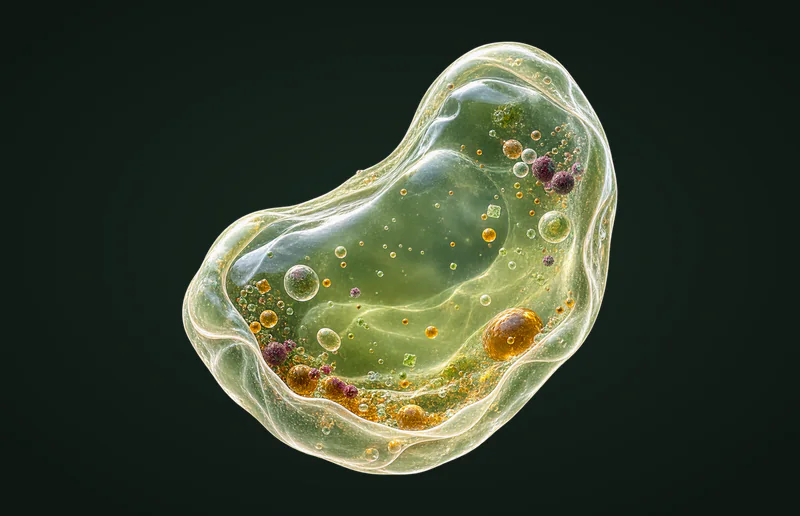
In the 3D model above, the large smooth compartment is the vacuole, and the membrane enclosing it is the tonoplast. Its sheer size is the point — no other single compartment dominates a eukaryotic cell like this one.
The cell sap is mostly water but also holds ions (K⁺, Cl⁻, malate, nitrate), sugars, organic acids, waste products, and sometimes brightly colored anthocyanin pigments that give flowers and fruit their red, purple, and blue tones. In some plants it also stores defensive compounds — the bitter alkaloids and the calcium-oxalate crystals that deter herbivores.
Function
The vacuole's most important job is turgor pressure. Water moves into the vacuole by osmosis — drawn by the high solute concentration the cell maintains in the sap — swelling it until it presses the cytoplasm firmly against the rigid wall of the plant cell. That outward pressure is turgor, and it is what makes leaves and non-woody stems rigid. When water runs short, the vacuoles shrink, turgor drops, and the plant wilts; in extreme drought the membrane pulls away from the wall entirely, a state called plasmolysis.
This same osmotic logic lets the plant grow cheaply. A young cell can enlarge dramatically just by taking water into the vacuole, without synthesizing much costly new cytoplasm — so the vacuole drives elongation, not just rigidity.
The vacuole is also the cell's storage tank and waste depot. It stockpiles nutrients and ions for later, sequesters toxic byproducts safely away from the cytosol, and in many plants takes on the digestive role that lysosomes play in animals, using its own acidic, enzyme-rich interior to break down macromolecules and worn organelles.
Not all vacuoles are giant water stores. In single-celled organisms, contractile vacuoles bail out excess water to stop the cell bursting in fresh water, and food vacuoles form when a protist engulfs prey — the same compartment, scaled to a different problem.
In the exam
The vacuole is a favorite vehicle for testing osmosis reasoning, so the question is rarely "what is a vacuole" and usually "what happens when water potential changes."
- AP Bio (Unit 2 & osmosis/water potential): The central vacuole and turgor pressure are the standard explanation for plant-cell rigidity and wilting. Expect to link water potential (Ψ = Ψ_s + Ψ_p), osmosis, and turgor in one chain — for example, predicting whether a cell gains or loses water in a given solution and what happens to its turgor.
- IB HL: Be ready to contrast the large permanent plant vacuole with the small temporary vacuoles of animal cells, and to identify the tonoplast by name as its membrane.
- A-Level: Plasmolysis and incipient plasmolysis (the point where turgor pressure reaches zero) are stock practical and data questions, often from a cell placed in a sucrose series.
- MCAT: Less central, but contractile vacuoles in protists appear as osmoregulation examples, and the vacuole's role as a plant lysosome-equivalent is fair game in compare-and-contrast.
Related cells
- Plant cell — the vacuole's home; see how it dominates the interior and presses against the wall.
- Cell membrane — compare the selectively permeable tonoplast to the plasma membrane.
- Lysosome — the animal-cell organelle that performs the vacuole's digestive job.
- Chloroplast — the other large plant-specific organelle, pushed to the cell edge by the swollen vacuole.
- Fungal cell — also uses sizable vacuoles for storage and pH balance.
Common misconceptions
- "Vacuoles are just empty space." The cell sap is an active, regulated solution of water, ions, sugars, and pigments held under controlled pressure — anything but empty.
- "Turgor pressure pushes the wall outward without limit." The rigid cell wall resists it; the balance between turgor pushing out and the wall pushing back is what gives controlled firmness rather than rupture.
- "Only plants have vacuoles." Animal and fungal cells have them too — just smaller and often temporary — and protists rely on contractile and food vacuoles.
- "The vacuole stores only water." It is also the cell's main store for ions and sugars, its waste dump, its pigment bag, and frequently its digestive compartment.
References
- Reece J.B. et al. Campbell Biology, 11th ed. — Chapter 6 (A Tour of the Cell) and Chapter 36 (Resource Acquisition and Transport in Vascular Plants).
- Taiz L. & Zeiger E. Plant Physiology and Development, 6th ed. — Chapter 3 (Water and Plant Cells).
- College Board AP Biology Course and Exam Description (2025) — Unit 2 (Cell Structure and Function).