The mitochondrion is the cell's main supplier of ATP — the molecule almost every other reaction in your body spends. It is the only organelle outside the nucleus that carries its own DNA.
A typical human cell has 100 to 2000 mitochondria, with the count rising in cells that work hard for a living: muscle fibers, kidney tubule cells, brown fat. The number is not fixed — exercise can double it, and starvation can shrink it.
Structure
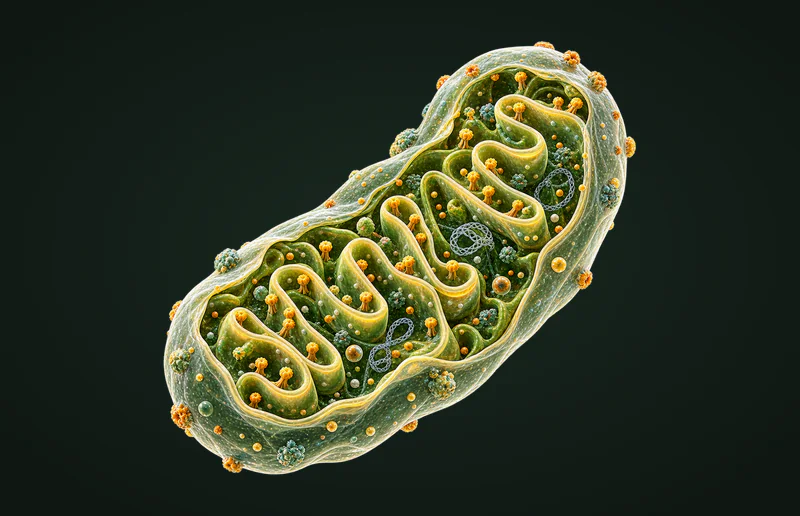
Mitochondria look like elongated kidney beans about 0.5 to 1 μm wide. Each one is bounded by two membranes, and the gap between them matters more than it sounds.
The outer membrane is the smooth, permeable shell. Small molecules and ions pass through pores called porins almost freely. This is where the boundary between "inside the mitochondrion" and "rest of the cytoplasm" begins, but it is not where the chemistry happens.
The inner membrane is the engine. It is densely folded into shelves called cristae, and that folding is the point: it gives the cell roughly five times more surface area for the protein machinery that lives there. The electron transport chain, ATP synthase, and the transporters that import substrate — all of them sit in the inner membrane.
Between those two membranes is the thin intermembrane space. Protons get pumped into this space during the electron transport chain, building a charge gradient that ATP synthase will spend.
Inside everything is the matrix — a dense soup containing:
- The enzymes of the Krebs cycle (citric acid cycle).
- A small loop of mitochondrial DNA (mtDNA), about 16,500 base pairs in humans, encoding 13 proteins of the electron transport chain plus its own ribosomal RNAs and tRNAs.
- Mitochondrial ribosomes — slightly different from your other ribosomes, which is why some antibiotics that hit bacteria also bother mitochondria. (Hold that thought.)
In the 3D model above, rotate the organelle and notice that the cristae are not random — they tend to align perpendicular to the long axis, maximizing packing.
Function
The mitochondrion's headline job is oxidative phosphorylation — running pyruvate (from glucose) and fatty acids through the Krebs cycle in the matrix, dumping the resulting electrons into the inner-membrane chain, and using the energy released to pump protons outward. The protons then come back through ATP synthase, and the rotation that happens drives ADP + Pi → ATP.
A glucose molecule that gets fully oxidized to CO₂ + H₂O yields roughly 30 ATP through this route, compared to just 2 from glycolysis alone. That ratio is why aerobic respiration is so dominant — and why losing oxygen kills cells so fast.
But ATP is not all mitochondria do:
- Calcium buffering. They are the cell's biggest calcium store after the ER and play a role in neuronal signaling.
- Heat (in brown fat). Uncoupling protein 1 short-circuits ATP synthase so the gradient dissipates as heat. Newborns and hibernating mammals lean on this.
- Programmed cell death. When a cell is too damaged to repair, releasing cytochrome c from the intermembrane space into the cytoplasm triggers apoptosis. That tight regulation is why mitochondria are sometimes called the cell's "kill switch."
The endosymbiotic origin
About two billion years ago, an early eukaryotic ancestor likely engulfed a free-living α-proteobacterium and didn't digest it. The bacterium kept dividing inside. Over generations most of its genes migrated to the host nucleus, but it kept a residual genome and a double membrane (one of which is roughly bacterial in composition).
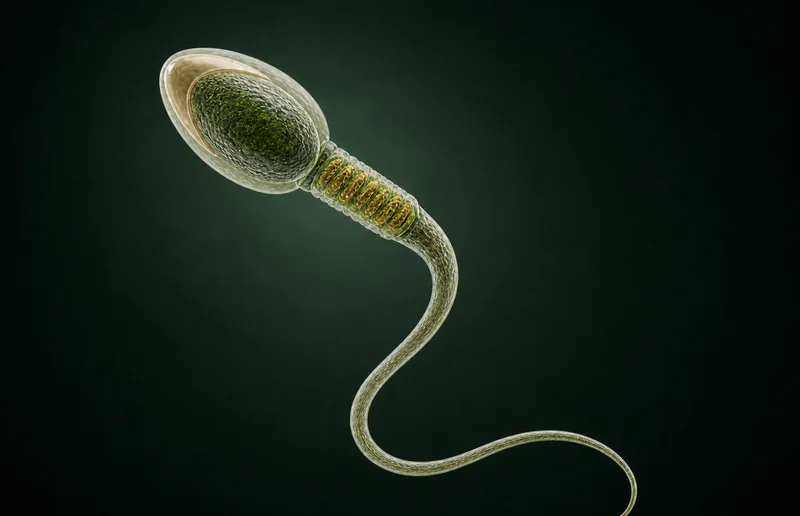
This is why the antibiotics chloramphenicol and tetracycline — which target bacterial ribosomes — can also hit mitochondrial ribosomes at high doses. It's also why mitochondrial DNA is maternally inherited: the sperm's mitochondria, packed into the midpiece for the swim, are tagged for degradation after fertilization.
In the exam
Mitochondrial questions are extremely common across exam systems. Watch for these patterns:
- AP Biology Unit 4.1 (Cellular Energetics): Most questions test whether you can locate each step of cellular respiration to the right compartment — glycolysis in cytoplasm, Krebs in matrix, oxidative phosphorylation on the inner membrane. Memorize the map, not the molecule list.
- IB HL Topic 2.8 / C1: "Explain why cristae increase ATP yield" is a classic 4-mark question. The answer is not "more space for ATP synthase" alone — name the inner-membrane proteins (ETC complexes I-IV and ATP synthase), then the surface-area argument.
- MCAT Biology Foundation 1B: Inheritance patterns. If a pedigree shows a trait passed only from mothers to all children (sons and daughters), it's mitochondrial DNA — not X-linked, not autosomal.
- USMLE Step 1: Diseases tied to mtDNA mutations (Leber's hereditary optic neuropathy, MELAS, MERRF) and the maternal inheritance pattern come up reliably.
Related cells
The story of the mitochondrion is half the story of energy in cells. To see the other half:
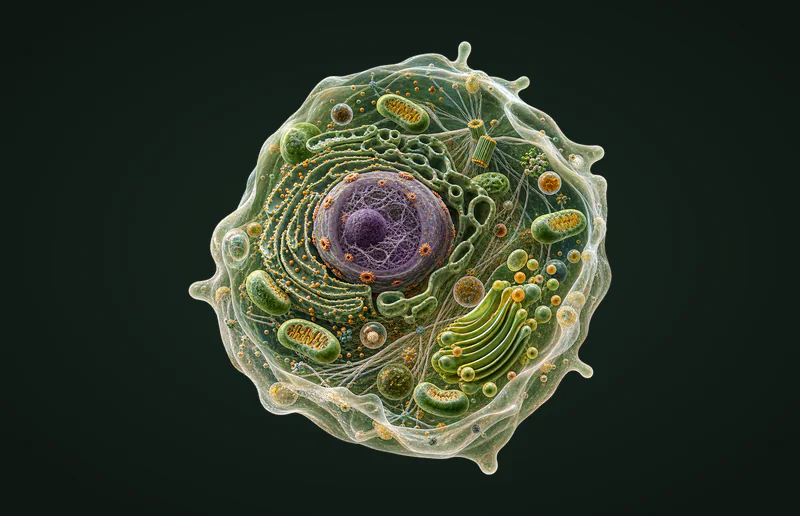
- Animal Cell — see where mitochondria sit relative to the other organelles in a typical eukaryote.
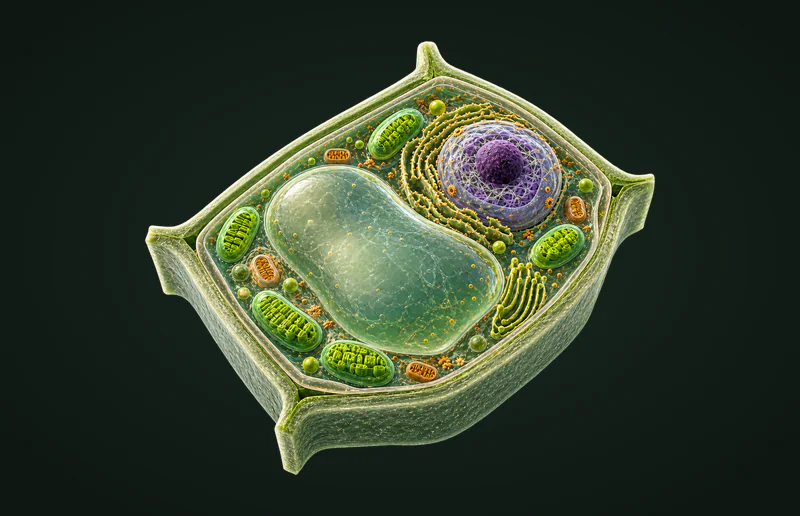
- Plant Cell — has mitochondria and chloroplasts, the only organelle pair with their own DNA.
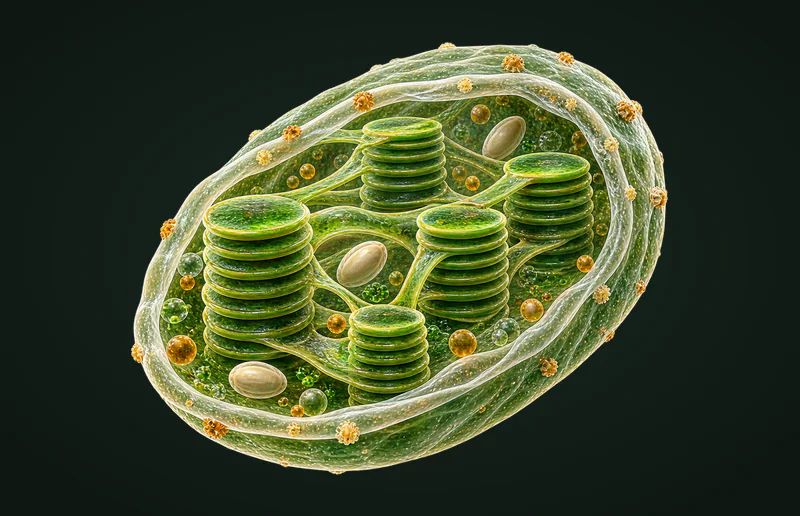
- Chloroplast — the photosynthesis counterpart with the same endosymbiotic origin story.
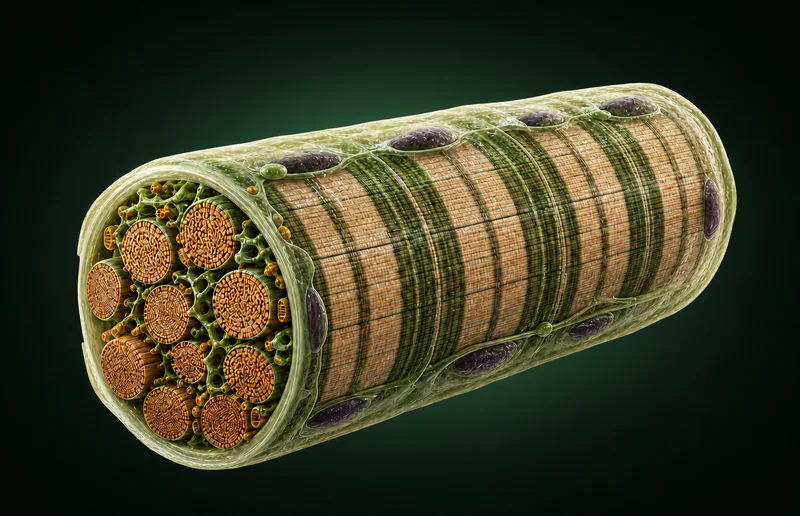
- Skeletal Muscle Fiber — one of the most mitochondria-rich cells in the body, especially in slow-twitch fibers.
- Sperm Cell — mitochondria are packed into the midpiece to power the flagellum, and then destroyed after fertilization.
Common misconceptions
- "The powerhouse of the cell" implies it makes energy. It doesn't. Energy is conserved. The mitochondrion converts chemical energy in food into chemical energy in ATP — a transfer, not a creation. (You will lose marks for "creates energy.")
- Cristae are random folds. They're not. Their shape and density are actively maintained by a protein complex called MICOS, and they remodel during apoptosis.
- All your mitochondria came from your mom. Almost. Roughly 1 in 5000 children inherits paternal mitochondria, a phenomenon called paternal leakage. The "strictly maternal" rule is true enough for exam purposes but worth knowing about.
References
- Alberts B. et al. Molecular Biology of the Cell, 7th ed. — Chapter 14: Energy Conversion: Mitochondria and Chloroplasts.
- Friedman, J.R. & Nunnari, J. "Mitochondrial form and function." Nature 505, 335-343 (2014).
- College Board AP Biology Course and Exam Description (2025) — Unit 4 (Cellular Energetics).