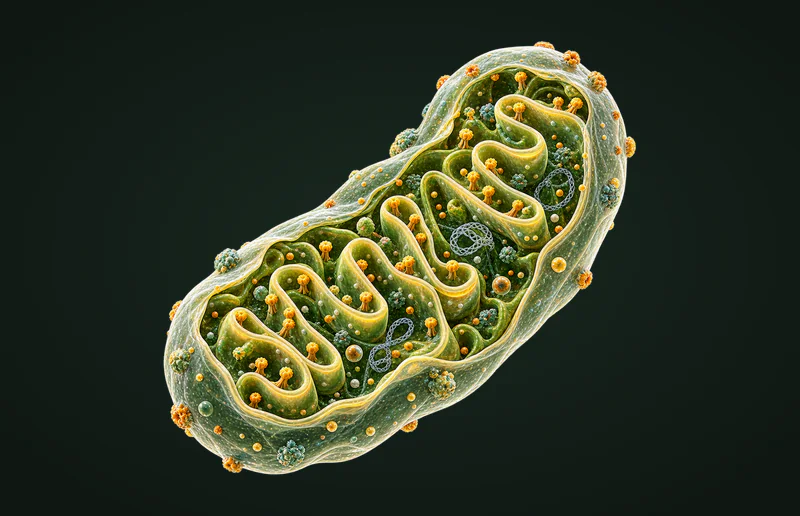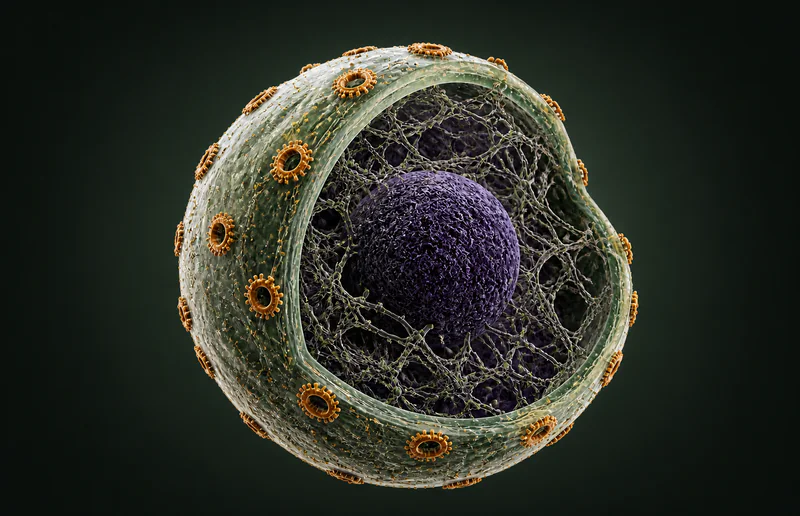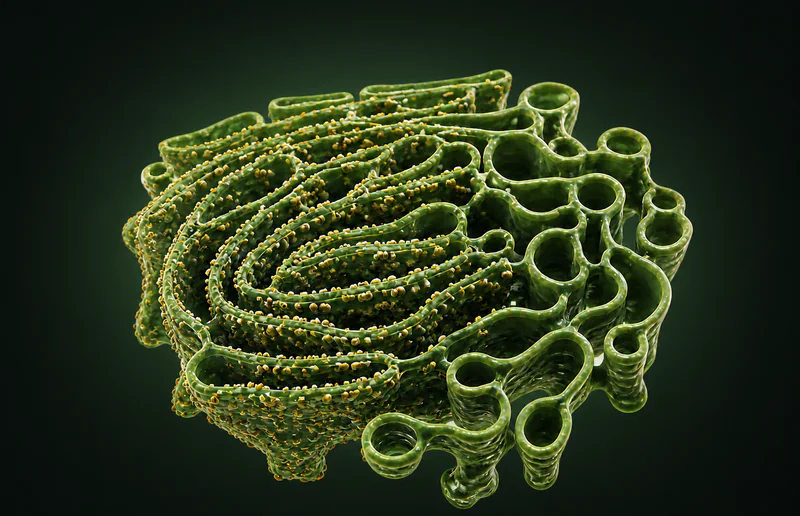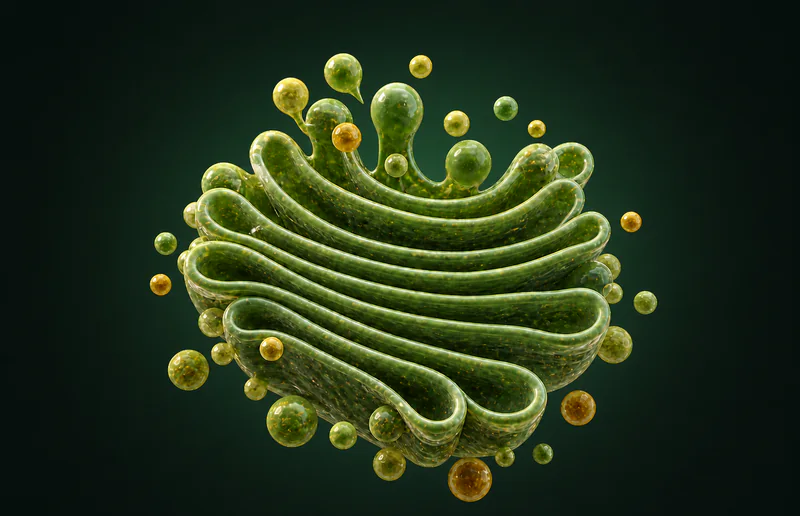
The cell membrane is the border that defines a cell — a thin, oily sheet just two molecules thick that decides what gets in, what stays out, and how the cell talks to the world.
Every cell on Earth has one. It is only about 7–8 nm thick — far too thin to resolve in a light microscope — yet it controls the entire traffic of the cell and holds its insides apart from everything else.
Structure
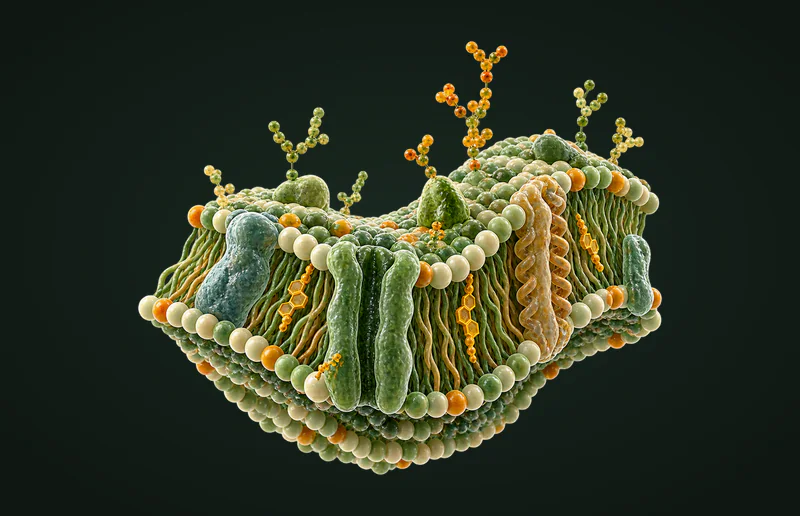
The membrane is a phospholipid bilayer. Each phospholipid has a water-loving (hydrophilic) phosphate head and two water-fearing (hydrophobic) fatty-acid tails. Drop these molecules into water and they sort themselves: heads face the watery outside and inside, tails hide in the middle. The arrangement is amphipathic self-assembly — no enzyme builds it, the physics of water does. In the 3D model above, this double layer of heads with tails between them is the sheet you see.
Floating in that sea of lipid are the other components of the fluid mosaic model:
- Integral (transmembrane) proteins span the whole bilayer and act as channels, carriers, pumps, and receptors. Their hydrophobic middle stretches grip the lipid tails; their charged ends poke into the water on each side.
- Peripheral proteins sit on one face only, often anchoring the cytoskeleton or relaying signals.
- Cholesterol wedges between the phospholipids as a fluidity buffer — it stops the membrane flowing too freely when warm and stops the tails packing solid when cold.
- Surface sugars (glycoproteins and glycolipids) form the glycocalyx, the ID tags used for cell recognition.
The bilayer is also asymmetric: the lipid mix and the sugar tags on the outer leaflet differ from the inner one, and the difference is maintained. The model is "fluid" because lipids and proteins drift laterally — a single phospholipid can travel the length of a bacterium in seconds — and "mosaic" because of that drifting patchwork of proteins.
Function
The membrane is selectively permeable: it lets some things cross freely and blocks others. Small nonpolar molecules (O₂, CO₂) dissolve straight through the lipid core. Ions and large polar molecules (glucose, amino acids) cannot cross the greasy middle — they need a protein.
Crossing splits into two routes by whether the cell spends energy:
- Passive transport moves substances down their concentration gradient and costs no ATP — simple diffusion, osmosis (water, often through aquaporin channels), and facilitated diffusion through channel and carrier proteins.
- Active transport spends ATP to push substances against their gradient. The classic example is the sodium-potassium pump, which exports 3 Na⁺ and imports 2 K⁺ per ATP, keeping a neuron poised to fire.
That pump does more than move ions. By holding unequal charge across the membrane it builds the membrane potential — the voltage every nerve and muscle cell spends when it signals. The gradient it stores also powers secondary active transport, where the Na⁺ rushing back in drags glucose along with it.
For cargo too big for any channel, the membrane reshapes itself. It folds inward to swallow material (endocytosis, including phagocytosis of whole bacteria) or fuses with vesicles to release contents (exocytosis) — the route a Golgi vesicle takes to secrete a hormone.
Beyond transport, the membrane's receptor proteins catch chemical signals — a hormone binding outside changes the protein's shape and passes the message in without the hormone ever entering — and its surface tags let the immune system tell self from non-self.
In the exam
- AP Bio (Units 2 & 3): The fluid mosaic model, selective permeability, and passive-versus-active transport are core. Expect an osmosis problem asking which way water moves between solutions of given solute concentration (water follows solute, hypertonic to where solute is higher), and a question on cholesterol as a temperature-buffering agent — it works in both directions, which trips students up.
- IB HL Topic 1.3 / B2.1: Be precise that facilitated diffusion is passive (via proteins, down the gradient, no ATP) while active transport is energy-requiring and against the gradient. The Na⁺/K⁺ pump is the expected named example, and "explain how membrane structure relates to function" is a recurring extended-response prompt.
- MCAT: Membrane potential, the Nernst equation idea, secondary active transport (Na⁺-glucose symport), and why amphipathic phospholipids self-assemble into bilayers are favorite reasoning targets. Know that signal transduction begins at a membrane receptor, not inside the cell.
Related cells
- Neuron — its membrane's ion pumps and channels generate the nerve impulse.
- Golgi apparatus — sends vesicles that fuse with the membrane in exocytosis.
- Cytoskeleton — supports and shapes the membrane from inside.
- Red blood cell — its membrane flexibility lets it fold through capillaries narrower than itself.
- Macrophage — uses large-scale endocytosis (phagocytosis) to engulf pathogens whole.
Common misconceptions
- "The membrane is a solid wall." It is fluid — lipids and proteins drift laterally, and the sheet can bend, fuse, and pinch off vesicles. A wall cannot do endocytosis.
- "Anything small can cross freely." Size is not the only factor. A small charged ion like Na⁺ is blocked by the hydrophobic core and needs a protein channel, even though it is far smaller than the O₂ that slips through.
- "Facilitated diffusion uses energy." It does not — it uses a protein, but the substance still moves down its gradient. Only active transport spends ATP.
- "Phospholipids flip easily between the two layers." Lateral drift within a leaflet is fast; flipping across to the other leaflet (a flip-flop) is rare and usually needs an enzyme called a flippase, which is why the bilayer stays asymmetric.
References
- Reece et al., Campbell Biology, 11th ed., Ch. 7 (Membrane Structure and Function).
- Alberts B. et al., Molecular Biology of the Cell, 7th ed., Ch. 10 (Membrane Structure) and Ch. 11 (Membrane Transport).
- Lodish H. et al., Molecular Cell Biology, 8th ed., Ch. 11 (Transmembrane Transport of Ions and Small Molecules).