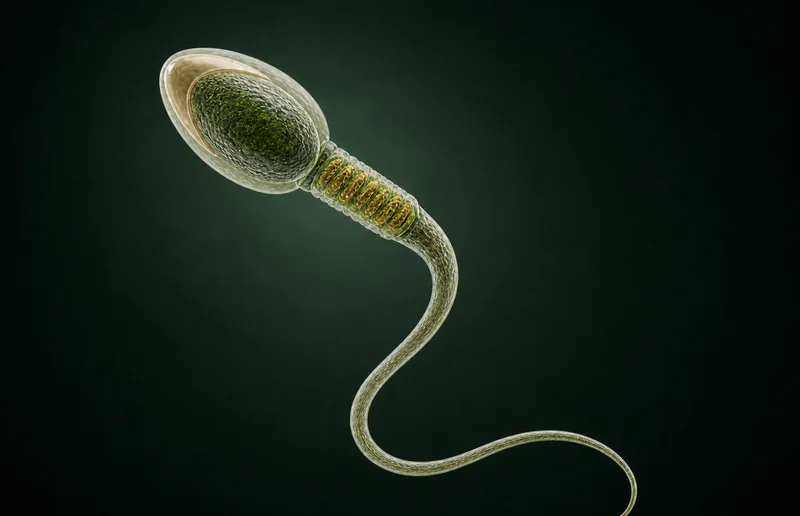
A sperm cell is a delivery vehicle stripped to the essentials — half a set of DNA, a chemical drill to break into the egg, an engine, and a tail. Everything not needed for the journey has been thrown overboard.
The sperm cell (spermatozoon) is one of the smallest cells in the human body — the head is barely 5 μm long — and the only one built to leave it and swim. It is a masterclass in form following a single function, the mirror image of the giant, resource-stuffed egg it races toward.
Structure
A sperm cell has three regions, each a specialized tool. In the 3D model above you can trace the head, midpiece, and tail.
- The head carries the nucleus, holding a haploid set of 23 chromosomes — half the normal number, so that fertilization restores the full 46. The DNA here is not wound around ordinary histones but around small proteins called protamines, which crush it into a dense, almost crystalline package: compact for the trip and protected from damage. Capping the head is the acrosome, a large enzyme-filled vesicle derived from the Golgi apparatus.
- The midpiece is wrapped in a tight helix of mitochondria — the engine room — coiled directly around the base of the tail.
- The tail is a single long flagellum built on a 9+2 microtubule axoneme, the same architecture as a cilium, driven by the motor protein dynein.
Almost everything else is gone. There is very little cytoplasm, and the ER and Golgi have already done their job (building the acrosome) and been discarded — the cell is pared down to keep it light and fast. The whole structure is assembled during spermiogenesis, the final remodeling step after meiosis, when a round cell reshapes itself into this streamlined courier.
Function
The sperm cell exists to deliver its DNA to the egg, and each part serves that one goal.
The flagellum drives the journey, beating in a propagating wave that pushes the cell forward — the only human cell that swims. Dynein arms walk the microtubule doublets past one another, and because they are anchored, the sliding bends the tail. Powering all of it is the midpiece: its packed mitochondria generate the ATP for the long, energy-hungry trip, which is exactly why they sit right next to the motor rather than anywhere else.
Before a sperm can fertilize, it must spend hours in the female tract undergoing capacitation — a maturation step that strips cholesterol from its membrane and primes it to respond. Only then does it become hyperactive and ready to react.
On arrival, the acrosome does the breaking-in. Triggered by contact with the egg's outer coat (the zona pellucida), it releases its enzymes — hyaluronidase and acrosin — in the acrosome reaction, digesting a path through the egg's protective layers. The exposed sperm head then fuses with the egg membrane and delivers the haploid nucleus. That fusion sets off the cortical reaction in the egg, hardening the zona so no second sperm can enter (the block to polyspermy). When the two haploid nuclei join, the diploid number is restored and a new cell begins.
There is a final twist: the sperm's mitochondria, having done their job, are tagged with ubiquitin and destroyed inside the egg. This is why mitochondrial DNA is inherited only from the mother — the same maternal-inheritance rule that makes the mitochondrion such a useful tool for tracing ancestry.
In the exam
- AP Bio / IB HL: The sperm is a clean structure-fits-function case — flagellum (movement), mitochondria-rich midpiece (ATP for swimming), acrosome (enzymes to penetrate the egg), haploid nucleus (restores the diploid number at fertilization). Be ready to justify each part from its job; this is a guaranteed short-answer pattern.
- IB HL / A-Level: Compare sperm and egg directly — sperm are tiny, motile, numerous, and contribute essentially only DNA and a centriole; the egg is large, non-motile, and supplies cytoplasm, organelles (including all the mitochondria), and stored nutrients. The asymmetry is the answer to "why is mtDNA maternal."
- MCAT: Know that sperm are haploid products of meiosis (specifically spermatogenesis, four sperm per primary spermatocyte), the role of capacitation and the acrosome reaction, and how the cortical reaction blocks polyspermy.
- USMLE Step 1: The 9+2 axoneme links to immotile cilia syndrome (Kartagener) causing infertility, and protamine packaging connects to why mature sperm DNA is transcriptionally silent.
Related cells
- Mitochondrion — coiled in the midpiece to power the tail, then destroyed after fertilization (hence maternal mtDNA).
- Nucleus — carries the haploid DNA, condensed by protamines, in the head.
- Cytoskeleton — the flagellum is a 9+2 microtubule motor driven by dynein.
- Golgi apparatus — builds the enzyme-filled acrosome during spermiogenesis.
- Stem cell — sperm arise from dividing spermatogonial germline stem cells.
Common misconceptions
- "Sperm cells are diploid like other body cells." They are haploid — products of meiosis carrying 23 chromosomes, so fertilization with a haploid egg restores the diploid 46.
- "The acrosome powers the tail." The acrosome holds enzymes for penetrating the egg; the mitochondria in the midpiece power the tail. Mixing these up is a classic lost mark.
- "Sperm are just a tail with DNA." Each region — head (with acrosome), midpiece, tail — is a distinct, essential tool, and the cell undergoes capacitation and the acrosome reaction before it can fertilize.
- "Sperm contribute mitochondria to the embryo." They bring them to the egg, but those paternal mitochondria are tagged and degraded, which is why mitochondrial inheritance is maternal.
References
- Reece et al., Campbell Biology, 11th ed., Ch. 46 (Animal Reproduction).
- Alberts B. et al., Molecular Biology of the Cell, 6th ed., Ch. 21 (Sexual Reproduction: Meiosis, Germ Cells, and Fertilization).
- Guyton & Hall, Textbook of Medical Physiology, 13th ed., Ch. 81 (Male Reproductive Functions).