A stem cell is an unspecialized cell with two rare powers: it can keep copying itself indefinitely, and it can turn into specialized cell types when the body needs them.
Stem cells are the body's repair kit and its developmental starting point. Every one of your 200-plus cell types traces back to a stem cell that committed to a path and stopped looking back.
Structure
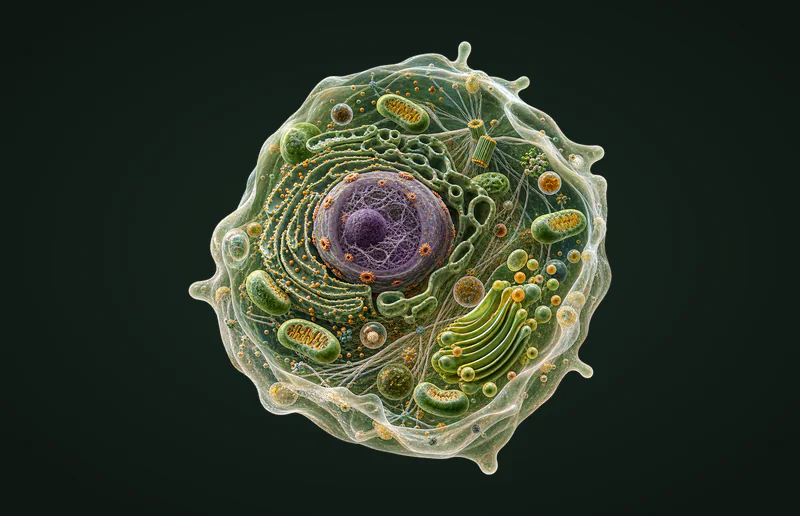
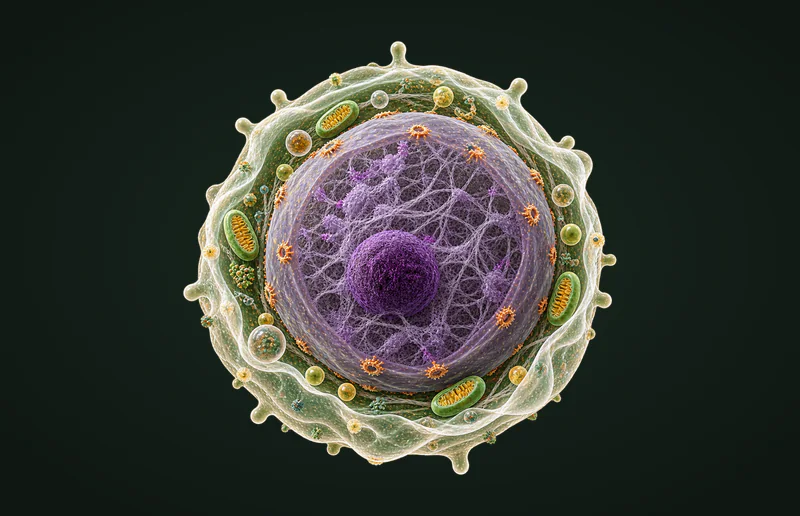
A stem cell looks deceptively plain. It is small and rounded, with few specialized features — what stands out under the microscope is a large nucleus taking up most of the cell, giving it a high nuclear-to-cytoplasmic ratio. In the 3D model above, that dominant nucleus is the defining feature, and it signals a cell whose business is reading and regulating genes rather than doing a finished job.
That plainness is the point. A stem cell has not yet committed to a role, so it has not built the specialized machinery a neuron carries (long axons, dense Nissl bodies) or a muscle fiber carries (sarcomeres, packed mitochondria). Its cytoplasm holds only the basics — mitochondria, ribosomes, a little ER — kept in a flexible, ready state.
At the molecular level the cell keeps its chromatin loosely packed and "poised," with the master transcription factors (in pluripotent cells, OCT4, SOX2, and NANOG) holding the developmental genes ready to switch on or off. A stem cell is defined less by what it contains than by which options it has kept open.
Function
Stem cells are defined by two abilities. Self-renewal means a stem cell can divide to make more stem cells, maintaining a reserve that does not run out over a lifetime. Differentiation means it can instead divide and mature into a specialized cell.
When a stem cell divides, it often does so asymmetrically: one daughter stays a stem cell (keeping the supply intact), while the other commits to becoming, say, a red blood cell. Many stem cells live in a protective microenvironment called a niche — bone-marrow stroma for blood stem cells, the bulge of a hair follicle for skin — and the niche's signals decide whether a daughter renews or differentiates.
Which genes switch on during differentiation decides the fate. Every cell in your body carries the same DNA; what changes is the pattern of expression, set by transcription factors and epigenetic marks. A stem cell still has all its options open because it has not yet locked that pattern in.
Stem cells are graded by how many fates they can take:
- Totipotent (the fertilized egg and its first few divisions) can form an entire organism, including the placenta and supporting tissues.
- Pluripotent (embryonic stem cells) can form any of the body's cell types, from all three germ layers, but not the supporting placental tissues.
- Multipotent (adult stem cells, like those in bone marrow) form a limited family — hematopoietic stem cells, for example, replenish every blood cell type.
- Unipotent (such as some skin or muscle progenitors) renew but make only one cell type.
A landmark addition is the induced pluripotent stem cell (iPSC): Shinya Yamanaka showed in 2006 that introducing just four transcription factors can reprogram an ordinary adult cell back to a pluripotent state, sidestepping the ethics of embryonic sources. That regenerative power is why stem cells anchor medicine — from decades-old bone-marrow transplants to current work on repairing heart, retina, and spinal-cord tissue.
In the exam
- AP Bio (Unit 6, Gene Expression and Regulation): Stem cells are the textbook illustration of differential gene expression — all body cells share one genome, so what distinguishes them is which genes are turned on. Examiners want you to state that the genome is unchanged and that regulation, not DNA loss, drives specialization.
- IB HL (Topic A2 / B2): Be ready to define a stem cell by the two properties (self-renewal + differentiation) and to give a named therapeutic use plus one ethical issue. Stargardt's disease and leukemia treatments are common hooks.
- MCAT (Foundational Concept 2): Know the potency ladder (totipotent → pluripotent → multipotent → unipotent) and the embryonic-versus-adult contrast, including the iPSC workaround and why it matters ethically and immunologically (a patient's own iPSCs avoid rejection).
- USMLE Step 1: Hematopoietic stem cells, the CD34 marker, and bone-marrow transplantation appear in immunology and hematology stems.
Related cells
- Red blood cell — produced from multipotent hematopoietic stem cells in bone marrow.
- Nucleus — its prominence reflects the stem cell's heavy gene-regulation workload.
- Neuron — one highly specialized, mostly irreversible fate a stem cell can take.
- Animal cell — the general toolkit a stem cell starts from before specializing.
- Skeletal muscle fiber — repaired by its own resident satellite (stem) cells.
Common misconceptions
- "Stem cells come only from embryos." Adult tissues (bone marrow, skin, gut lining) carry their own multipotent stem cells, and ordinary cells can be reprogrammed into induced pluripotent stem cells.
- "A stem cell becoming specialized changes its DNA." The genome stays the same — differentiation changes which genes are expressed, through transcription factors and epigenetic marks, not the underlying sequence.
- "Pluripotent means it can form a whole organism." That is totipotent. Pluripotent cells form any body cell type but cannot build the placenta and supporting tissues a full organism needs.
- "Stem cells divide uncontrollably, so they're basically cancer." Healthy stem-cell division is tightly regulated by the niche; cancer arises when that regulation fails. The overlap is why stem-cell research informs oncology, not because they are the same thing.
References
- Reece et al., Campbell Biology, 11th ed., Ch. 18 & 20 (Gene Regulation; Biotechnology).
- Alberts B. et al., Molecular Biology of the Cell, 7th ed., Ch. 22 (Stem Cells and Tissue Renewal).
- Takahashi K. & Yamanaka S. "Induction of pluripotent stem cells from adult fibroblasts." Cell 126, 663–676 (2006).