The nucleus is the cell's control center — a double-membraned vault that holds almost all of a eukaryote's DNA and decides which genes get read, when, and how often.
A typical human cell has exactly one nucleus, usually 5 to 10 μm across — large enough that it is the first structure most students find down a light microscope. A few cell types break the rule: mature red blood cells eject theirs to make room for hemoglobin, while skeletal muscle fibers fuse during development and carry hundreds.
Structure
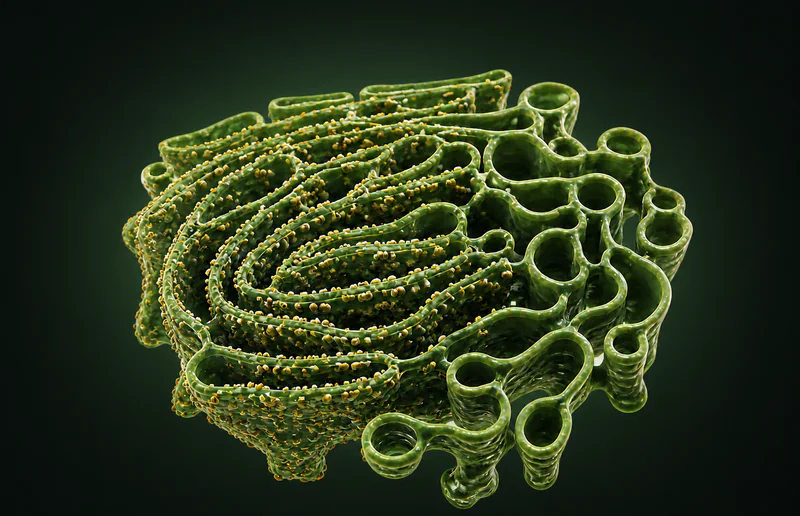
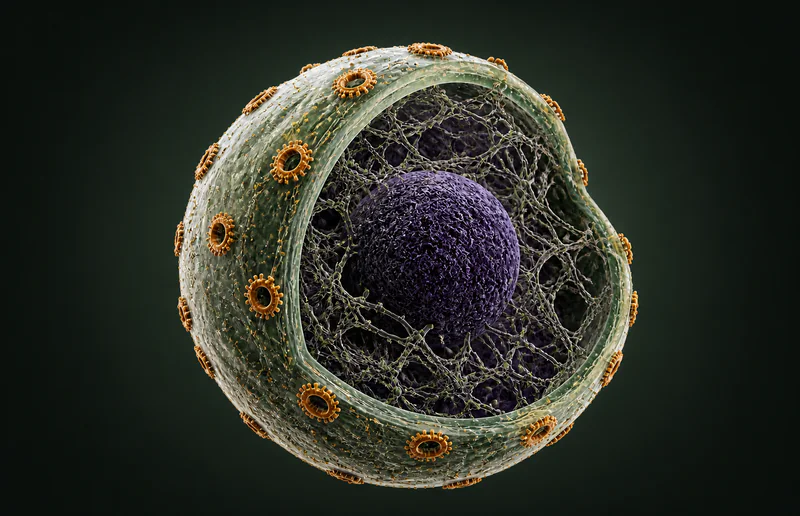
The nucleus is wrapped in a nuclear envelope — two phospholipid bilayers, not one, separated by a narrow perinuclear space. The outer membrane is continuous with the rough endoplasmic reticulum, so the two compartments share a lumen and the nucleus is, structurally, a specialized bay of the ER.
Punched through both membranes are thousands of nuclear pores, each a protein assembly called the nuclear pore complex, roughly 120 nm wide and built from about 30 different proteins called nucleoporins. They are not simple holes: they act as selective gates, letting small molecules and ions diffuse freely but checking large cargo like proteins and mRNA for the right molecular "passport" — a nuclear localization or export signal — before passing it through.
Just inside the envelope sits the nuclear lamina, a mesh of intermediate-filament proteins (lamins) that gives the nucleus its shape and anchors chromatin to the periphery. Mutations in lamin genes cause premature-aging disorders like progeria, which is a favorite "structure explains disease" angle in exams.
Inside, the DNA is not naked. It is wound around histone proteins into chromatin, which the cell keeps in two states: loosely packed euchromatin, where genes are available to read, and densely packed heterochromatin, where genes are silenced. In the 3D model above, the patchy texture on the interior surface represents this condensed heterochromatin pressed against the lamina.
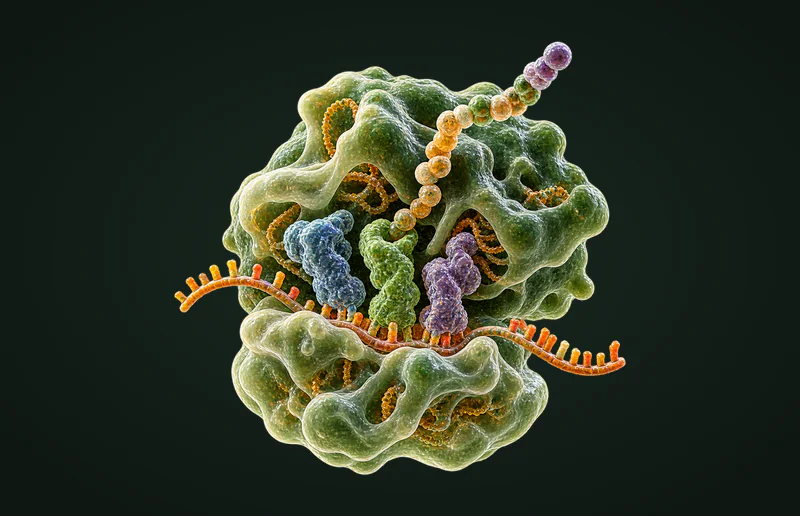
One spot is denser than the rest: the nucleolus, a non-membrane-bound region where ribosomal RNA is transcribed and the subunits of ribosomes are assembled before being shipped out through the pores.
Function
The nucleus runs the cell by controlling gene expression. DNA stays inside; the instructions leave as messenger RNA. This separation — transcription in the nucleus, translation in the cytoplasm — is the defining feature of eukaryotes and the reason they can regulate genes far more precisely than a bacterium can, where the two processes happen at once in one open compartment.
The workflow has steps a prokaryote skips entirely. RNA polymerase transcribes DNA into pre-mRNA; that transcript then gets a 5' cap, a poly-A tail, and has its introns spliced out — all inside the nucleus — before the mature mRNA is exported through the pores to waiting ribosomes. By gating which transcripts leave and which transcription factors are allowed in, the nucleus acts as a checkpoint on the entire flow of genetic information.
It is also where DNA is replicated before cell division and where the genome is repaired. Because the envelope physically sequesters the chromosomes, a double-strand break or mutation is more likely to be detected and fixed than in a cell with exposed DNA. During mitosis the envelope breaks down so spindle fibers can reach the chromosomes, then reassembles around each daughter nucleus — a disassembly-reassembly cycle worth knowing for cell-cycle questions.
In the exam
- AP Bio (Unit 2 & 6): Expect a question on why compartmentalizing DNA lets eukaryotes regulate genes more finely than prokaryotes — the answer hinges on transcription and translation being separated in space and time, allowing mRNA processing (capping, splicing, tailing) before translation.
- IB HL: The nuclear envelope's continuity with the rough ER, and the selective role of nuclear pores, are common short-answer targets. Be ready to label euchromatin versus heterochromatin and to state that pores require a signal sequence for large cargo.
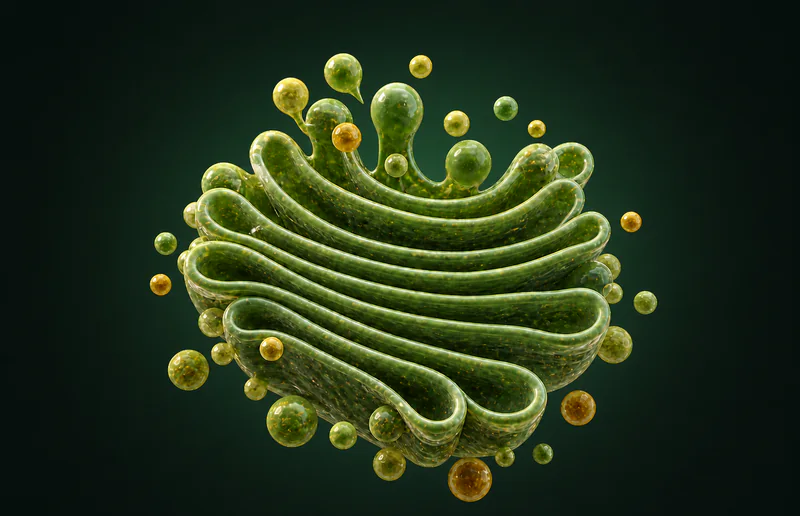
- MCAT: Questions link the nucleolus to ribosome assembly and ask you to trace a secreted protein's path: nucleus → mRNA export → ribosome → ER → Golgi → vesicle. Know the order cold, and know that histone modification and chromatin state regulate access to genes.
- USMLE Step 1: Laminopathies (progeria, certain muscular dystrophies) tie nuclear-lamina structure to disease, and "Barr body" — a condensed, inactivated X chromosome visible at the nuclear edge — shows up in genetics and cytology items.
Related cells
- Ribosome — assembled in the nucleolus, then exported to translate the mRNA the nucleus sends out.
- Endoplasmic reticulum — its membrane is continuous with the outer nuclear membrane.
- Animal cell — see the nucleus in the context of the whole cell.
- Bacterium — the contrast: no nucleus, DNA loose in a region called the nucleoid.
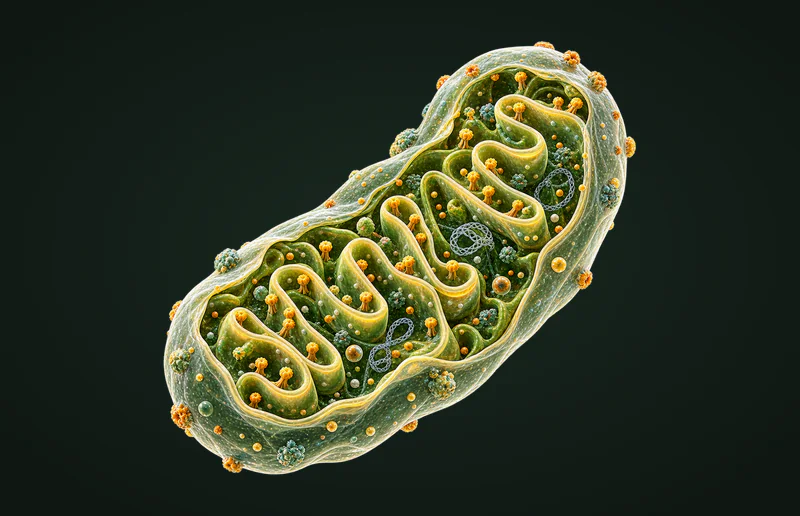
- Mitochondrion — the other organelle that carries its own DNA.
Common misconceptions
- "The nucleus contains all the cell's DNA." Almost — but mitochondria (and chloroplasts in plants) keep their own small genomes, a leftover from their bacterial ancestors.
- "The nuclear pore is just a gap." It is an active, selective transport complex; getting large cargo through requires the correct signal sequence and carrier proteins.
- "The nucleolus is a separate organelle." It has no membrane — it is simply a dense region of the nucleus dedicated to building ribosomes, and it disappears and reforms with each cell division.
- "The nuclear envelope is a single membrane." It is two bilayers, and the outer one is part of the ER. Drawing it as one line loses marks on labeled-diagram questions.
References
- Alberts B. et al., Molecular Biology of the Cell, 6th ed. — Ch. 12 (Intracellular Compartments and Protein Sorting) and Ch. 4 (DNA, Chromosomes, and Genomes).
- Lodish H. et al., Molecular Cell Biology, 8th ed. — Ch. 13 (Moving Proteins into Membranes and Organelles).
- College Board AP Biology Course and Exam Description (2025) — Units 2 and 6.