The Golgi apparatus is the cell's post office — it takes raw proteins from the ER, finishes them, labels them with a destination, and ships them out in the right vesicle.
Named after Camillo Golgi, who first stained it in 1898 with a silver method that finally made it visible, this organelle is the central sorting hub of the cell's secretory pathway. Cells that export a lot — mucus-secreting goblet cells, antibody-producing plasma cells — carry especially large, busy Golgi stacks.
Structure
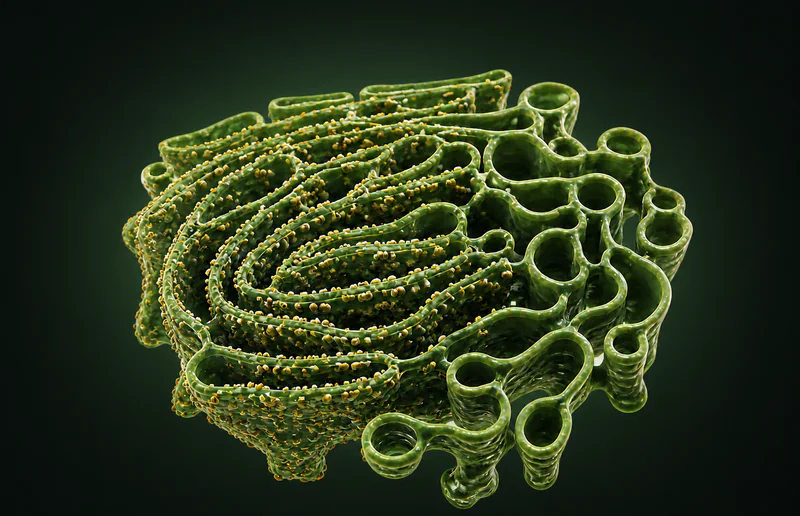
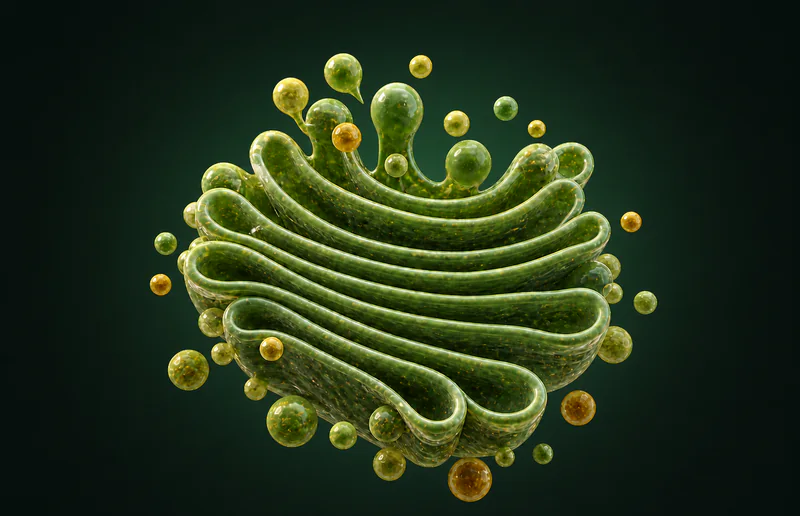
The Golgi is a stack of flattened membrane sacs called cisternae, usually four to eight, curved like a stack of pita bread. The stack is polarized — it has two functionally distinct ends, and a protein always moves through it in one direction.
- The cis face points toward the endoplasmic reticulum. It is the receiving dock, where vesicles arriving from the ER fuse and unload at a region called the cis-Golgi network.
- The trans face points toward the cell membrane. It is the shipping dock, where finished products are sorted and bud off in vesicles from the trans-Golgi network.
In the 3D model above, the curved stack of plates is the cisternae; the small spheres pinching off the edges are transport vesicles.
Each cisterna holds a different set of processing enzymes, so the stack works like an assembly line: a protein enters at the cis face and is modified a little more at each station as it advances toward the trans face. How it advances is itself a famous exam-and-textbook debate — the cisternal maturation model holds that whole cisternae move forward and mature while enzymes are recycled backward, which is now the favored explanation over the older "vesicle shuttle" picture.
Function
The Golgi modifies, sorts, and packages. As proteins move through the stack, enzymes trim and refine the sugar chains the ER started (glycosylation), add phosphate or sulfate groups, and proteolytically cut some precursor proteins into their active forms — for example, converting proinsulin toward insulin. These chemical modifications double as address labels.
The clearest example is the mannose-6-phosphate tag: enzymes destined for lysosomes get this specific marker in the cis-Golgi, and a receptor at the trans face reads it and routes them correctly. Lose that tagging step and lysosomal enzymes are secreted by mistake — the basis of I-cell disease, a classic USMLE item.
At the trans face, the Golgi sorts each protein into the correct vesicle:
- Secretory vesicles head to the cell membrane to release their contents outside by exocytosis, either continuously or stored until a signal triggers release.
- Other vesicles carry the mannose-6-phosphate-tagged enzymes that build new lysosomes.
- Membrane proteins are delivered to the plasma membrane itself, with the side that faced the lumen ending up facing the cell exterior.
The Golgi also builds many of the cell's own polysaccharides — in plant cells it produces non-cellulose components of the cell wall, which are then secreted to the wall by vesicles.
In the exam
- AP Bio (Unit 2): The secretory pathway — ribosome → rough ER → Golgi → vesicle → plasma membrane → exocytosis — is one of the most-tested sequences. Know the direction (cis receives, trans ships) and that the Golgi modifies and sorts rather than synthesizes proteins.
- IB HL: Expect to explain glycosylation as the address-labeling step and to identify cells with prominent Golgi (goblet cells, plasma cells) by their high secretory output. Linking organelle abundance to a cell's job is a recurring data-question.
- MCAT / USMLE: The mannose-6-phosphate pathway and I-cell disease tie Golgi tagging to a concrete disorder. Step 1 also tests that secretory vesicles fuse with the membrane via exocytosis and that the Golgi orients membrane-protein topology.
Related cells
- Endoplasmic reticulum — supplies the proteins the Golgi finishes.
- Lysosome — built from enzymes the Golgi tags with mannose-6-phosphate.
- Cell membrane — the final destination for secretory vesicles.
- Ribosome — where the journey of every secreted protein begins.
- Plant cell — its Golgi also helps build the cell wall.
Common misconceptions
- "The Golgi makes proteins." It does not synthesize them — it modifies, sorts, and packages proteins already made by ribosomes on the ER.
- "The cisternae are all the same." The stack is polarized: cis and trans faces hold different enzymes and do different jobs, and a protein cannot skip stations.
- "Vesicles wander to their destination." They are addressed — molecular tags added in the Golgi, read by specific receptors, determine exactly where each vesicle goes.
- "Glycosylation happens entirely in the Golgi." It begins in the ER and is refined in the Golgi; the two organelles share the job, which is why trace-the-route questions expect both.
References
- Alberts B. et al., Molecular Biology of the Cell, 6th ed. — Ch. 13 (Intracellular Vesicular Traffic).
- Lodish H. et al., Molecular Cell Biology, 8th ed. — Ch. 14 (Vesicular Traffic, Secretion, and Endocytosis).
- College Board AP Biology Course and Exam Description (2025) — Unit 2 (Cell Structure and Function).