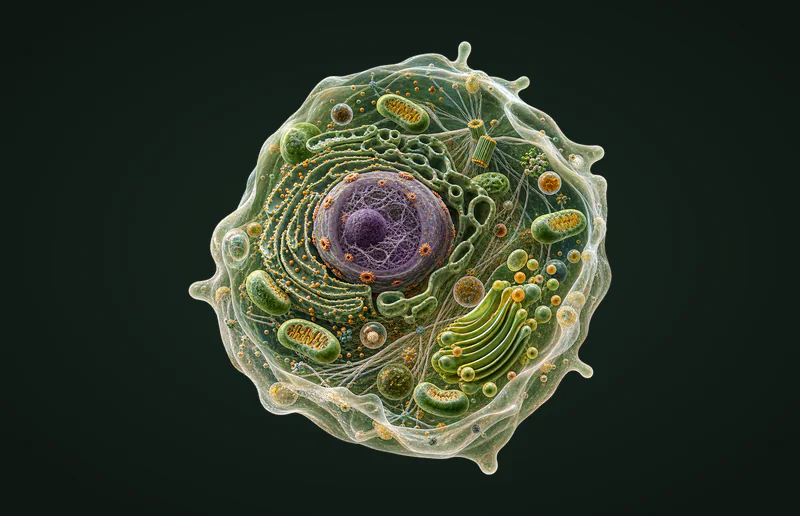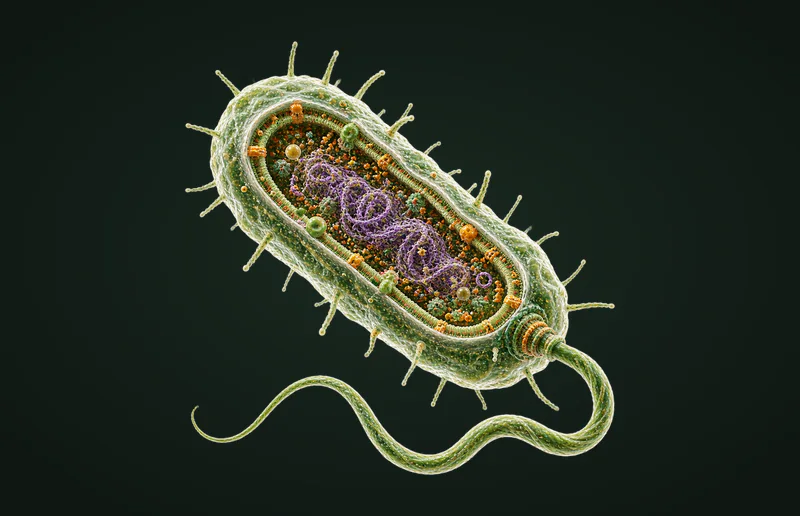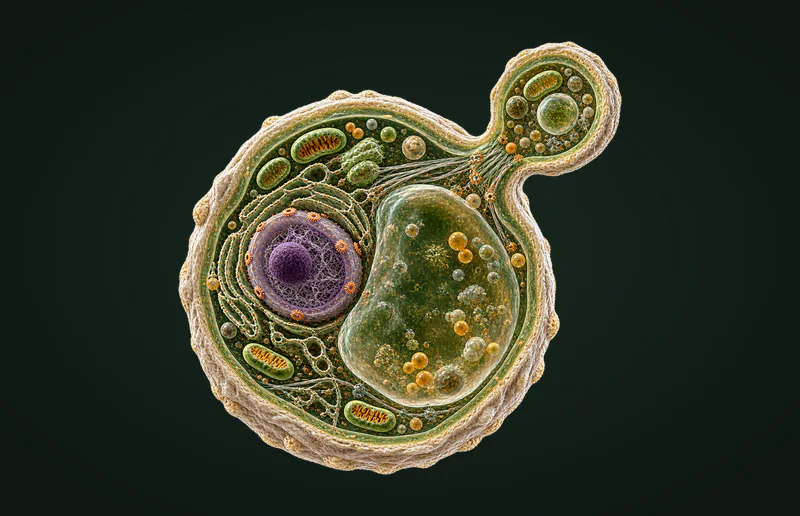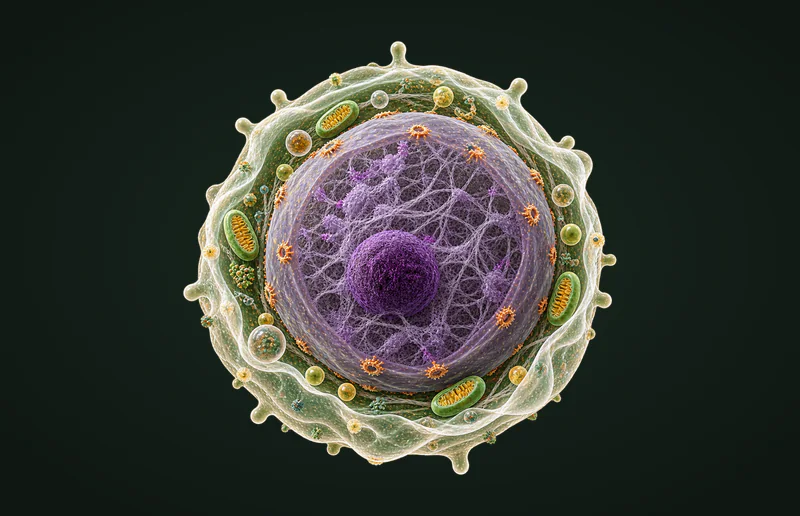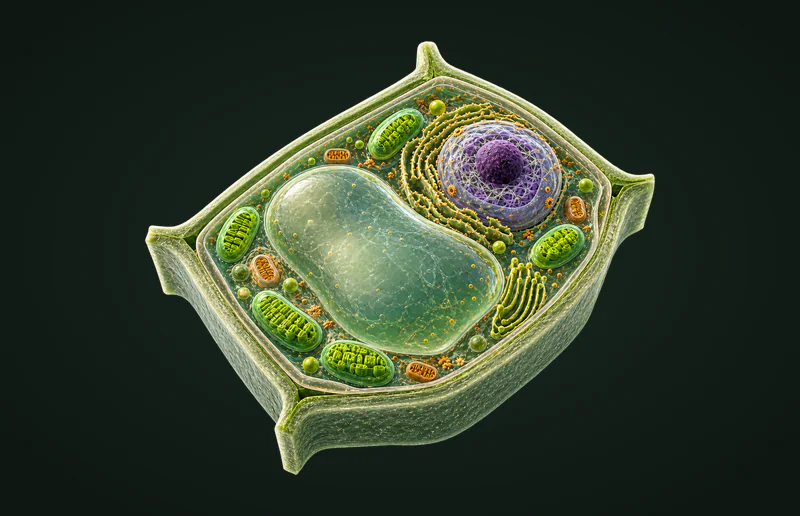
A plant cell is a eukaryotic cell built for a stationary, sunlight-powered life — it adds three things an animal cell lacks: a rigid wall, green chloroplasts, and a giant central vacuole.
Because plants cannot move to find food, their cells make their own from light. Almost everything distinctive about the plant cell follows from that one fact.
Structure
A plant cell has all the standard eukaryotic organelles — nucleus, mitochondria, rough and smooth ER, ribosomes, Golgi — plus three features you can pick out in the 3D model above.
A rigid cell wall of cellulose surrounds the cell membrane. Cellulose is a polymer of glucose whose chains pack into microfibrils with the tensile strength of steel for their weight, laid down by enzyme complexes in the membrane. The wall gives the cell a fixed, boxy shape and braces it against internal pressure.
Chloroplasts are the green organelles where photosynthesis happens. Like mitochondria, they carry their own DNA and a double membrane — a fingerprint of their endosymbiotic origin as engulfed cyanobacteria.
A large central vacuole, often filling 80–90% of the cell volume, stores water, ions, sugars, and waste behind a membrane called the tonoplast. It pushes everything else into a thin shell against the wall.
Neighboring plant cells stay connected through tiny membrane-lined channels in the wall called plasmodesmata, which thread the cytoplasm of one cell into the next so they can share water, sugars, and signaling molecules — the plant version of being networked.
Function
The plant cell's defining job is making food from light. Its chloroplasts run the light reactions on stacked membranes called thylakoids, capturing photons to make ATP and NADPH, then use those in the surrounding stroma (the Calvin cycle) to fix CO₂ into glucose. The cell's mitochondria then burn some of that glucose for ATP, just like an animal cell. A plant cell does both photosynthesis and respiration — the chloroplast makes the sugar, the mitochondrion spends it.
The wall and the central vacuole work as a team for support. Water flows into the vacuole by osmosis and swells it until the cytoplasm presses firmly against the wall. That outward turgor pressure, resisted by the rigid wall, is what keeps a non-woody plant upright. Lose water, turgor falls, the cell goes flaccid, and the plant wilts; lose more and the membrane pulls away from the wall entirely (plasmolysis).
The wall also defends the cell and sets the limits of its growth. A plant cell enlarges mostly by loosening its wall and taking water into the vacuole — an energy-cheap way to grow that lets a seedling shoot up without building much new cytoplasm.
In the exam
- AP Bio (Unit 2 & 3): Lead any plant-vs-animal comparison with the plant additions — cell wall, chloroplasts, central vacuole — then connect turgor to water potential (Ψ). Examiners love the equation Ψ = Ψ_solute + Ψ_pressure, where a turgid plant cell has a negative solute term balanced by positive pressure from the wall.
- IB HL / A-Level: Be ready to explain why a plant cell in a hypotonic (dilute) solution becomes turgid rather than bursting (the wall resists), while an animal cell would lyse. The matching hypertonic case — plasmolysis — is the paired half of the question. Plasmodesmata as the symplast route for water movement is a common detail.
- MCAT: Less plant-heavy, but the C₃/C₄/CAM distinctions and the chloroplast/mitochondrion energy split appear in passage-based questions.
- A-Level (AQA): Starch grains and the chloroplast as the site of glucose storage versus production are reliably tested; watch the wording "site of synthesis" versus "site of storage."
Related cells
- Animal cell — the standard comparison.
- Chloroplast — the organelle that powers the plant cell.
- Vacuole — generates the turgor that keeps plants rigid.
- Mitochondrion — present too; plant cells respire as well as photosynthesize.
- Fungal cell — also walled, but with chitin and no chloroplasts.
Common misconceptions
- "The cell wall and cell membrane are the same." The wall is a rigid cellulose layer outside the flexible membrane; both are present, and only the membrane controls what enters the cell. The wall is freely permeable.
- "Plant cells don't have mitochondria because they have chloroplasts." They have both. Chloroplasts make sugar in daylight; mitochondria burn it around the clock, including at night when photosynthesis stops.
- "Turgor pressure could burst the cell." The rigid wall resists it — turgidity is controlled firmness, not rupture. The wall is exactly why a plant cell can sit in pure water safely.
- "Photosynthesis happens in the green pigment, so chlorophyll is the organelle." Chlorophyll is a pigment molecule embedded in the thylakoid membranes; the chloroplast is the organelle that houses it.
References
- Reece et al., Campbell Biology, 11th ed., Ch. 6–7 (A Tour of the Cell; Membrane Structure) and Ch. 10 (Photosynthesis).
- Alberts B. et al., Molecular Biology of the Cell, 7th ed., Ch. 14 (Energy Conversion: Mitochondria and Chloroplasts).
- Taiz L. & Zeiger E., Plant Physiology and Development, 6th ed. — water relations and the cell wall.