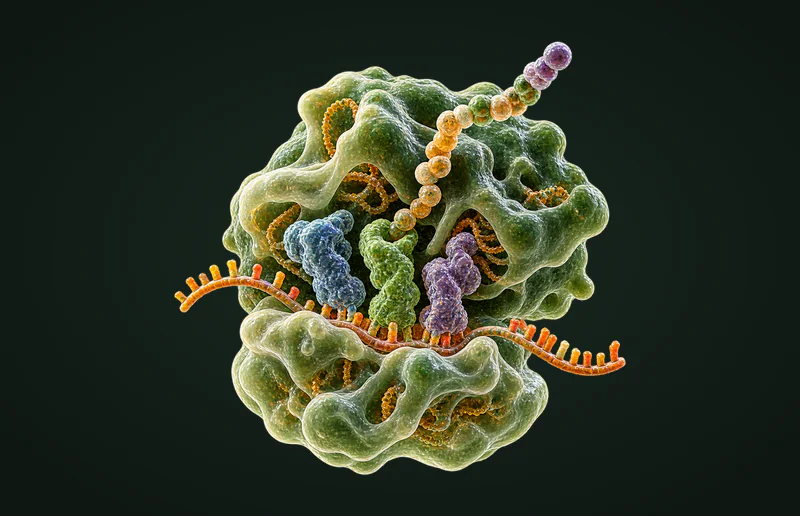
A centriole is a tiny, precisely built cylinder that organizes the microtubules a cell uses to divide — when an animal cell splits, the centrioles set up the machinery that pulls the chromosomes apart.
Centrioles are small (about 0.5 μm long and 0.2 μm wide) and come in pairs, sitting at right angles to each other inside a region called the centrosome, near the nucleus. They are one of the most geometrically regular structures the cell builds.
Structure
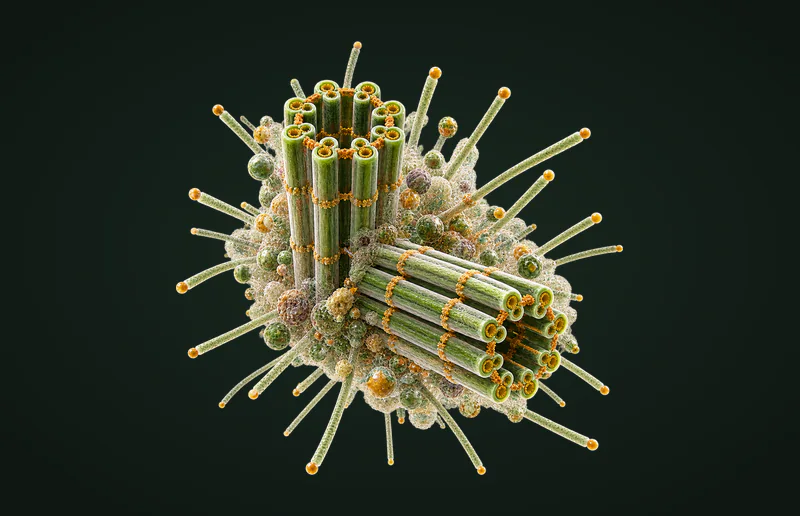
A centriole is built from microtubules in a strikingly regular pattern: nine triplets of microtubules arranged in a pinwheel ring, with no microtubule down the center — the classic "9 + 0" arrangement. In the 3D model above, the cylinder's wall is made of these nine grouped tubules running lengthwise, with each triplet tilted like the blades of a turbine.
The two centrioles of a pair lie perpendicular to one another: an older mother centriole and a younger daughter that grew off it. Around the pair sits the pericentriolar material (PCM) — a protein cloud rich in γ-tubulin ring complexes that act as templates from which new microtubules grow. Centriole pair plus PCM together form the centrosome, the cell's main microtubule-organizing center (MTOC).
Centrioles are close relatives of basal bodies, the structures that anchor cilia and flagella. A basal body shares the same nine-fold design, which is why a centriole can convert into one — and why the sperm flagellum grows from a centriole-derived base.
Function
The centriole's headline role is in cell division. Before an animal cell divides, the centrosome (with its centriole pair) duplicates once during S phase, so each daughter cell will inherit exactly one. The two centrosomes then migrate to opposite ends of the cell, and from each, microtubules grow outward — nucleated by the γ-tubulin in the PCM — to form the mitotic spindle.
The spindle's microtubules attach to chromosomes at the kinetochore (on the centromere) and, by shortening, pull one complete set of chromosomes to each pole. The duplicated, separated centrosomes therefore define the two poles that chromosomes are sorted between, which is why faithful centrosome duplication matters: an extra or missing centrosome can drive abnormal multipolar spindles and leave daughter cells with the wrong chromosome number (aneuploidy), a hallmark of many cancers.
Centrioles also template cilia and flagella. Acting as a basal body, a centriole seeds the nine-fold microtubule core — the axoneme — of these motile and sensory projections. Even non-dividing cells use this: the single primary cilium on many cells, which senses chemical and mechanical signals, grows from a centriole.
A telling detail: plant cells, most fungi, and many algae divide without centrioles, organizing their spindles from diffuse MTOCs instead. So centrioles sharpen and orient division in animals but are not universally required to do it — a point examiners love.
In the exam
Centriole questions cluster around mitosis and around not confusing the word with similar terms.
- AP Bio (Unit 4, Cell Communication & Cell Cycle): Centrioles appear as the organizers of the spindle. Know the 9-triplet (9+0) structure, that they sit in the centrosome, and that the centrosome duplicates in S phase before mitosis.
- IB HL: Be ready to state that animal cells use centrioles to organize spindle microtubules, and that plant cells manage division without them — a frequent compare-and-contrast. Knowing the centriole–basal body link earns credit on cilia/flagella questions.
- A-Level: Expect to label the centriole in an animal-cell diagram and to distinguish it from the centromere on a chromosome diagram — a common trap built into the same question.
- USMLE Step 1: Centrosome amplification (too many centrosomes → multipolar spindles → aneuploidy) connects to cancer biology, and primary ciliary dyskinesia (Kartagener syndrome) — defective axoneme dynein causing immotile cilia, situs inversus, and infertility — traces back to the basal-body/axoneme machinery.
Related cells
- Cytoskeleton — the microtubule network the centriole-containing centrosome organizes.
- Nucleus — its chromosomes are the cargo the spindle separates.
- Sperm cell — its flagellum grows from a basal body, a centriole relative.
- Animal cell — see where the centriole pair sits near the nucleus.
- Epithelial cell (columnar) — ciliated examples rely on basal bodies derived from centrioles.
Common misconceptions
- "All cells need centrioles to divide." Plant cells, most fungi, and many protists divide successfully without them, using other microtubule-organizing centers.
- "The centriole pulls the chromosomes itself." It doesn't touch the chromosomes. It organizes the spindle microtubules; the actual pulling is done by spindle-fiber shortening and motor proteins at the kinetochore.
- "Centriole and centromere are the same word for the same thing." The centriole is an organelle near the nucleus; the centromere is the constricted region of a chromosome where the kinetochore forms and spindle fibers attach. Different structures, different jobs.
- "The centriole is the microtubule-organizing center." Strictly, the centrosome — the centriole pair plus the surrounding pericentriolar material — is the MTOC. The γ-tubulin that nucleates microtubules lives in that PCM, not in the centriole barrel itself.
References
- Alberts B. et al. Molecular Biology of the Cell, 6th ed. — Chapters 16–17 (The Cytoskeleton; The Cell Cycle).
- Lodish H. et al. Molecular Cell Biology, 8th ed. — Chapter 18 (Cell Organization and Movement: Microtubules).
- College Board AP Biology Course and Exam Description (2025) — Unit 4 (Cell Communication and Cell Cycle).