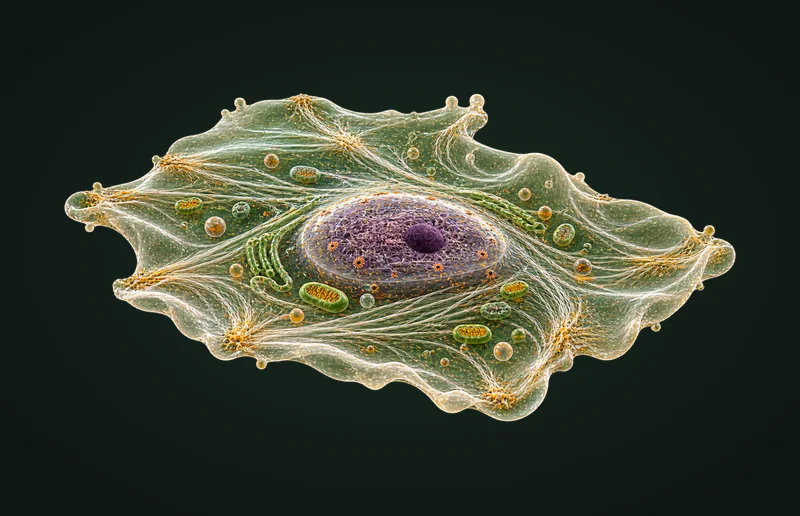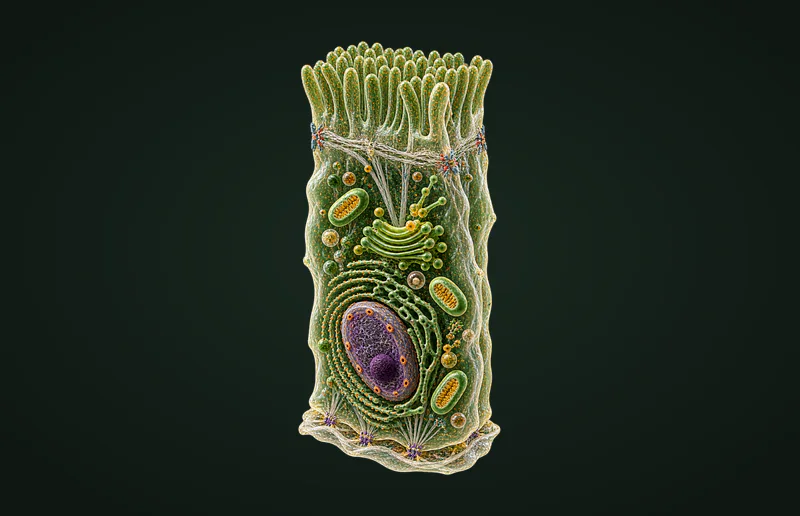
A columnar epithelial cell is a tall, brick-shaped cell built for absorption — it stands upright, packs in organelles, and carpets its top surface with tiny projections to grab as much material as possible.
These cells line the places where the body takes things in — most famously the gut — turning a flat surface into an enormous absorptive area. Where a squamous cell is all about getting out of the way, a columnar cell is all about getting work done.
Structure
A columnar cell is tall and rectangular, standing like a column (hence the name), with its oval nucleus pushed down to the base of the cell. That basal nucleus is diagnostic: it keeps the apical region clear for the absorptive and secretory machinery. In the 3D model above, the upright column shape with a basal nucleus is the giveaway.
The apical (top) surface — the side facing the cavity it lines — is covered in microvilli: fingerlike folds of cell membrane, each supported by a core of actin filaments anchored into a band of cytoskeleton called the terminal web. Under the light microscope this dense carpet looks fuzzy and is called the brush border; only the electron microscope resolves the individual microvilli.
The cells stand side by side in a single layer, sealed near the top by a ring of tight junctions (the apical junctional complex) that forces absorbed molecules to pass through the cells rather than leaking between them. Their tall bodies leave room for plenty of mitochondria clustered toward the apex, near the membrane pumps that demand ATP. A variant called pseudostratified columnar epithelium looks layered because the nuclei sit at different heights, but every cell still touches the basement membrane — it is one layer pretending to be several.
Function
The columnar cell is specialized for absorption and secretion. Its height houses the machinery for active transport, and its microvilli give the huge surface area that absorption demands. In the small intestine, this is how digested nutrients are pulled out of the gut and into the body — often against a concentration gradient, which is why the cells are so mitochondria-rich.
The math is striking. Microvilli increase the apical surface area roughly 20-fold. Stack that on the larger plicae circulares (circular folds) and the finger-like villi of the intestinal wall, and the gut interior reaches a surface area on the order of 30 square meters — about half a badminton court, not the "tennis court" of older textbooks, but still vast for an organ you could fold into a backpack.
Absorption itself is a two-step trick: a sodium-glucose cotransporter (SGLT1) on the apical membrane drags glucose in alongside sodium, and the basolateral Na⁺/K⁺ ATPase pumps that sodium back out, keeping the gradient running. The brush border membrane also carries digestive enzymes (lactase, sucrase, maltase) that finish breaking down sugars right at the point of uptake.
Many columnar cells also secrete. Goblet cells scattered among them release mucus to lubricate and protect the lining; in the stomach and glands, columnar cells secrete enzymes, hormones, and acid. Some carry cilia instead of microvilli — as in the respiratory tract and the oviduct, where they beat in coordinated waves to sweep mucus, debris, or an egg along. So the tall shape supports a divided top surface: microvilli for absorbing, cilia for sweeping, secretion for protecting — jobs a flat squamous cell cannot do.
In the exam
- AP Bio / IB HL / MCAT: Columnar epithelium is the absorption example — link the tall shape and microvilli (brush border) to increased surface area for nutrient uptake in the small intestine. The surface-area argument is the point, and examiners want it spelled out.
- Contrast it directly with squamous epithelium: tall vs flat, absorption vs diffusion, mitochondria-rich vs minimal. Know goblet cells as the mucus-secreting variant and ciliated columnar epithelium as the respiratory sweeper.
- A-Level: The classic SGLT1 + Na⁺/K⁺ ATPase question asks how glucose moves from gut lumen into blood. Trace it: secondary active transport in at the apex, facilitated diffusion out at the base, the pump maintaining the gradient.
- USMLE Step 1: Cilia questions hit immotile cilia syndrome (Kartagener), and Celiac disease shows up as villous atrophy — flatten the villi and microvilli and absorption collapses, the whole structure-function story run in reverse.
Related cells
- Squamous epithelial cell — the flat, diffusion-specialized contrast.
- Cell membrane — folded into the microvilli that boost surface area.
- Mitochondrion — clustered apically to power active transport of absorbed nutrients.
- Cytoskeleton — actin cores hold microvilli rigid; microtubules drive the cilia.
- Nucleus — pushed to the base of the tall cell.
Common misconceptions
- "Microvilli and cilia are the same." Microvilli are short, non-motile actin folds that increase surface area; cilia are longer, microtubule-based, and actively beat to move material. A cell usually has one or the other.
- "Microvilli are visible as separate hairs under a light microscope." They appear only as a fuzzy brush border; resolving individual microvilli needs an electron microscope.
- "Pseudostratified epithelium is many layers." The nuclei sit at different heights, but every cell reaches the basement membrane — it is a single layer that only looks stacked.
- "Taller cells just mean bigger tissue." The height and the brush border specifically serve absorption and secretion; the shape is a tool, not a side effect.
References
- Marieb & Hoehn, Human Anatomy & Physiology, 11th ed., Ch. 4 (Epithelial Tissue).
- Guyton & Hall, Textbook of Medical Physiology, 13th ed., Ch. 66 (Absorption in the Gastrointestinal Tract).
- Alberts B. et al., Molecular Biology of the Cell, 6th ed., Ch. 11 (Membrane Transport of Small Molecules).