The endoplasmic reticulum is the cell's factory floor and folding room — a vast, continuous network of membrane sacs where most proteins and lipids are made and quality-checked before they go anywhere.
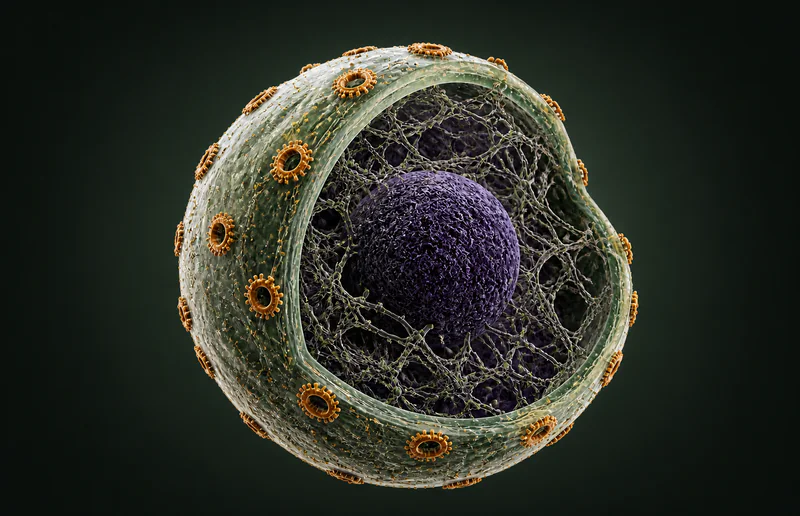
The ER is the largest membrane system in a eukaryotic cell, sometimes more than half of all its membrane. It spreads outward from the nucleus, whose outer membrane is part of the same continuous sheet, so the nuclear envelope is really one specialized end of the ER.
Structure
The ER is a maze of flattened sacs and tubes called cisternae, all enclosing one shared interior space, the lumen. The membrane is a single bilayer, but the network folds it into enormous surface area packed into a small volume — the cell's trick for fitting an industrial-scale assembly line into a few cubic micrometers.
It comes in two regions that look and act differently:
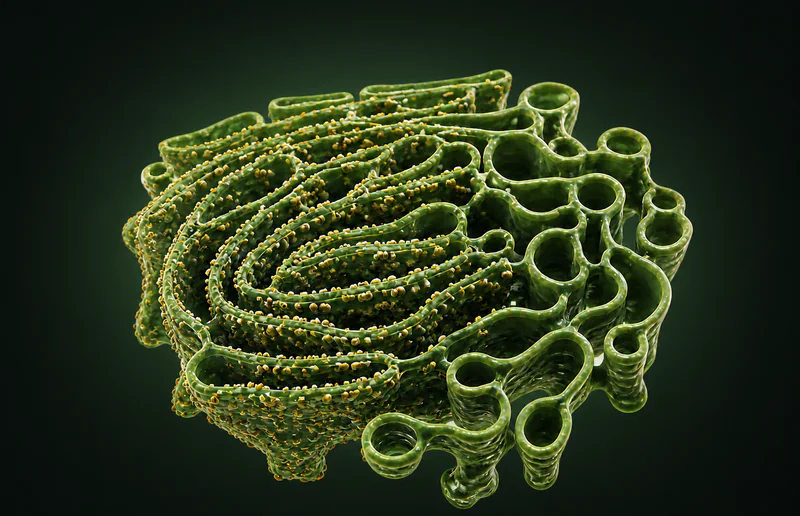
- Rough ER is coated on its cytoplasmic face with ribosomes, giving it a studded, "rough" texture under the electron microscope. It tends to form stacked, sheet-like cisternae, the geometry that maximizes ribosome docking sites. This is where membrane and secreted proteins are made and folded.
- Smooth ER has no ribosomes. It is more tubular and net-like, and it handles lipids, calcium, and detoxification rather than protein synthesis.
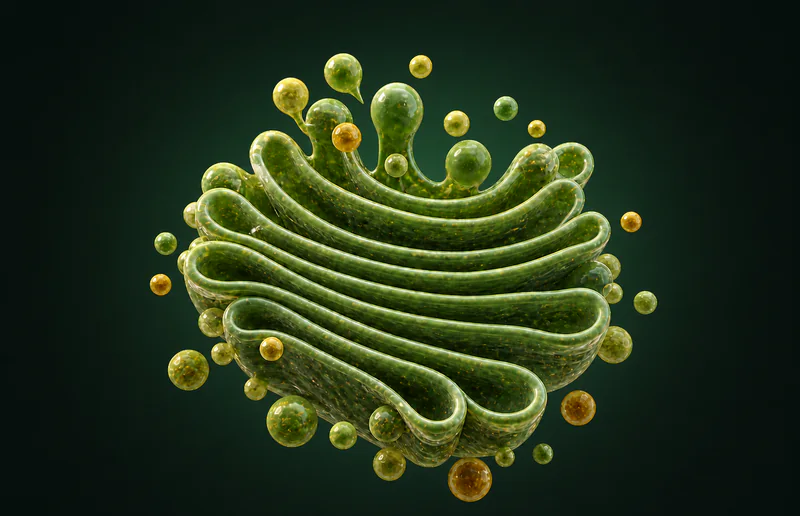
In the 3D model above, the layered, sheet-like folds are the cisternae of the rough ER; the ribosomes appear as the fine dots covering its surface.
The two regions are physically continuous — a protein or lipid can move from one to the other without crossing a membrane — but their enzyme content and shape differ, so the cell treats them as distinct workshops.
Function
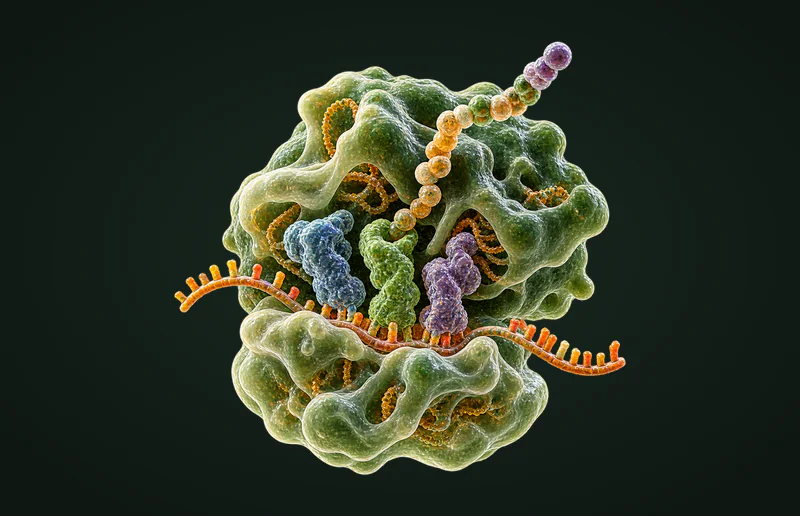
Rough ER makes proteins destined to be secreted, embedded in membranes, or sent to lysosomes. The process is co-translational: as a ribosome begins translating such a protein, an exposed signal sequence is grabbed by a signal-recognition particle, which docks the ribosome onto a channel in the ER membrane. The growing chain then threads directly into the lumen, where chaperone proteins help it fold and enzymes add early sugar tags (N-linked glycosylation).
This is also the cell's strictest quality-control gate. Misfolded proteins are caught, retained, and sent back across the membrane for destruction by the proteasome. When misfolded proteins pile up faster than they can be cleared, the cell triggers the unfolded protein response — a stress pathway that comes up in disease questions about diabetes and neurodegeneration.
Smooth ER has a different résumé. It synthesizes phospholipids and steroids (so steroid-hormone cells of the ovary, testis, and adrenal cortex are packed with it), detoxifies drugs and alcohol — heavily in liver cells, via cytochrome P450 enzymes — and stores calcium ions. In skeletal muscle fibers a specialized smooth ER called the sarcoplasmic reticulum releases the calcium surge that triggers each contraction, then pumps it back to allow relaxation.
Finished cargo buds off the ER in transport vesicles and travels to the Golgi apparatus for final sorting. The ER is the first stop on the cell's secretory highway, and everything that leaves the cell or sits in its membrane passes through here first.
In the exam
- AP Bio (Unit 2): Know the division of labor — rough ER = protein synthesis and folding; smooth ER = lipids, detox, calcium storage. The protein pathway ribosome → rough ER → Golgi → vesicle → plasma membrane is a classic trace-the-route question, and you should be able to say why a protein enters the ER (a signal sequence).
- IB HL: Be ready to explain why cells that secrete a lot of protein (pancreatic acinar cells, antibody-secreting plasma cells) have abundant rough ER, while steroid-producing and detox cells are rich in smooth ER. Linking structure to function from a micrograph is common.
- MCAT / USMLE: The smooth ER's cytochrome P450 system underlies drug metabolism and drug–drug interactions, and sarcoplasmic-reticulum calcium handling underlies excitation–contraction coupling and malignant hyperthermia. Expect a pharmacology or physiology twist rather than a pure structure question.
Related cells
- Ribosome — bound to rough ER, feeding new proteins into its lumen.
- Golgi apparatus — receives ER cargo for final modification and sorting.
- Nucleus — its outer membrane is continuous with the ER.
- Skeletal muscle fiber — its sarcoplasmic reticulum is a specialized smooth ER that controls contraction.
- Animal cell — see the ER wrapping the nucleus in context.
Common misconceptions
- "Rough and smooth ER are separate organelles." They are connected regions of one continuous membrane network — molecules can move between them without crossing a membrane.
- "The ER makes all the cell's proteins." Only proteins headed for membranes, secretion, or lysosomes enter the ER; proteins for the cytosol are made on free ribosomes and never touch it.
- "Smooth ER does nothing important." Its lipid synthesis, detoxification, and calcium storage are essential — a liver cell could not clear alcohol, and a muscle fiber could not contract, without it.
- "The ribosomes are part of the ER membrane." They dock onto it temporarily during translation and release when finished; a "rough" patch can become "smooth" when its ribosomes leave.
References
- Alberts B. et al., Molecular Biology of the Cell, 6th ed. — Ch. 12 (Intracellular Compartments and Protein Sorting) and Ch. 13 (Intracellular Vesicular Traffic).
- Lodish H. et al., Molecular Cell Biology, 8th ed. — Ch. 13 (Moving Proteins into Membranes and Organelles).
- College Board AP Biology Course and Exam Description (2025) — Unit 2 (Cell Structure and Function).