A ribosome is the molecular machine that reads messenger RNA and builds protein from it — the only structure in the cell that literally translates the genetic code into a working molecule.
Ribosomes are tiny (about 20–30 nm) but staggeringly abundant: a fast-growing cell can carry millions, and they make up a large fraction of a cell's total dry mass. They are also the one piece of machinery shared by every form of life on Earth, which is a strong hint that they are very, very old — older than the split between bacteria, archaea, and eukaryotes.
Structure
A ribosome is built from ribosomal RNA (rRNA) and dozens of proteins, organized into two subunits that clamp together only when it is time to work and separate when they are done.
- The small subunit reads the mRNA — it holds the message and checks that each incoming codon matches its tRNA correctly, a proofreading step that keeps translation accurate.
- The large subunit does the chemistry — its peptidyl transferase center joins amino acids together with peptide bonds. Critically, that catalytic core is made of rRNA, not protein, which makes the ribosome a ribozyme — an RNA enzyme.
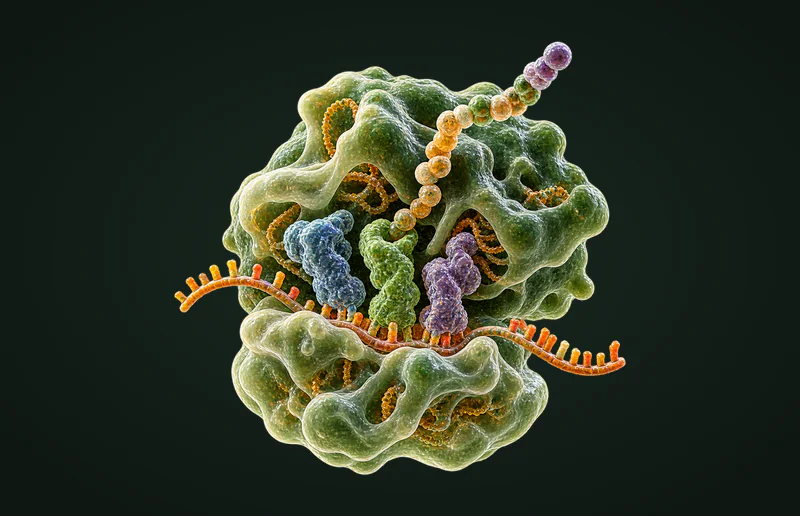
Between the subunits run three sites — A, P, and E — that a transfer RNA (tRNA) moves through as it delivers its amino acid: the A site (aminoacyl) accepts the incoming tRNA, the P site (peptidyl) holds the growing chain, and the E site (exit) releases the spent tRNA. In the 3D model above, the two stacked lobes are the large and small subunits locked around a strand of mRNA.
Ribosomes come in two flavors by location. Free ribosomes float in the cytosol and make proteins for use inside the cell. Bound ribosomes dock onto the rough endoplasmic reticulum and make proteins destined for membranes, lysosomes, or secretion. They also come in two flavors by size: the 70S ribosome of bacteria (and of mitochondria and chloroplasts) versus the larger 80S ribosome of the eukaryotic cytoplasm.
Function
The ribosome carries out translation, the second half of gene expression. The nucleus sends out mRNA; the ribosome reads it three bases at a time. Each three-base codon specifies one amino acid, and the matching tRNA — carrying the correct amino acid and bearing the complementary anticodon — brings it in.
Translation runs in three phases. In initiation, the small subunit finds the start codon (AUG) and the large subunit joins. In elongation, the cycle repeats: a tRNA enters the A site, the large subunit forms a peptide bond linking its amino acid to the growing chain, the ribosome translocates one codon down, and the spent tRNA exits through the E site. A bacterial ribosome can add about 20 amino acids per second.
In termination, the ribosome hits one of three stop codons. No tRNA fits, so release factors step in, the finished polypeptide is let go, and the subunits dissociate to be reused. Many ribosomes often read the same mRNA at once, strung along it like beads to form a polysome, which multiplies a cell's protein output from a single transcript.
Where the protein goes depends on the protein, not the ribosome. If the emerging chain carries a signal sequence, the whole ribosome is pulled to the rough ER and finishes translation there; if not, it stays free in the cytosol.
In the exam
- AP Bio (Unit 6): Translation steps — initiation, elongation, termination — and the A/P/E sites are reliable free-response material. Know that the ribosome's catalytic activity comes from rRNA, making it a ribozyme, and be ready to read a codon table from an mRNA sequence.
- IB HL: Distinguish free versus membrane-bound ribosomes by the destination of their product, and contrast the 70S prokaryotic ribosome with the 80S eukaryotic one. The endosymbiotic clue — mitochondria and chloroplasts carry 70S ribosomes — is a frequent link question.
- MCAT / USMLE: That size difference is a favorite — many antibiotics target the bacterial 70S ribosome without harming our 80S cytoplasmic ribosomes. Aminoglycosides and tetracyclines hit the 30S small subunit; macrolides, chloramphenicol, and clindamycin hit the 50S large subunit. Expect a pharmacology item asking which subunit a drug attacks, and why it spares human cells (mostly).
Related cells
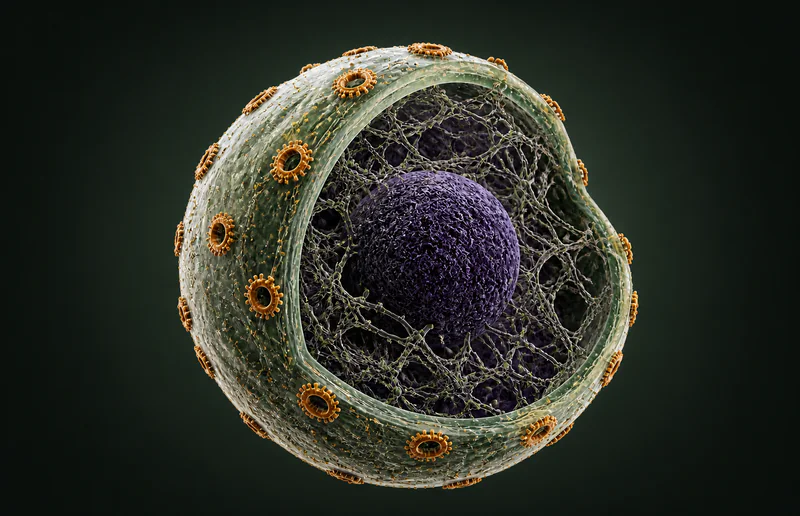
- Nucleus — its nucleolus assembles ribosomal subunits and exports them through the pores.
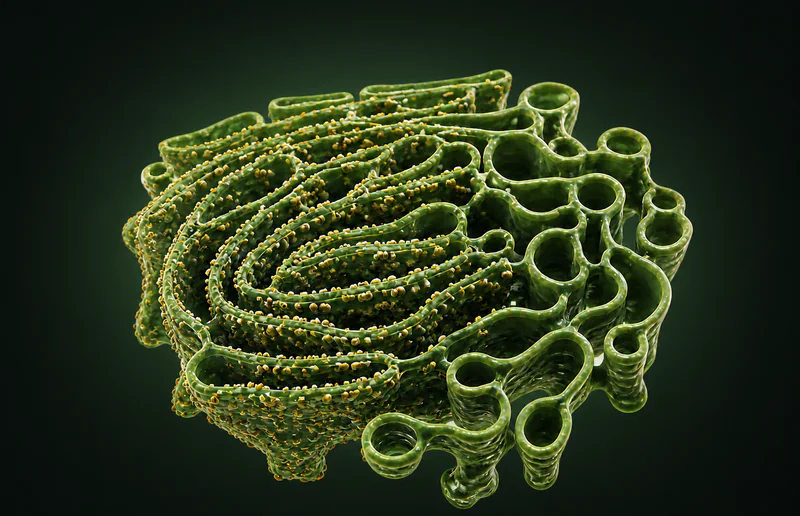
- Endoplasmic reticulum — the rough ER is studded with bound ribosomes feeding proteins into its lumen.
- Bacterium — uses the smaller 70S ribosome that antibiotics exploit.
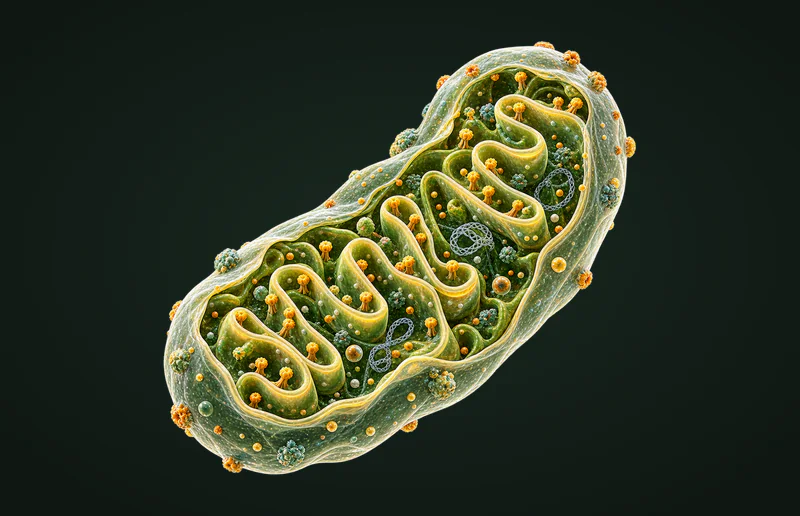
- Mitochondrion — carries its own 70S-like ribosomes, a relic of its bacterial origin.
- Animal cell — see free and bound ribosomes in context.
Common misconceptions
- "Ribosomes are organelles." They have no membrane — they are ribonucleoprotein machines, present even in bacteria that lack true membrane-bound organelles.
- "Free and bound ribosomes are different ribosomes." They are identical; a ribosome becomes "bound" only when the protein it is making carries a signal sequence that docks it onto the ER.
- "The protein part does the catalysis." The peptide-bond chemistry is performed by rRNA — the ribosome is a ribozyme, and this is strong evidence for an early RNA world.
- "The ribosome decides where a protein goes." It doesn't — the protein's own signal sequence (or lack of one) decides whether it stays in the cytosol or enters the ER.
References
- Alberts B. et al., Molecular Biology of the Cell, 6th ed. — Ch. 6 (How Cells Read the Genome: From DNA to Protein).
- Lodish H. et al., Molecular Cell Biology, 8th ed. — Ch. 4 (Basic Molecular Genetic Mechanisms).
- College Board AP Biology Course and Exam Description (2025) — Unit 6 (Gene Expression and Regulation).