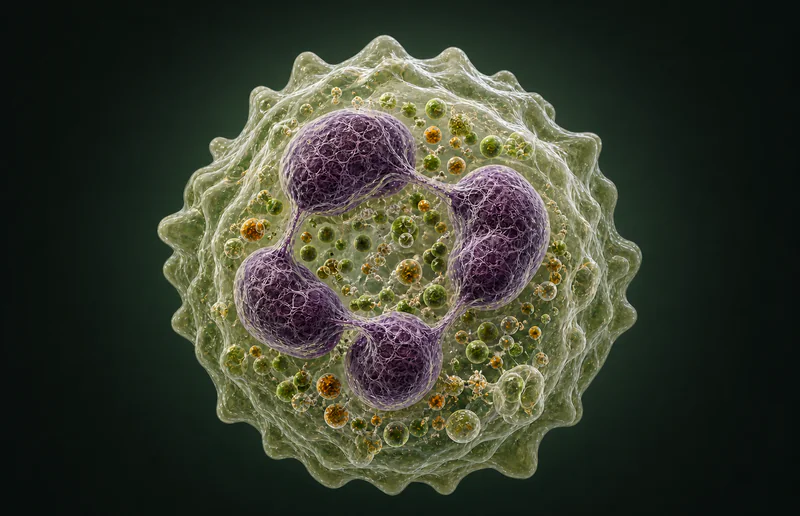
A neutrophil is the immune system's first responder — the most common white blood cell, a fast, disposable foot soldier that swarms an infection and eats the bacteria on sight.
Neutrophils make up 50–70% of your white blood cells, and your bone marrow churns out about 100 billion of them a day. They live only hours to a few days in the blood — they are built to be spent.
Structure
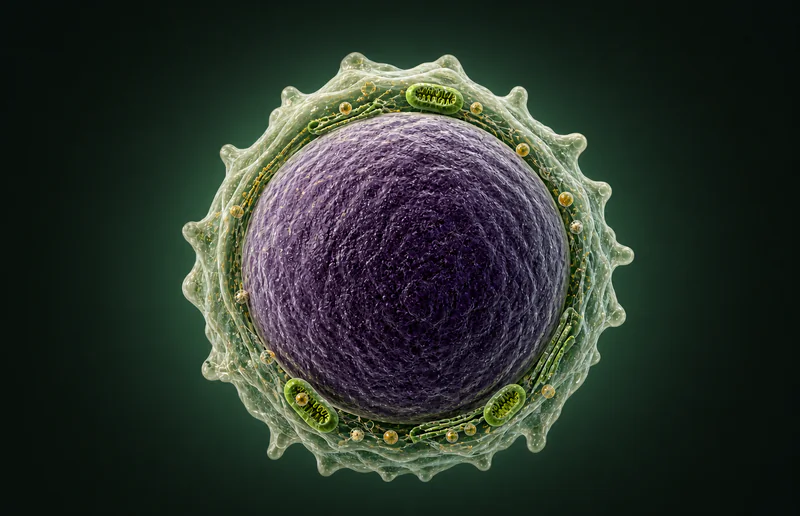
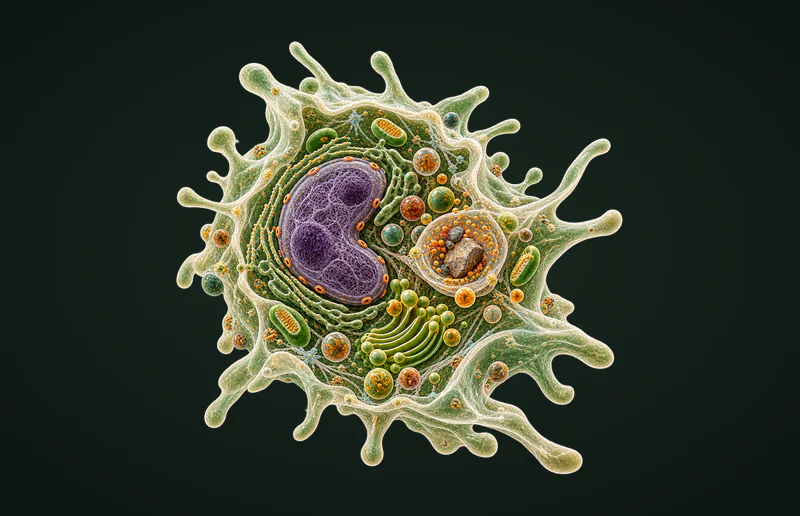
A neutrophil's signature feature is its multilobed nucleus — a single nucleus pinched into two to five connected lobes joined by thin strands of chromatin. This is why neutrophils are also called polymorphonuclear cells, or PMNs. In the 3D model above, that segmented nucleus is the identifying trait, and counting the lobes is a real clinical clue — too many lobes (hypersegmentation) hints at vitamin B12 or folate deficiency.
Its cytoplasm is packed with granules, small membrane sacs of antimicrobial cargo. There are two main kinds: azurophilic (primary) granules, which are essentially specialized lysosomes loaded with myeloperoxidase and digestive enzymes, and specific (secondary) granules full of antibacterial proteins like lactoferrin. These granules stain a neutral pinkish color with standard dyes — hence "neutro-phil," neutral-loving — and they are the cell's pre-armed chemical weapons.
The lobed nucleus is not just a label; the flexible, segmented shape lets the cell squeeze its bulk between the cells lining a blood vessel and out into infected tissue.
Function
The neutrophil runs innate immunity — fast, non-specific defense — and its main mode of attack is phagocytosis. The sequence is worth knowing step by step:
- Chemotaxis. Chemical signals from damaged tissue and bacteria (such as complement fragment C5a and bacterial peptides) draw the neutrophil toward the trouble.
- Margination and extravasation. The neutrophil rolls along the vessel wall, sticks using selectins and integrins, and squeezes between endothelial cells into the tissue (diapedesis).
- Engulfment. It surrounds the bacterium and pulls it into a vesicle called a phagosome.
- Killing. The phagosome fuses with granules and lysosomes to form a phagolysosome, then unleashes two attacks: digestive enzymes, and a respiratory burst that uses the enzyme NADPH oxidase to make reactive oxygen species — bleach-like molecules that destroy the microbe.
It has a second, dramatic weapon. When overwhelmed, a neutrophil can fling out a web of its own DNA studded with antimicrobial proteins — a neutrophil extracellular trap (NET) — to snare and kill bacteria in the surrounding tissue. This usually kills the neutrophil in the process, a kind of suicidal last stand called NETosis.
Because neutrophils are short-lived and die in large numbers at an infection site, the buildup of dead neutrophils, digested bacteria, and fluid is what we see as pus.
Unlike a lymphocyte, a neutrophil has no memory and no specificity. It attacks anything flagged as foreign — recognizing broad molecular patterns common to many microbes rather than one precise antigen — fast, and then dies.
In the exam
- MCAT / USMLE Step 1: Neutrophils are the lead example of innate, non-specific immunity and the dominant cell of acute inflammation. Know that they are the first leukocytes recruited to a bacterial infection (followed later by macrophages), their multilobed nucleus, the phagocytosis-and-respiratory-burst killing mechanism, and that a high neutrophil count (neutrophilia) with a "left shift" toward immature forms points to acute bacterial infection.
- USMLE: A high-yield linked disease is chronic granulomatous disease, where a defective NADPH oxidase cripples the respiratory burst, leaving patients vulnerable to catalase-positive organisms. It is a clean way to test whether you understand how the neutrophil kills.
- AP Bio / IB: Contrast neutrophils with lymphocytes on a comparison table — innate vs adaptive, non-specific vs specific, no memory vs memory, fast vs slower-but-targeted. That two-arm framework is the structure most immune-system free-response questions hang on.
Related cells
- Macrophage — the larger, longer-lived phagocyte that arrives after the neutrophil and cleans up.
- Lymphocyte — the specific, memory-forming arm of immunity.
- Lysosome — its enzymes fuse with the phagosome to digest engulfed bacteria.
- Stem cell — neutrophils are produced from bone-marrow hematopoietic stem cells.
- Cell membrane — reshapes around prey to drive phagocytosis.
Common misconceptions
- "Neutrophils remember pathogens like lymphocytes do." They do not. Innate cells respond the same way every time, recognizing general microbial patterns with no lasting memory of any specific invader.
- "Pus is a sign the body is failing." Pus is mostly spent neutrophils — evidence that the immune response is actively working, not losing.
- "The multilobed nucleus is several nuclei." It is one nucleus divided into connected lobes, not multiple separate nuclei.
- "All phagocytes are the same." Neutrophils are fast, abundant, and short-lived; macrophages are slower, fewer, longer-lived, and double as antigen-presenters that brief lymphocytes. The handoff between them organizes the whole timeline of an infection.
References
- Abbas et al., Cellular and Molecular Immunology, 9th ed., Ch. 4 (Innate Immunity).
- Reece et al., Campbell Biology, 11th ed., Ch. 43 (The Immune System).
- Guyton & Hall, Textbook of Medical Physiology, 13th ed., Ch. 34 (Resistance of the Body to Infection: Leukocytes, Granulocytes).