A peroxisome is the cell's chemical-safety lab — it runs reactions that make hydrogen peroxide on purpose, then neutralizes that peroxide before it can do damage.
Peroxisomes are small (0.1–1 μm) and present in nearly every eukaryotic cell, with especially high counts in liver and kidney cells, where detoxification and lipid processing are constant work. They were named for the molecule that defines them — peroxide — and the enzyme that disposes of it.
Structure
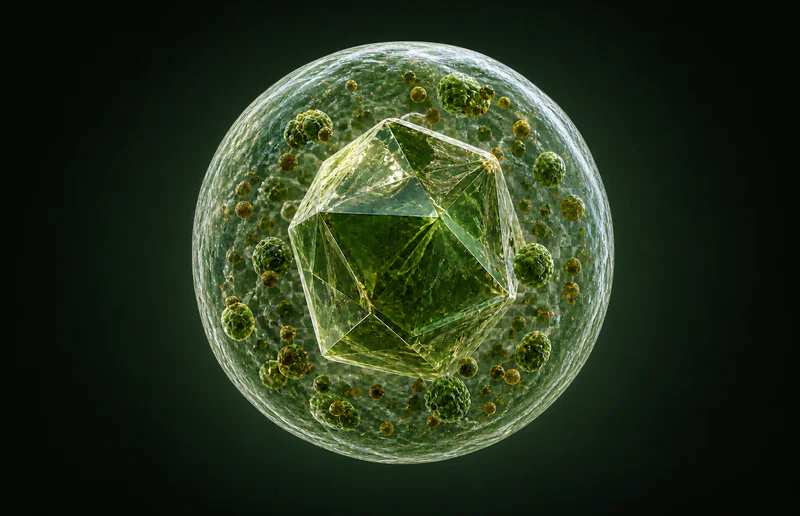
A peroxisome is a single membrane enclosing a dense matrix of enzymes. In many cells that core is so tightly packed with oxidase enzymes that it forms a visible crystalline core — the solid interior you can see in the 3D model above.
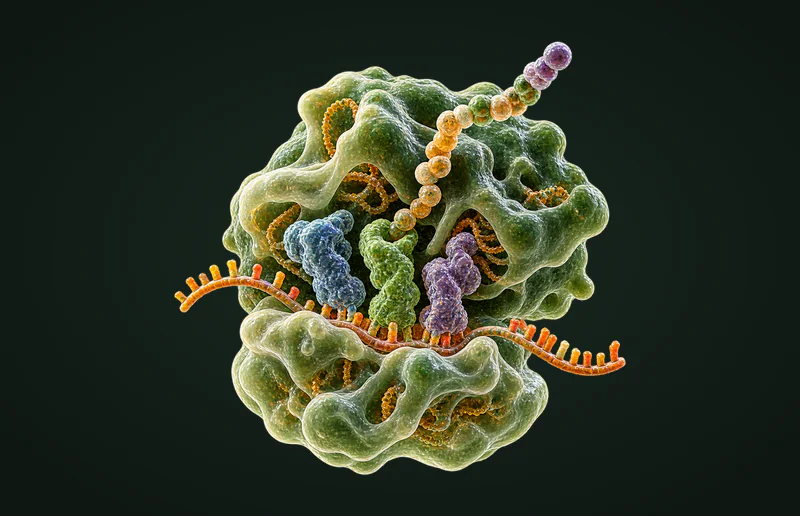
Unlike mitochondria and chloroplasts, peroxisomes have no internal membranes and no DNA. They cannot build their own proteins; every enzyme inside is made on free ribosomes in the cytosol and imported afterward — fully folded, which is unusual. Most import targets a short tail sequence called PTS1 (often the tripeptide Ser-Lys-Leu), recognized by a cytosolic receptor that ferries the cargo across the membrane and recycles back out.
New peroxisomes arise two ways: existing ones grow and divide, and fresh ones can bud from the endoplasmic reticulum. The proteins that build and divide them are called peroxins (PEX proteins) — and a defect in those genes is the root of severe inherited disease, which is why they show up on exams.
Function
The peroxisome's two headline jobs are oxidation and detoxification, linked by one risky molecule.
First, oxidase enzymes strip hydrogen atoms from substrates and hand them to molecular oxygen, producing hydrogen peroxide (H₂O₂) — a reactive, cell-damaging compound. The most important of these reactions is beta-oxidation of very-long-chain fatty acids (roughly 22 carbons or longer), which peroxisomes shorten before mitochondria can finish the job.
That H₂O₂ is the hazard, and the peroxisome's second job is the answer: the enzyme catalase immediately splits H₂O₂ into harmless water and oxygen. At low peroxide levels catalase can also work in "peroxidatic" mode, using the H₂O₂ to oxidize other toxins — including a meaningful share of the ethanol you drink, converting it to acetaldehyde. Generating a toxin and destroying it in the same sealed compartment is exactly why these reactions are quarantined behind a membrane.
Peroxisomes also handle reactions mitochondria can't:
- Plasmalogen synthesis — the first steps of making these specialized membrane phospholipids happen only here. Plasmalogens are abundant in the myelin that insulates a neuron.
- Bile acid and cholesterol intermediates in the liver.
- Photorespiration in plants, where peroxisomes cooperate with chloroplasts and mitochondria.
In the exam
Peroxisome questions are usually short, but they reward you for getting the chemistry direction right.
- AP Bio (Unit 2, Cell Structure & Function): Know the peroxisome as the H₂O₂ story — oxidases produce hydrogen peroxide during fatty-acid and amino-acid oxidation, and catalase neutralizes it. The "make a toxin, then destroy it in a sealed compartment" logic is a strong free-response answer for why compartmentalization matters.
- IB HL: Contrast it cleanly with the lysosome: peroxisomes oxidize using oxygen, lysosomes hydrolyze using water at acidic pH. Both are single-membrane sacs without DNA.
- MCAT: Expect beta-oxidation specificity — very-long-chain fatty acids start in the peroxisome, then the shortened product moves to the mitochondrion. Catalase is also a stock example of an enzyme with an extremely high turnover number.
- USMLE Step 1: Zellweger syndrome (a PEX-gene defect that prevents peroxisome assembly) and X-linked adrenoleukodystrophy (faulty import of the VLCFA transporter) are the classic clinical hooks — both cause neurological disease from accumulated very-long-chain fatty acids and failed plasmalogen synthesis.
Related cells
- Mitochondrion — shares fatty-acid oxidation, but cannot start on the very-long-chain fats the peroxisome handles first.
- Lysosome — the other small digestive organelle, easily confused with the peroxisome.
- Endoplasmic reticulum — new peroxisomes can bud from it.
- Chloroplast — partners with peroxisomes during photorespiration in plant cells.
- Animal cell — see the peroxisome among the organelles.
Common misconceptions
- "Peroxisomes and lysosomes are the same." Both are small single-membrane sacs, but peroxisomes run oxidation reactions with oxygen at neutral pH, while lysosomes run acidic hydrolysis with water. Different chemistry, different jobs.
- "Catalase makes hydrogen peroxide." It is the opposite — catalase destroys H₂O₂. The oxidase enzymes are what produce it; catalase cleans it up.
- "They build their own enzymes." Peroxisomes have no DNA or ribosomes; all their enzymes are imported, already folded, from the cytosol.
- "Peroxisomes only detoxify." Detox is half the story. Their unique synthetic roles — plasmalogens for myelin, bile-acid intermediates, photorespiration in plants — are why losing them is fatal in disease.
References
- Alberts B. et al. Molecular Biology of the Cell, 6th ed. — Chapter 12 (Intracellular Compartments and Protein Sorting: Peroxisomes).
- Lodish H. et al. Molecular Cell Biology, 8th ed. — Chapter 13 (Moving Proteins into Membranes and Organelles).
- College Board AP Biology Course and Exam Description (2025) — Unit 2 (Cell Structure and Function).