A neuron is the body's wiring — a single cell stretched into a signaling line that can carry an electrical message a meter long in a few milliseconds, then hand it chemically to the next cell.
You have roughly 86 billion neurons in your brain alone, each connected to thousands of others. Together they form the network that senses, decides, and moves. The longest single human neuron runs from the base of the spine to the big toe — about a meter of one cell.
Structure
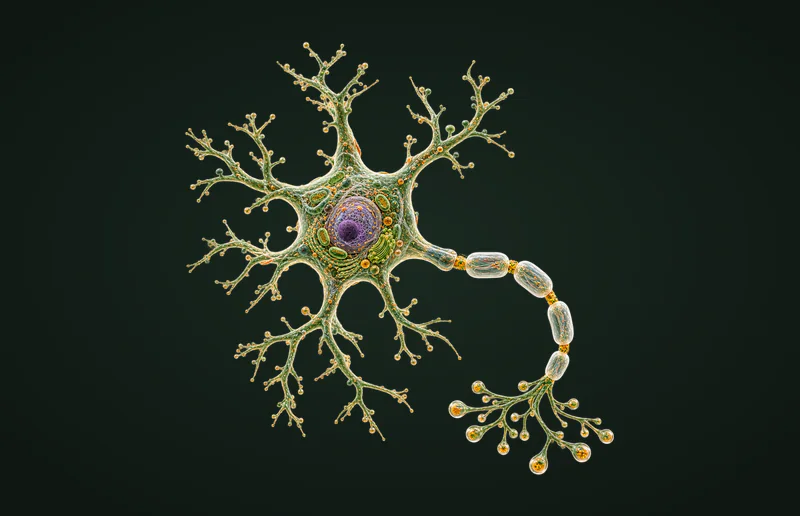
A neuron is shaped entirely around carrying a signal in one direction. In the 3D model above you can trace its three regions:
- Dendrites — branching arms that receive signals from other neurons. The more branches, the more inputs the cell can gather, and the branching pattern can change with learning.
- The cell body (soma) — holds the nucleus and organelles and integrates the incoming signals. It is the metabolic headquarters; the mitochondria and protein synthesis that supply the whole cell are concentrated here.
- The axon — a single long fiber that sends the signal away, beginning at a trigger zone called the axon hillock and ending in synaptic terminals that pass the signal to the next cell.
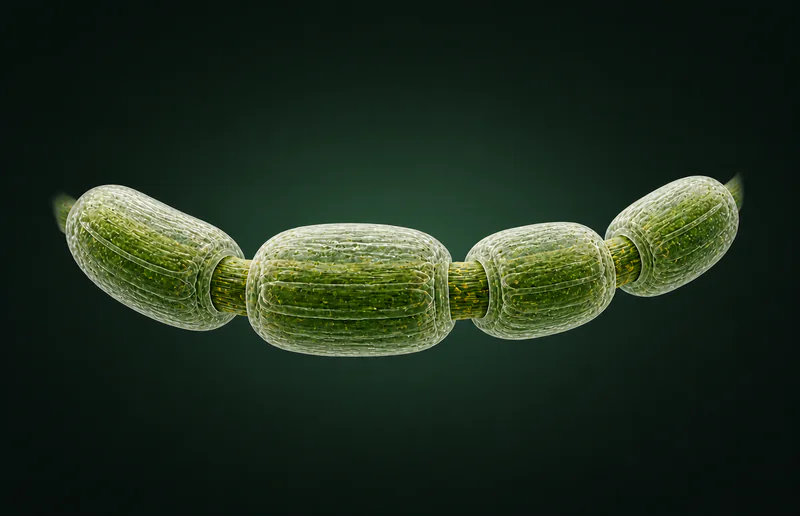
Many axons are wrapped in a fatty myelin sheath that speeds the signal. Because the soma sits far from the axon's tip, the neuron relies on the cytoskeleton as a railway: motor proteins haul vesicles and mitochondria along microtubules the full length of the axon (axonal transport). And because a neuron commits everything to this signaling shape, most mature neurons cannot divide — which is why nerve damage heals so poorly.
Function
A neuron does two things in sequence: it carries an electrical signal down its own length, then converts it to a chemical signal to cross to the next cell.
The electrical part is the action potential. At rest, the cell membrane holds the inside at about −70 mV, maintained by the sodium-potassium pump (3 Na⁺ out, 2 K⁺ in per ATP) and by potassium leak channels. When inputs at the dendrites push the axon hillock past a threshold of roughly −55 mV, voltage-gated sodium channels snap open and Na⁺ floods in, driving the inside positive — depolarization. Those channels then inactivate while voltage-gated potassium channels open, K⁺ flows out, and the membrane swings back down — repolarization, briefly overshooting into hyperpolarization. The whole spike is all-or-nothing and self-propagating: each depolarized patch triggers the next, so the signal travels down the axon without weakening.
A refractory period follows each spike, during which the inactivated sodium channels cannot reopen. This does two jobs: it sets a ceiling on firing rate, and it forces the impulse to travel in one direction only, since the patch behind the wave is momentarily unexcitable.
The chemical part is the synapse. The action potential reaches the synaptic terminal and opens voltage-gated calcium channels; the Ca²⁺ influx makes vesicles fuse and dump neurotransmitters into the synaptic cleft. These bind receptors on the next neuron's dendrites, either depolarizing it toward firing (excitatory) or hyperpolarizing it away from firing (inhibitory). The signal is electrical within a neuron and chemical between neurons.
This design lets neurons compute: each cell sums thousands of excitatory and inhibitory inputs over space and time and fires only if the balance at the hillock crosses threshold.
In the exam
- AP Bio Unit 4 / IB HL: The action potential is core — resting potential, the role of the Na⁺/K⁺ pump, threshold, depolarization (Na⁺ in), repolarization (K⁺ out), and the refractory period. Know that the signal is all-or-nothing and travels one way, and be able to sketch and label the voltage-versus-time graph.
- MCAT / USMLE: Synaptic transmission is high-yield — the calcium-triggered release of neurotransmitter, reuptake and enzymatic breakdown (e.g., acetylcholinesterase), and how excitatory vs. inhibitory inputs are summed. Pair this with saltatory conduction along myelinated axons: expect to explain how myelination and larger axon diameter both raise conduction velocity.
- A recurring graph question gives a voltage trace and asks which ion channel is open at each labeled point. Map peak rise → Na⁺ in, falling phase → K⁺ out.
Related cells
- Myelinated axon — the insulated fiber that makes neural signals fast.
- Cell membrane — its ion channels and pumps generate the action potential.
- Cytoskeleton — the track that transports cargo the length of the long axon.
- Mitochondrion — powers the Na⁺/K⁺ pump that resets the gradient after every spike.
- Skeletal muscle fiber — a common target a motor neuron signals.
Common misconceptions
- "The signal is electrical the whole way." It is electrical within a neuron but chemical across the synapse between neurons.
- "A bigger action potential means a stronger stimulus." Action potentials are all-or-nothing — stimulus strength is coded by frequency of firing (and number of neurons recruited), not by spike size.
- "The sodium-potassium pump causes the action potential." It does not. The pump sets up the resting gradient; the spike itself is driven by voltage-gated channels opening. The pump just restores the gradient afterward.
- "Neurons can regrow easily." Most mature central-nervous-system neurons cannot divide, which is why brain and spinal-cord damage is often permanent. (Peripheral axons can sometimes regrow along their old sheath.)
References
- Purves, D. et al. Neuroscience, 6th ed. — Ch. 2–5 (Electrical Signals of Nerve Cells; Synaptic Transmission).
- Kandel, E.R. et al. Principles of Neural Science, 5th ed. — Part II (Cell and Molecular Biology of the Neuron).
- College Board AP Biology Course and Exam Description (2025) — Unit 4 (Cell Communication and Signaling).