The chloroplast is the organelle that runs photosynthesis — it captures sunlight and uses that energy to turn carbon dioxide and water into the sugar that feeds nearly every food chain on Earth.
Chloroplasts are found in plant cells and algae. A single leaf mesophyll cell can hold 40 to 50 of them, each a green, lens-shaped compartment a few micrometers wide that can shuffle around inside the cell to chase or dodge the light.
Structure
Like the mitochondrion, the chloroplast is bounded by two membranes — but inside it adds a third, internal membrane system, and that is where the light is captured.
- The outer membrane is smooth and permeable to small molecules.
- The inner membrane is more selective and encloses the body of the organelle.
- Inside, a fluid called the stroma fills the space, holding the enzymes of sugar synthesis.
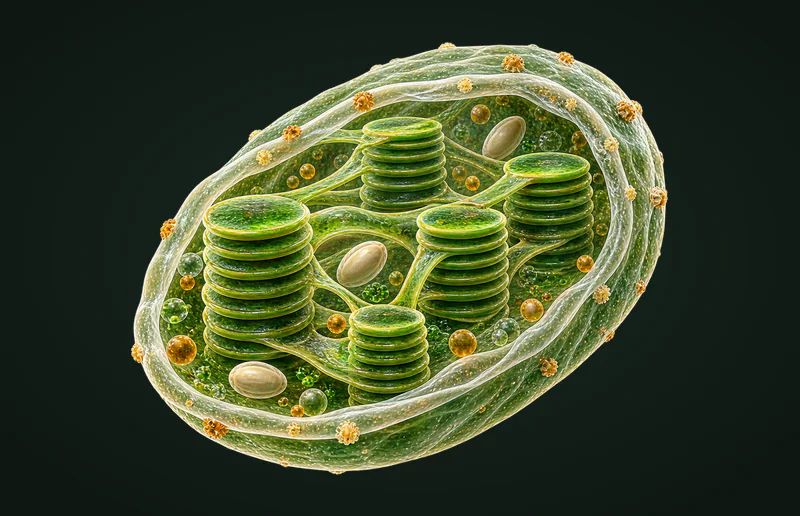
- Suspended in the stroma are flattened discs called thylakoids, stacked into piles. Each stack is a granum (plural grana), connected to its neighbors by stromal thylakoids, and the green pigment chlorophyll sits embedded in the thylakoid membranes.
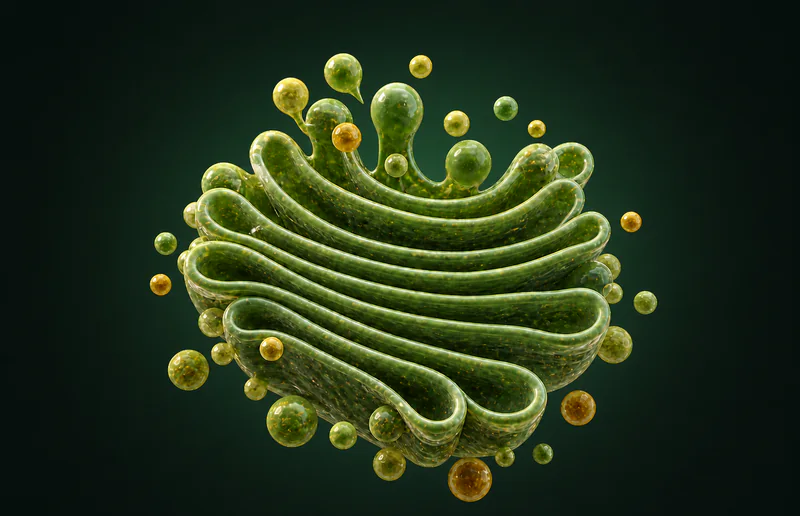
In the 3D model above, the stacked coin-like discs are the grana of thylakoids; the surrounding fluid is the stroma. This layout splits photosynthesis into two zones — light-catching membranes and sugar-building fluid — and the thylakoid stacking gives chlorophyll and its protein partners a huge surface area to work on, the same surface-area logic that cristae use in mitochondria.
The space inside the thylakoid discs, the thylakoid lumen, is its own compartment. Protons are pumped into it during the light reactions, and that gradient is what drives ATP synthesis — a chemiosmotic mechanism nearly identical to the one in your mitochondria.
Chloroplasts also carry their own small circle of DNA and their own bacteria-like 70S ribosomes — direct evidence that they descend from a free-living cyanobacterium swallowed long ago (the endosymbiotic theory).
Function
Photosynthesis runs in two linked stages, each in its own part of the chloroplast.
The light-dependent reactions happen in the thylakoid membranes. Chlorophyll in photosystems II and I absorbs sunlight, which energizes electrons; to replace those lost electrons, the cell splits water, releasing the oxygen we breathe as a by-product. As electrons pass down the chain between the photosystems, protons are pumped into the thylakoid lumen, and ATP synthase lets them flow back out to make ATP. The pathway also reduces NADP⁺ to NADPH. So stage one converts light into two portable forms of chemical energy: ATP and NADPH.
The Calvin cycle (the light-independent reactions) happens in the stroma. Using the ATP and NADPH from stage one, the enzyme RuBisCO attaches carbon dioxide to a five-carbon sugar in a step called carbon fixation; the products are reduced and rearranged, and for every three CO₂ fixed the cycle yields one three-carbon sugar, eventually built up into glucose. RuBisCO is reckoned to be the most abundant enzyme on the planet, which is worth a mark in any "name the enzyme" question.
The net result: light energy + CO₂ + H₂O → glucose + O₂. That glucose then powers the plant — including its own mitochondria, which burn it back down for ATP. Photosynthesis and respiration are mirror images, and a plant cell runs both at once.
In the exam
- AP Bio (Unit 3): Know the two-stage structure — light reactions in the thylakoid membrane, Calvin cycle in the stroma — and that water is split in the light reactions to release O₂. Linking the ATP and NADPH made in stage one to carbon fixation in stage two is a classic free-response, as is recognizing that the chloroplast uses chemiosmosis just like the mitochondrion.
- IB HL: Expect to map specific events to specific locations (water-splitting and electron transport in the thylakoid membrane, RuBisCO and the Calvin cycle in the stroma) and to discuss limiting factors — light intensity, CO₂ concentration, and temperature — from a rate graph.
- A-Level: The endosymbiotic evidence (own circular DNA, own 70S ribosomes, double membrane, binary-fission-like division) is a recurring source of marks. Be ready to list the parallels with mitochondria.
Related cells
- Plant cell — the chloroplast's home, the one cell type that runs both photosynthesis and respiration.
- Mitochondrion — its mirror image; together they cycle energy and carbon, and both use chemiosmosis.
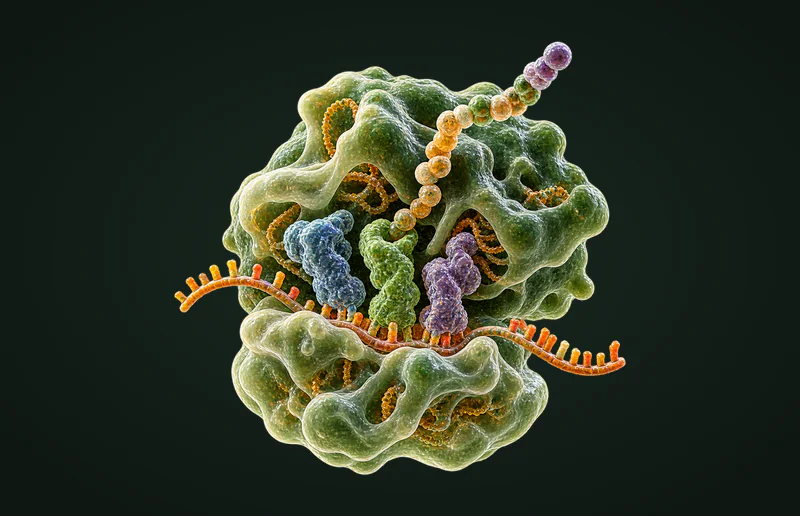
- Ribosome — chloroplasts carry their own bacteria-like 70S ribosomes.
- Vacuole — the other large organelle that defines a mature plant cell.
Common misconceptions
- "Plants only photosynthesize and don't respire." Plant cells respire constantly in their mitochondria — photosynthesis runs on top of respiration, not instead of it, and at night only respiration continues.
- "Chlorophyll is the chloroplast." Chlorophyll is the green pigment embedded in the thylakoid membranes; the chloroplast is the whole organelle that houses it.
- "Oxygen comes from the CO₂ the plant takes in." The O₂ released comes from splitting water in the light reactions, not from carbon dioxide — a point confirmed by isotope-labeling experiments and a frequent multiple-choice trap.
- "The Calvin cycle doesn't need light." It is called light-independent, but it depends on the ATP and NADPH that only the light reactions supply, so it effectively stops in the dark once those run out.
References
- Reece J.B. et al., Campbell Biology, 11th ed. — Ch. 10 (Photosynthesis).
- Alberts B. et al., Molecular Biology of the Cell, 6th ed. — Ch. 14 (Energy Conversion: Mitochondria and Chloroplasts).
- College Board AP Biology Course and Exam Description (2025) — Unit 3 (Cellular Energetics).