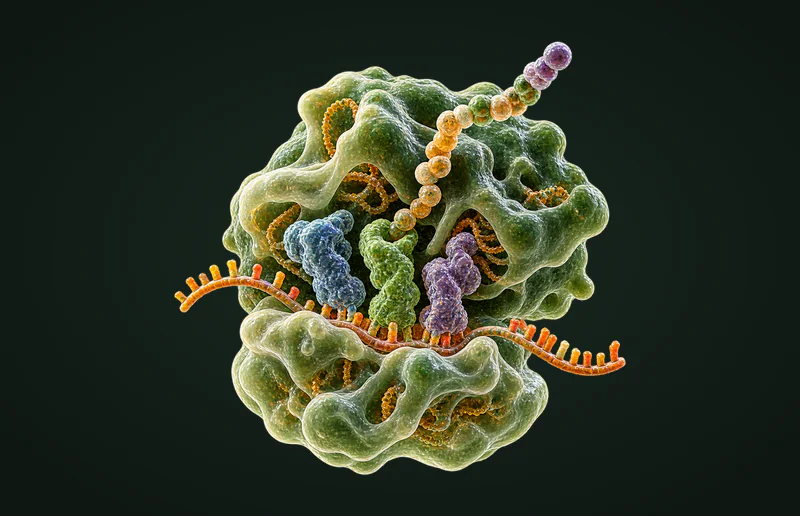
The cytoskeleton is the cell's skeleton, muscles, and railway combined — a dynamic protein scaffold that holds the cell's shape, moves its cargo, and pulls it apart when it divides.
Unlike a real skeleton, the cytoskeleton is constantly rebuilt. Its filaments grow and shrink within minutes, which is how a single cell can crawl, change shape, or split in two on demand. It fills the cytoplasm of every eukaryote, and bacteria carry simpler relatives of the same proteins.
Structure
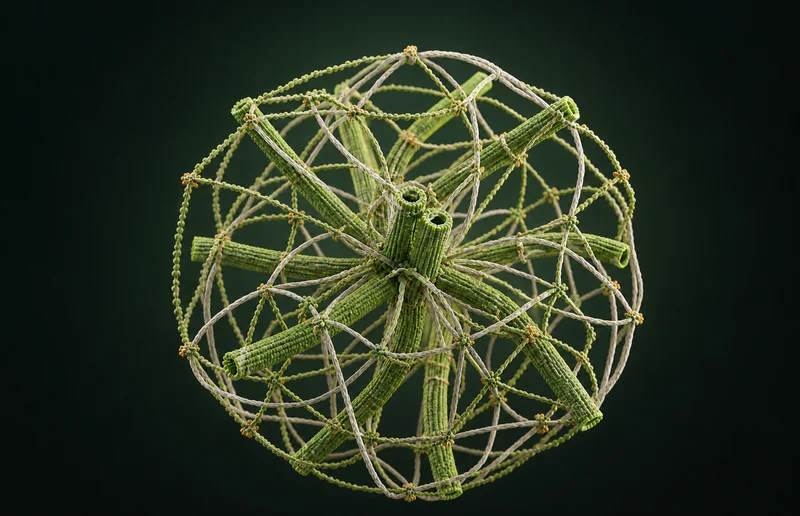
The cytoskeleton is built from three families of protein fibers, each a different size and job. In the 3D model above, the crisscrossing strands of different thicknesses represent these three systems woven through the cytoplasm.
- Microfilaments (about 7 nm) are the thinnest, made of two twisted strands of actin. They concentrate just under the cell membrane as the cortical actin layer, handling shape changes, cell crawling, and the pinching of cell division. Each filament is polar, with a fast-growing plus end and a slow minus end.
- Intermediate filaments (about 10 nm) are rope-like and tough, made of fibrous proteins such as keratin, vimentin, and the nuclear lamins. They are the most stable of the three, are not polar, and bear mechanical stress — anchoring the nucleus and tying neighboring cells together through desmosomes.
- Microtubules (about 25 nm) are the thickest, hollow tubes built from α/β-tubulin dimers. They are the cell's highways and its scaffolding for division, growing out from a microtubule-organizing center near the centriole. Like microfilaments they are polar, with a plus end that probes outward.
Microtubules and microfilaments are also notably dynamic: microtubules undergo "dynamic instability," switching between growth and abrupt shrinkage, which lets the cell rapidly re-aim its internal scaffolding. Intermediate filaments, by contrast, are the steady cables that take the load.
Function
The cytoskeleton does four big jobs at once.
Shape and support. The three filament types together give the cell its form and resist deformation, much like tent poles holding up fabric. Intermediate filaments in particular distribute mechanical stress so a stretched or compressed cell does not tear.
Transport. Motor proteins burn ATP to walk along the fibers carrying cargo. Kinesin generally hauls vesicles and organelles toward the microtubule plus end (cell periphery), while dynein moves them toward the minus end (cell center); myosin walks along actin. This is how a neuron ferries cargo down an axon that may be a meter long.
Movement. Actin assembly pushes the leading edge of a crawling macrophage forward, extending lamellipodia. Microtubule-based cilia and flagella — built on a 9+2 axoneme and powered by dynein — beat to move whole cells like sperm or to sweep mucus along an airway.
Cell division. During mitosis, microtubules form the mitotic spindle that attaches to chromosomes and pulls one full set to each pole, and a contractile ring of actin and myosin pinches the cell in two during cytokinesis.
Because these filaments assemble and disassemble on cue, the cytoskeleton is less a fixed frame than a constantly reorganizing system — the same actin that braces a resting cell can be torn down and rebuilt to let it migrate.
In the exam
Cytoskeleton questions reward you for pairing each filament with its protein, its size, and its job — and for knowing the drugs that target them.
- AP Bio (Unit 2, Cell Structure & Function): Know the three filament types by size and protein — actin (microfilaments), keratin/lamins (intermediate), tubulin (microtubules) — and pair each with its main role. Motor proteins (kinesin, dynein, myosin) and their fuel (ATP) are common multiple-choice items.
- IB HL: Microtubules and the mitotic spindle appear in cell-division questions; expect to explain how spindle fibers attach at the kinetochore of the centromere and shorten to separate chromosomes.
- A-Level / applied twist: Anti-microtubule drugs are a favorite real-world hook. Taxol (paclitaxel) stabilizes microtubules so they can't shorten, while vinblastine and colchicine block their assembly — all three freeze dividing cells in mitosis, which is why they are chemotherapy or gout drugs.
- USMLE Step 1: Microtubule poisons reappear (vincristine, paclitaxel), and Chédiak–Higashi syndrome — defective microtubule-dependent lysosome transport in neutrophils — is a classic clinical vignette.
Related cells
- Centriole — the core of the microtubule-organizing center that nucleates the spindle.
- Neuron — depends on microtubule motor transport along its very long axon.
- Cell membrane — braced from inside by the cortical actin layer.
- Sperm cell — its flagellum is a microtubule-based axoneme motor.
- Skeletal muscle fiber — its contraction runs on the same actin–myosin pairing the cytoskeleton uses.
Common misconceptions
- "The cytoskeleton is a rigid, permanent frame." It is dynamic — filaments assemble and break down constantly, which is precisely what enables movement, transport, and division.
- "Only animal cells have one." Plant, fungal, and even bacterial cells have cytoskeletal proteins; bacteria use FtsZ (a tubulin relative) and MreB (an actin relative).
- "Microtubules and microfilaments are the same." They differ in size, protein, and role — microtubules are thick hollow tubulin highways; microfilaments are thin actin strands. Mixing them up loses easy marks.
- "Motor proteins carry cargo by themselves in any direction." Each motor moves along a specific track in a specific direction — kinesin and dynein on microtubules in opposite directions, myosin on actin — and they spend ATP to do it.
References
- Alberts B. et al. Molecular Biology of the Cell, 6th ed. — Chapter 16 (The Cytoskeleton).
- Lodish H. et al. Molecular Cell Biology, 8th ed. — Chapters 17–18 (Cell Organization and Movement: Microfilaments and Microtubules).
- College Board AP Biology Course and Exam Description (2025) — Unit 2 (Cell Structure and Function).