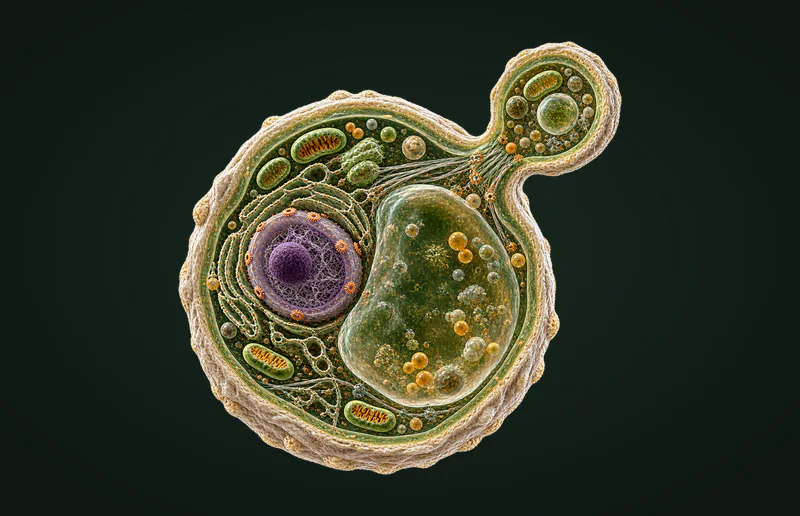
A fungal cell is a eukaryote that sits between plant and animal — it has a rigid wall like a plant, but no chloroplasts, so like an animal it must absorb its food rather than make it.
Fungi include yeasts, molds, and mushrooms. The fungal cell is the building block of all of them, whether it lives as a single free-floating yeast or as one thread in a network that can span acres of soil.
Structure
A fungal cell is wrapped in a cell wall, but its wall is made of chitin — the same tough nitrogen-containing polysaccharide in insect exoskeletons and crab shells — not the cellulose of a plant cell. The chitin is layered with glucans and bound to wall proteins, giving the cell rigidity while still letting secreted enzymes pass outward.
Just inside the wall sits the cell membrane, and here is a detail worth holding onto: a fungal membrane uses ergosterol as its main sterol, where animal membranes use cholesterol. That difference is the single most important target in antifungal medicine.
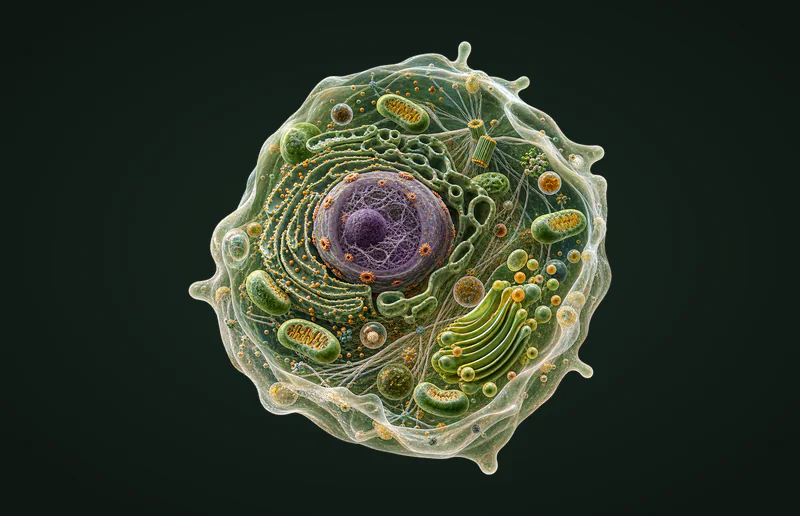
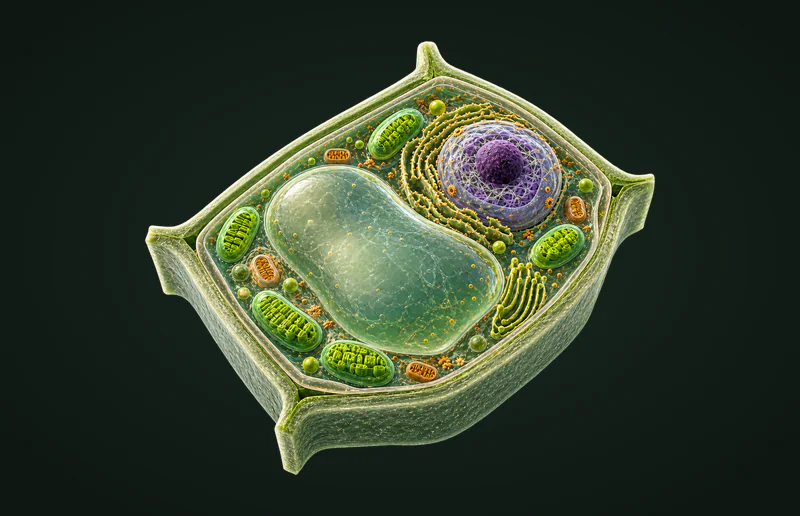
Inside the membrane, a fungal cell carries the standard eukaryotic organelles — a nucleus, mitochondria, ER, ribosomes, and a large vacuole — all visible in the 3D model above.
The decisive absence is chloroplasts: fungi do not photosynthesize. Many fungi also grow as long branching threads called hyphae, whose cells are separated by porous cross-walls (septa) that let cytoplasm, and even nuclei, flow between compartments. A whole mat of hyphae is a mycelium.
Function
Because a fungal cell has no chloroplasts, it is a heterotroph — it cannot make its own food and must absorb organic carbon from its surroundings. Its strategy is distinctive and the opposite of an animal's: it secretes digestive enzymes out through its wall onto its food, breaks the food down externally, then absorbs the small molecules across its membrane. Digestion happens outside the cell; only absorption happens through it. The thread-like hyphal shape maximizes the surface area doing that absorbing.
This is why fungi are nature's great decomposers. By breaking down dead wood, leaf litter, and animal remains — including the lignin almost nothing else can digest — they recycle carbon and nitrogen back into ecosystems. Others are parasites, and many form helpful partnerships: the mycorrhizae that trade soil minerals for plant sugars at the root, or the yeast that ferments sugar into ethanol and CO₂, raising bread and brewing beer.
Yeasts run that fermentation as their anaerobic energy route: with no oxygen, they convert glucose to pyruvate by glycolysis and then to ethanol, regenerating the NAD⁺ that keeps glycolysis going. The CO₂ is what makes dough rise; the ethanol is the brewer's product.
The chitin wall and ergosterol membrane provide shape and protection much as the cellulose wall does for plants. Their distinctive chemistry is exactly what antifungal drugs aim at — but because both fungi and their human hosts are eukaryotes sharing most of their machinery, the safe targets are few.
In the exam
- IB HL (Topic A2 / diversity): Fungi appear in kingdom-comparison questions. The marks: eukaryotic, walled with chitin (not cellulose), heterotrophic by external digestion and absorption, no chloroplasts. Contrast cleanly with plants (walled but autotrophic) and animals (heterotrophic but wall-free).
- AP Bio: Yeast is the model organism for fermentation — be ready to write the anaerobic pathway (glucose → 2 ethanol + 2 CO₂ + 2 ATP) and explain why the cell does it (to regenerate NAD⁺), not just that it does.
- USMLE Step 1 (microbiology): The ergosterol point pays off. Azoles block ergosterol synthesis; amphotericin B binds ergosterol and punches holes in the membrane; echinocandins block β-glucan wall synthesis. Knowing the structural target predicts the drug class.
- A-Level: Distinguish a single-celled yeast (reproduces by budding) from a multicellular mycelium of hyphae, and link the hyphal shape to a large surface area for absorption.
Related cells
- Plant cell — also walled, but cellulose and photosynthetic.
- Animal cell — also heterotrophic, but without a wall and digesting food internally.
- Vacuole — prominent in fungal cells, used for storage and osmotic balance.
- Bacterium — the other major decomposer, but prokaryotic and walled with peptidoglycan.
- Mitochondrion — fungi respire aerobically when oxygen is available and ferment when it is not.
Common misconceptions
- "Fungi are plants." They are a separate kingdom — no chloroplasts, a chitin (not cellulose) wall, and they absorb food rather than make it. Genetically, fungi are closer to animals than to plants.
- "Fungi digest food inside the cell." They secrete enzymes onto the food and digest it externally, then absorb the products. This is the reverse of how an animal cell eats.
- "All fungi are single-celled." Yeasts are, but most fungi grow as multicellular networks of hyphae; the mushroom you see is a dense fruiting body of those threads.
- "Antifungals are hard to make because fungi are tough." It is because fungi are eukaryotes like us — most of their biochemistry matches ours, so safe drug targets are limited to the wall and the ergosterol membrane.
References
- Reece et al., Campbell Biology, 11th ed., Ch. 31 (Fungi).
- Alberts B. et al., Molecular Biology of the Cell, 7th ed. — eukaryotic cell organization.
- Carlile M., Watkinson S. & Gooday G., The Fungi, 2nd ed. — cell wall and hyphal growth.