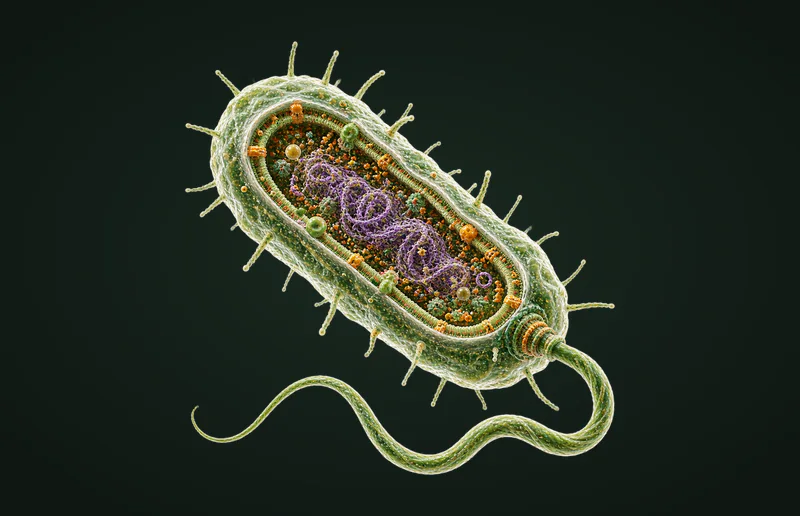
A bacterium is a prokaryote — a single cell with no nucleus and no membrane-bound organelles, running the whole of life from one open compartment. Simpler than an animal cell, and far older.
Bacteria are the most abundant organisms on Earth; your own body carries roughly as many bacterial cells as human ones. They are also small — about 1–5 μm, a tenth the diameter of a typical eukaryotic cell, which gives them a large surface-area-to-volume ratio and very fast exchange with their environment.
Structure
The defining feature of a bacterium is what it lacks: no nucleus. Its single circular chromosome sits loose in the cytoplasm in a region called the nucleoid — coiled and supercoiled, but not wrapped in any membrane. In the 3D model above, that dense central tangle is the nucleoid.
The rest of the parts are stripped down:
- A cell wall of peptidoglycan — a mesh of sugar chains cross-linked by short peptides — surrounds the cell membrane, giving shape and resisting osmotic rupture. This wall is the target of penicillin, which blocks the enzyme that cross-links it.
- Ribosomes are smaller (70S, versus the 80S of eukaryotes) and float free, translating mRNA into protein.
- A flagellum may stick out, a stiff helical filament spun by a rotary motor in the membrane like a ship's propeller.
The wall also splits bacteria into two stainable groups: Gram-positive cells have a thick peptidoglycan layer that traps crystal-violet dye (staining purple), while Gram-negative cells have a thin layer plus an outer lipopolysaccharide membrane (staining pink). That single test guides antibiotic choice in the clinic.
Many bacteria carry small extra DNA rings called plasmids and a sticky outer capsule that helps them evade immune cells and stick to surfaces. What is absent matters just as much: no mitochondria, no ER, no Golgi — none of the membrane-bound organelles of eukaryotes.
Function
A bacterium does everything one open compartment can. Its cell membrane — not a separate organelle — runs the electron transport chain and makes ATP, the job mitochondria do in eukaryotes. Its free ribosomes translate mRNA the moment it is transcribed, because with no nuclear envelope there is no barrier between transcription and translation; the two happen at once, sometimes on the same mRNA strand.
That simplicity makes bacteria fast. Under good conditions some divide every 20 minutes by binary fission — replicating the single chromosome from one origin, segregating the copies, and pinching the cell in two — which is why a tiny contamination becomes a visible colony overnight.
Bacteria also swap genes horizontally. They pass plasmids through a pilus (conjugation), pick up free DNA from the environment (transformation), or receive it from a virus (transduction). Conjugation in particular spreads antibiotic-resistance genes between cells, even across species, and is a major reason resistance moves through populations so quickly.
In the exam
- AP Bio (Unit 1 & 2): The prokaryote-vs-eukaryote contrast is foundational — no nucleus, no membrane-bound organelles, smaller 70S ribosomes, a single circular chromosome in a nucleoid. Know binary fission as asexual reproduction and contrast it with mitosis (no spindle, no condensed chromosomes the way eukaryotes have them).
- IB HL (Topic A2): Be ready to label a prokaryotic cell — nucleoid, plasmid, capsule, flagellum, pili, peptidoglycan wall, 70S ribosomes — and to contrast each part with its eukaryotic counterpart.
- MCAT (Foundational Concept 1): The 70S ribosome and the peptidoglycan wall are drug-target favorites; antibiotics exploit both because human cells share neither. Know which classes hit the wall (β-lactams), the 30S ribosomal subunit (aminoglycosides, tetracyclines), or the 50S subunit (macrolides).
- USMLE Step 1: Gram stain results, plus the link from horizontal gene transfer to multidrug resistance, appear constantly. A pedigree-free "trait spreads between unrelated bacteria" stem points to plasmid conjugation.
Related cells
- Animal cell — the eukaryote contrast.
- Ribosome — bacteria use the smaller 70S version antibiotics target.
- Nucleus — the structure bacteria conspicuously lack.
- Plant cell — also walled, but with cellulose, not peptidoglycan.
- Mitochondrion — descended from a free-living bacterium, which is why it keeps 70S-like ribosomes and a circular genome.
Common misconceptions
- "Bacteria have no DNA because they have no nucleus." They have DNA — a single circular chromosome — just not enclosed in a nuclear envelope. They often carry extra DNA on plasmids too.
- "All bacteria are harmful." Most are harmless or helpful; your gut bacteria aid digestion, synthesize vitamin K and some B vitamins, and crowd out pathogens.
- "Bacteria and viruses are the same." Bacteria are living cells that metabolize and reproduce on their own; viruses are non-cellular particles that must hijack a host cell to replicate. Antibiotics work on bacteria, not viruses.
- "Prokaryotes are 'primitive' and therefore simple." They are structurally simple but metabolically dazzling — bacteria fix nitrogen, breathe sulfur or iron, and photosynthesize in ways no eukaryote can. Old is not the same as basic.
References
- Reece et al., Campbell Biology, 11th ed., Ch. 27 (Bacteria and Archaea).
- Alberts B. et al., Molecular Biology of the Cell, 7th ed., Ch. 1 (Cells and Genomes).
- Madigan M. et al., Brock Biology of Microorganisms, 15th ed. — cell envelope and horizontal gene transfer.