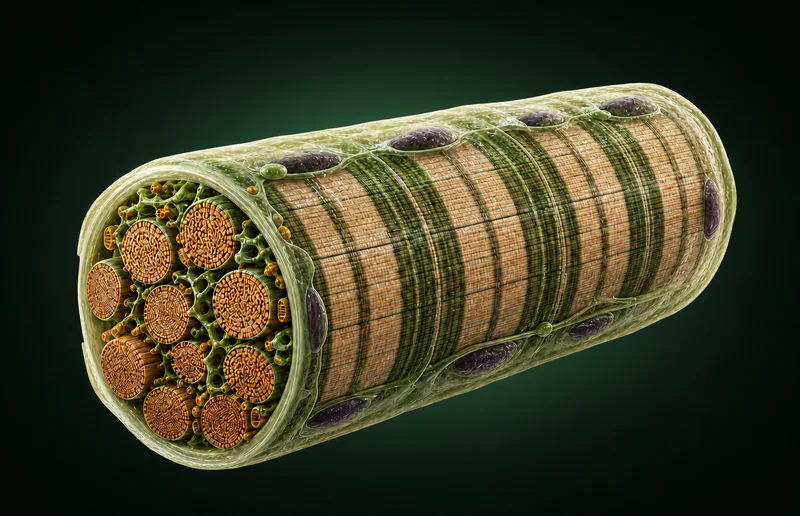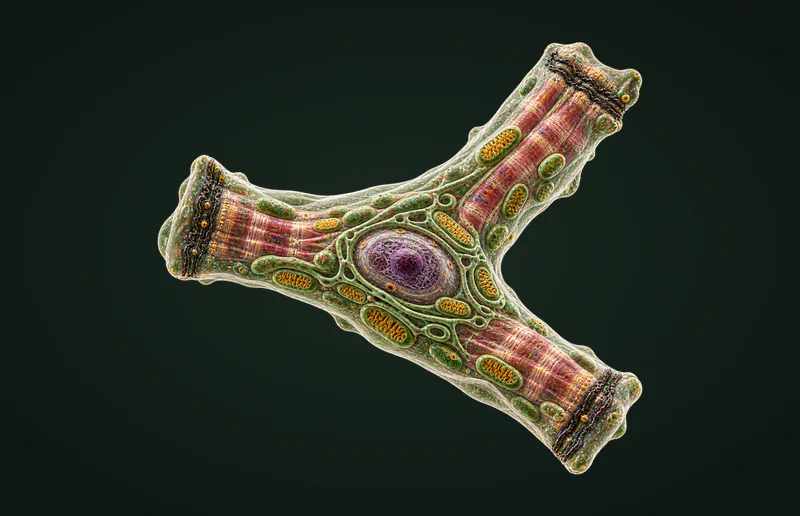
A cardiac muscle cell is the tireless engine of the heart — striated like skeletal muscle for power, but wired together so a whole heart chamber contracts as one, about three billion times in a lifetime without rest.
These cells (cardiomyocytes) build the heart's walls. Unlike the muscles you flex on command, they beat involuntarily and never get a real day off.
Structure
A cardiac muscle cell is branched, with usually one central nucleus — fewer and more central than the many peripheral nuclei of a skeletal muscle fiber. Like skeletal muscle, it is striated, packed with sarcomeres of actin and myosin that give it the same striped, contractile machinery and the same Z lines and A/I bands.
Its defining feature is at the ends, where one cell meets the next: the intercalated disc. In the 3D model above, these are the dark, stair-stepped junctions joining the branched cells. They are not just glue — they hold three kinds of junction. Desmosomes anchor the cells together mechanically so they do not tear apart under the strain of beating; adherens junctions anchor the sarcomeres' actin to the cell ends so the pull transmits across cells; and gap junctions form open channels that let ions — and therefore electrical signals — pass directly from one cell to the next.
Cardiac cells are also exceptionally rich in mitochondria — up to a third of the cell's volume — because the heart can never afford to run out of ATP. They have T-tubules and a sarcoplasmic reticulum like skeletal muscle, but the SR is less extensive, which becomes important below.
Function
Cardiac muscle contracts by the same sliding filament mechanism as skeletal muscle, but several features make it heart-specific.
First, the gap junctions in the intercalated discs let the depolarizing signal flow instantly from cell to cell, so the heart muscle behaves as a single coordinated unit — a functional syncytium. One chamber depolarizes and contracts together, squeezing blood efficiently, rather than as a bag of independent cells.
Second, cardiac muscle is autorhythmic: specialized pacemaker cells (in the sinoatrial node) leak ions steadily until they reach threshold on their own, generating impulses without any signal from the brain. Autonomic nerves and hormones only modulate the rate — sympathetic speeds it up, parasympathetic (vagus) slows it down.
Third, its contraction uses calcium-induced calcium release: the action potential opens calcium channels in the membrane, and that trickle of extracellular calcium triggers the SR to release its own larger store. This is why cardiac muscle depends partly on blood calcium, unlike skeletal muscle. The plateau in the cardiac action potential — a slow calcium current holding the membrane depolarized — stretches the contraction out.
That plateau also gives cardiac muscle a long refractory period, a forced pause after each contraction that prevents the sustained, fused contraction (tetanus) that skeletal muscle can do. The heart must relax between beats to refill with blood, and this built-in pause guarantees it.
The heavy mitochondria load makes cardiac muscle almost entirely dependent on aerobic respiration, with very little ability to run anaerobically. That is why cutting off its oxygen supply — a heart attack — kills these cells so fast, and why they barely regenerate afterward.
In the exam
- MCAT / USMLE: Compare the three muscle types cold. Cardiac = striated, involuntary, branched, single central nucleus, intercalated discs with gap junctions, autorhythmic, long refractory period. The gap-junction coordination and pacemaker autorhythmicity are the highest-yield points.
- USMLE Step 1 physiology: Expect the cardiac action potential with its plateau — phase 0 (Na⁺ in), phase 2 plateau (Ca²⁺ in balancing K⁺ out), phase 3 (K⁺ out) — and calcium-induced calcium release. A favorite question links the long refractory period to why the heart cannot be tetanized.
- AP Bio / IB HL: Lower-stakes, but be ready to explain the functional syncytium (gap junctions → coordinated beat) and why the heart is myogenic (the beat originates in the muscle, not the nerve).
Related cells
- Skeletal muscle fiber — the striated, voluntary comparison.
- Mitochondrion — fills up to a third of the cardiomyocyte to fuel nonstop beating.
- Cell membrane — its gap junctions couple the cells electrically.
- Neuron — autonomic neurons modulate, but do not start, the heartbeat.
- Endoplasmic reticulum — the sarcoplasmic reticulum that releases the bulk of the trigger calcium.
Common misconceptions
- "The brain makes the heart beat." The heart is autorhythmic — its own pacemaker cells set the beat; nerves only adjust the rate. A heart removed from the body keeps beating.
- "Cardiac and skeletal muscle are basically the same." Cardiac is branched, single-nucleated, electrically coupled by intercalated discs, calcium-dependent on the extracellular fluid, and involuntary.
- "Heart muscle can be retrained to tetanize for a stronger beat." Its long refractory period prevents sustained contraction by design, so the heart always has time to refill.
- "All the contraction calcium comes from inside the cell." In cardiac muscle a trigger amount enters from outside and causes the SR to release the rest — calcium-induced calcium release — so heart contraction is sensitive to blood calcium in a way skeletal muscle is not.
References
- Guyton, A.C. & Hall, J.E. Textbook of Medical Physiology, 13th ed. — Ch. 9 (Cardiac Muscle; the Heart as a Pump) & Ch. 10 (Rhythmical Excitation of the Heart).
- Marieb, E.N. & Hoehn, K. Human Anatomy & Physiology, 11th ed. — Ch. 18 (The Cardiovascular System: The Heart).
- Lodish, H. et al. Molecular Cell Biology, 8th ed. — Ch. 17 (Cell Organization and Movement: muscle and intercalated-disc junctions).