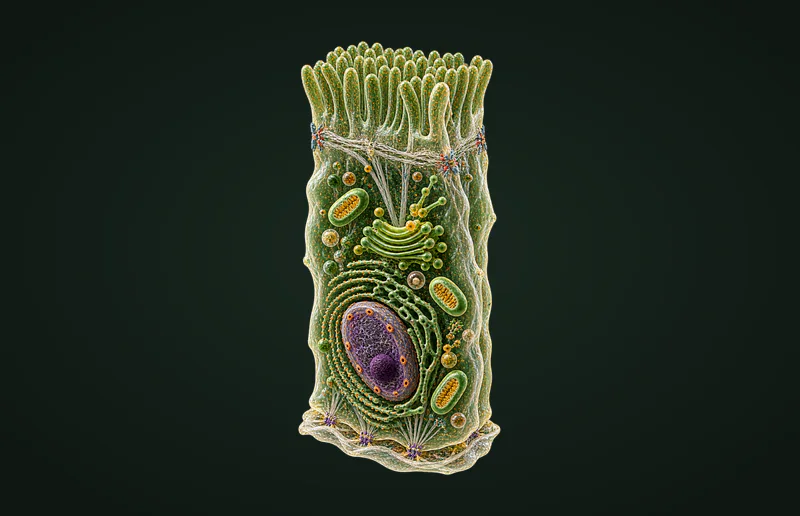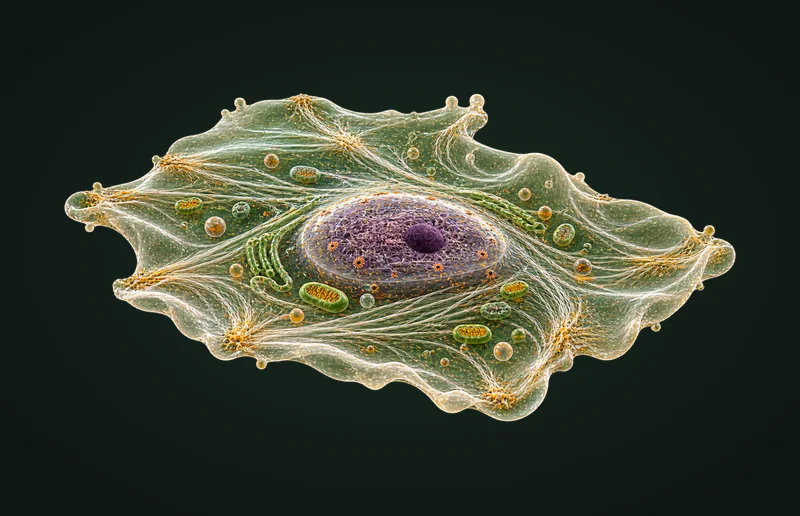
A squamous epithelial cell is a thin, flat tile — so thin that gases and small molecules slip straight across it, which is exactly why it lines the surfaces where fast diffusion matters.
"Squamous" comes from the Latin squama, meaning scale. These cells fit together like floor tiles or fish scales to form smooth, continuous sheets across the body's surfaces and cavities. They are the simplest epithelial shape, and that simplicity is the whole point.
Structure
A squamous epithelial cell is flat and wide, with a flattened, disc-shaped nucleus bulging slightly in the center — the only thick part of an otherwise sheet-like cell. A simple squamous cell can be under 0.2 μm thick at its thinnest edge, thinner than the wavelength of visible light. In the 3D model above, that broad, thin profile with a central nucleus is the defining shape.
The cells pack edge to edge with almost no gap between them. They are held together laterally by tight junctions that seal the spaces between cells, adherens junctions and desmosomes that bind neighbors mechanically, and they grip the surface below through hemidesmosomes anchored into a thin basement membrane. That basement membrane — a layer of collagen IV and laminin secreted partly by the epithelium itself — gives the fragile sheet something to hold onto.
Like all epithelia, squamous cells are polarized: the apical surface facing the lumen or outside world differs from the basal surface facing the body. Arranged in a single layer, they form simple squamous epithelium; stacked in many layers, they form stratified squamous epithelium (as in skin), which trades diffusion for protection.
Epithelia are also avascular — no blood vessels run through them. A squamous cell gets its oxygen and nutrients by diffusion from capillaries in the connective tissue beneath the basement membrane, which is one more reason being thin pays off.
Function
The squamous cell's flatness is its function: diffusion and filtration. Fick's law says the rate of diffusion across a barrier is inversely proportional to its thickness, so a cell that is barely there moves molecules fastest. This is structure dictating physics.
This is why simple squamous epithelium lines:
- the alveoli of the lungs, where oxygen and carbon dioxide cross between air and blood across a barrier only a couple of cells thick;
- the capillaries (as endothelium), where nutrients and gases pass between blood and tissue, and where the cells also release signals like nitric oxide to dilate the vessel;
- the glomerulus of the kidney, where blood is filtered under pressure to begin making urine;
- the lining of the heart, blood vessels, and body cavities (the serosa and mesothelium), providing a smooth, low-friction surface so organs slide past one another.
Where the body needs protection rather than exchange — the skin's surface, the lining of the mouth, esophagus, and vagina — squamous cells stack into many layers. In the epidermis the outermost layers fill with keratin, die, and flatten into a tough, waterproof barrier that is shed and replaced continuously. So the same cell shape serves two jobs depending on its arrangement: a single layer for rapid exchange, many layers for defense.
In the exam
- AP Bio / IB HL: This is the textbook model of structure fitting function — flat, thin cells minimize diffusion distance, which is why they line alveoli and capillaries for gas exchange. Be ready to justify the shape from the job, and to invoke surface-area-to-volume and the short diffusion path together.
- Distinguish simple squamous (one layer, diffusion) from stratified squamous (many layers, protection), and contrast with tall columnar epithelium built for absorption. A common multiple-choice trap pairs a tissue with the wrong job.
- A-Level (AQA / OCR): Gas exchange questions ask you to name the two thin barriers oxygen crosses in the alveolus — the squamous alveolar epithelium and the squamous capillary endothelium — then explain the short diffusion pathway. Naming both layers is where marks are won.
- USMLE Step 1: Metaplasia shows up here — chronic acid reflux can convert esophageal squamous epithelium into intestinal columnar epithelium (Barrett's esophagus), and smoking can convert respiratory columnar epithelium into stratified squamous. Both are adaptive but pre-cancerous, and squamous cell carcinoma is a classic skin and lung tumor.
Related cells
- Columnar epithelial cell — the tall absorptive epithelium, the standard contrast.
- Red blood cell — passes oxygen across squamous alveolar and capillary linings.
- Cell membrane — the surface across which diffusion happens.
- Macrophage — patrols the alveolar surface that squamous cells line, clearing inhaled debris.
- Nucleus — flattened to match the thin cell.
Common misconceptions
- "Thin means fragile and useless." Thinness is the feature — it makes the cell an excellent diffusion barrier. Protection comes from stacking many layers, not from thickening a single cell.
- "All epithelium looks the same." Epithelial cells range from flat squamous (diffusion) to tall columnar (absorption) to cube-shaped cuboidal (secretion). Shape signals function.
- "Squamous epithelium is only in skin." Single-layer squamous lines the lungs, blood vessels, kidney filters, and body cavities, where its job is exchange, not protection. The skin version is the stratified, protective exception.
- "Endothelium is something other than epithelium." Endothelium is simple squamous epithelium — it just gets a special name when it lines the inside of blood vessels and the heart.
References
- Marieb & Hoehn, Human Anatomy & Physiology, 11th ed., Ch. 4 (Tissues: Epithelial Tissue).
- Alberts B. et al., Molecular Biology of the Cell, 6th ed., Ch. 19 (Cell Junctions and the Extracellular Matrix).
- Guyton & Hall, Textbook of Medical Physiology, 13th ed., Ch. 39 (Physical Principles of Gas Exchange).