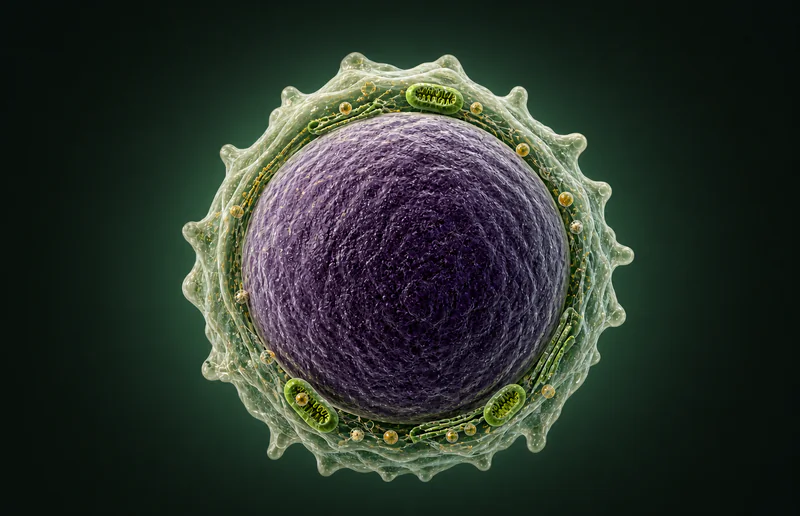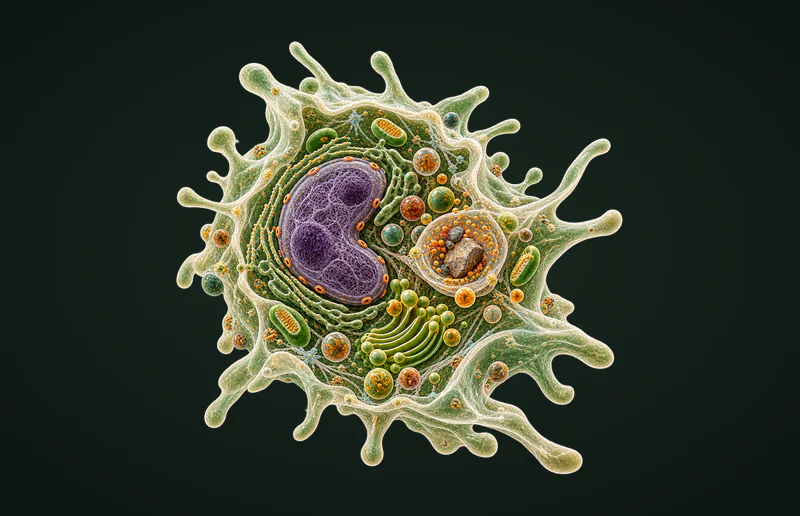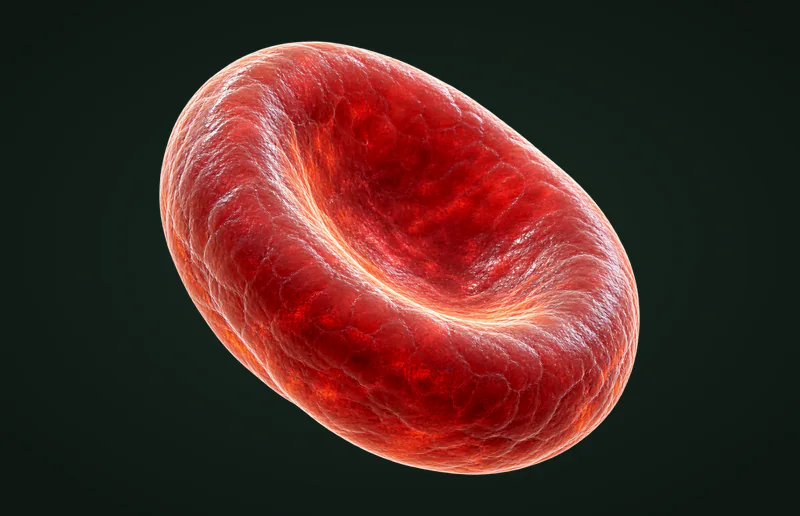
A red blood cell is a specialist stripped down to one job — carrying oxygen. To make room for it, the cell throws out almost everything else, including its own nucleus.
Red blood cells (erythrocytes) are the most common cell in your body — about 25 trillion of them, roughly a quarter of all your cells. Each one lives about 120 days on a nonstop loop through your blood vessels, traveling hundreds of kilometers before it wears out.
Structure
A red blood cell is a biconcave disc — round and dimpled on both faces, like a doughnut without the hole punched through. It measures about 7–8 μm across. In the 3D model above, that pinched, dual-concave shape is the defining feature.
It is famously empty inside. A mature mammalian red blood cell has no nucleus and almost no organelles — no mitochondria, no ER, no ribosomes. Nearly the entire interior is packed with one protein: hemoglobin, about 270 million copies per cell, making up roughly a third of the cell's weight. Hemoglobin is what binds oxygen, and what makes blood red.
What holds the shape together is a protein skeleton just under the cell membrane. A mesh of spectrin and actin is tethered to membrane proteins (band 3 and ankyrin), giving the cell the rare combination of being both flexible and elastic — it can fold to pass through a capillary half its own width and then snap back to a disc on the other side.
The shape and the emptiness both serve oxygen transport. The biconcave disc gives about 40% more surface area than a sphere of the same volume, speeds gas diffusion because no point inside is far from the membrane, and lets the cell deform without bursting.
Function
The red blood cell's whole purpose is gas transport. Each hemoglobin holds four heme groups, and each heme has one iron atom that reversibly binds one O₂. In the lungs, where oxygen is plentiful, all four sites fill; in the tissues, where oxygen is scarce, hemoglobin releases it.
The binding is cooperative: the first O₂ makes the next one bind more easily, which is why the oxygen-saturation curve is an S-shape (sigmoidal) rather than a straight line. That curve is the whole trick — it lets hemoglobin load almost fully in the lungs yet unload sharply in working tissue.
On the return trip the cell helps carry carbon dioxide. Most CO₂ is converted to bicarbonate inside the red cell by the enzyme carbonic anhydrase, then carried in the plasma — so the red cell manages CO₂ even though it mostly does not transport it directly.
Dropping the nucleus and mitochondria is a clever trade. With no nucleus there is more room for hemoglobin; with no mitochondria the cell does not burn the very oxygen it is supposed to deliver. It makes its ATP by anaerobic glycolysis instead, which is also why it needs none of the oxygen it carries for its own housekeeping.
The cost of the trade is that a red blood cell cannot repair itself or divide. Once its proteins wear out and its membrane stiffens, the spleen filters it out, and the bone marrow makes replacements from blood stem cells — about 2 million new red cells every second, tuned by the kidney hormone erythropoietin.
In the exam
- AP Bio / IB HL: The red blood cell is the textbook example of form fitting function — biconcave shape (surface area, short diffusion distance, flexibility), no nucleus (more hemoglobin), no mitochondria (does not consume its cargo). Expect to justify each feature in a short-answer, and watch for osmosis questions where a red cell swells in hypotonic solution (and can lyse — hemolysis) or shrivels in hypertonic solution (crenation).
- MCAT / USMLE Step 1: The sigmoidal O₂-dissociation curve is essential. Know that a right shift (lower affinity, more O₂ released to tissue) is caused by higher CO₂, lower pH, higher temperature, and more 2,3-BPG — collectively the Bohr effect — and that carbon monoxide and fetal hemoglobin shift it left.
- USMLE: Sickle-cell disease links a single amino-acid change (glutamate to valine in β-globin) to a distorted, rigid cell that jams capillaries — a high-yield connection between molecular structure and the biconcave shape you started with.
Related cells
- Stem cell — bone-marrow stem cells produce new red blood cells.
- Nucleus — notable for being absent in the mature mammalian red cell.
- Mitochondrion — also absent, so the cell relies on anaerobic glycolysis.
- Cell membrane — its spectrin-supported flexibility lets the cell fold through capillaries.
- Platelet — the other anucleate formed element of blood.
Common misconceptions
- "Red blood cells have no DNA, so they were never alive." They start with a nucleus during development in the marrow and eject it as they mature — the mature cell is a living cell that has simply run out of replacement parts.
- "Hemoglobin is iron." Hemoglobin is a protein that holds iron at the center of each heme group; the iron is the binding site, not the whole molecule.
- "All red blood cells lack a nucleus." Only mammalian ones do. Birds, reptiles, amphibians, and fish keep nucleated red cells throughout life.
- "More hemoglobin always means more oxygen delivered." Delivery depends on unloading too. In carbon-monoxide poisoning hemoglobin is full but won't release O₂, so saturation can read high while tissues suffocate.
References
- Guyton & Hall, Textbook of Medical Physiology, 13th ed., Ch. 32 (Red Blood Cells, Anemia, and Polycythemia).
- Reece et al., Campbell Biology, 11th ed., Ch. 42 (Circulation and Gas Exchange).
- Lodish H. et al., Molecular Cell Biology, 8th ed. — membrane cytoskeleton of the erythrocyte (spectrin-actin network).