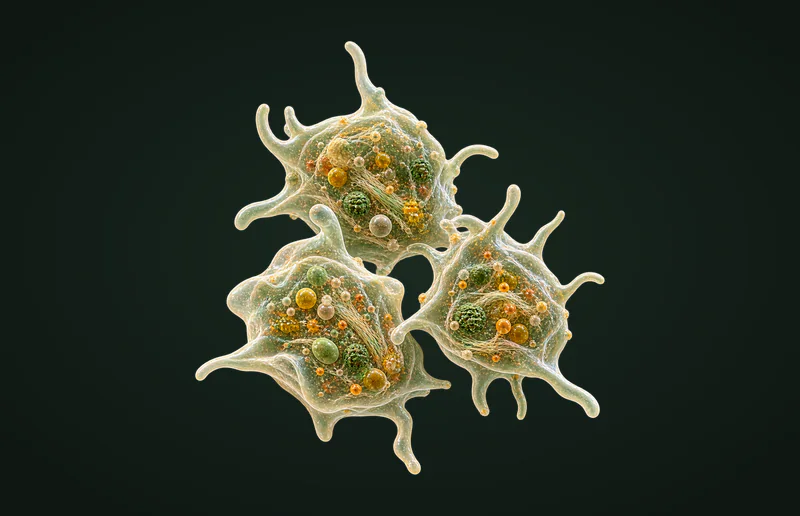
A platelet is not a whole cell but a fragment of one — a tiny, nucleus-free package that rushes to a cut and plugs the leak before you lose much blood.
Platelets (thrombocytes) are the smallest formed elements in blood, about 2–3 μm across. A microliter of blood holds 150,000 to 400,000 of them, drifting near the vessel wall and patrolling for damage. They live only 8–10 days before the spleen and liver clear them.
Structure
A platelet is a cell fragment, not a complete cell. It has no nucleus and cannot divide or make much new protein. It is pinched off from a giant bone-marrow cell called a megakaryocyte, which extends long arms into the marrow's blood vessels and sheds thousands of platelets from its cytoplasm — one megakaryocyte yields several thousand platelets before it is used up.
In the 3D model above, the platelet appears as a small, smooth disc. That resting shape is deceptive. Its cytoplasm is loaded with two kinds of granules: dense granules holding ADP, calcium, and serotonin, and alpha granules holding clotting proteins like fibrinogen and von Willebrand factor. A ring of microtubules holds the disc shape, and an internal stash of membrane lets the cell expand its surface fast.
Its membrane is studded with receptors that sense injury — most importantly GPIb (which grips von Willebrand factor on exposed collagen) and GPIIb/IIIa (which links platelets to one another). When activated, the platelet transforms: it changes shape dramatically, sprouting spiky projections (pseudopods) to grip a wound and pile onto its neighbors. It looks like a different object at rest and at work.
Function
The platelet's one job is hemostasis — stopping bleeding. The process runs in ordered stages:
- Adhesion. When a vessel is cut, the damaged wall exposes collagen. Von Willebrand factor bridges the collagen to the platelet's GPIb receptor, and platelets stick almost instantly.
- Activation. Contact triggers the platelet to change shape and dump its granules. The released ADP and thromboxane A₂ act as recruiting signals, calling in more platelets and amplifying the response.
- Aggregation. Recruited platelets switch on their GPIIb/IIIa receptors, which grab fibrinogen and use it to bridge platelet to platelet. They clump into a soft platelet plug that seals the gap.
This plug is fast but flimsy. To make it durable, the platelet surface also helps trigger the coagulation cascade — a chain of clotting-factor proteins that ends with thrombin converting soluble fibrinogen into fibrin, tough insoluble threads. The fibrin weaves through the platelet plug and locks it into a stable clot, which platelets then contract to pull the wound edges together.
The balance is delicate. Too few platelets (thrombocytopenia) and you bruise and bleed easily; too many or over-active, and a clot can form where it should not — the trigger for many heart attacks and strokes, where a clot on a ruptured artery plaque blocks blood flow downstream.
In the exam
- MCAT / USMLE Step 1: Know the hemostasis sequence cold — vessel injury → platelet adhesion (to collagen, via von Willebrand factor and GPIb) → activation (granule release, shape change) → aggregation (GPIIb/IIIa binding fibrinogen, the platelet plug) → coagulation cascade → fibrin clot. Be ready to state that platelets are anucleate fragments of megakaryocytes.
- USMLE: Drug mechanisms are favorite linked questions. Aspirin irreversibly blocks the enzyme COX, cutting thromboxane A₂ and so reducing aggregation — which is why low-dose aspirin prevents clots. Clopidogrel blocks the ADP receptor; abciximab blocks GPIIb/IIIa. Each maps onto a specific step above.
- AP Bio / IB HL: Less detail, but distinguish the primary hemostasis (platelet plug) from secondary hemostasis (fibrin clot from the cascade), and connect platelets to their megakaryocyte origin and bone-marrow stem cells. A common point is that platelets, like red blood cells, are anucleate — but for a different reason and from a different parent cell.
Related cells
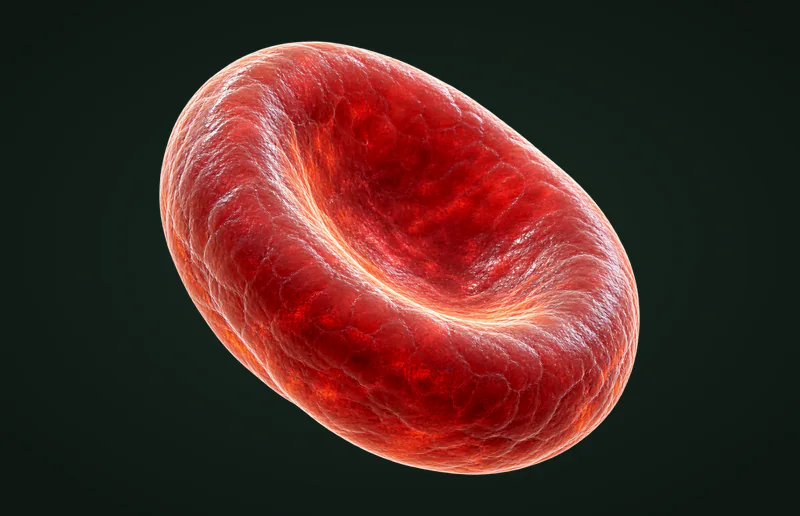
- Red blood cell — the other anucleate formed element of blood; both get trapped in the fibrin mesh of a clot.
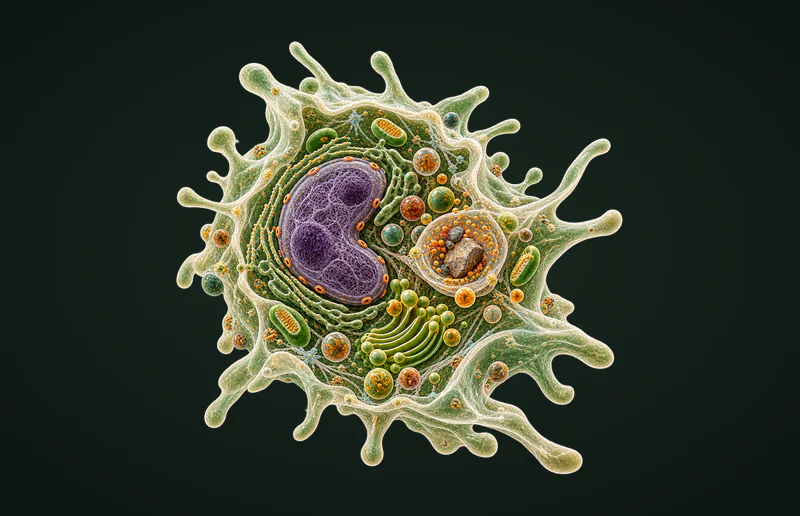
- Stem cell — platelets come from megakaryocytes, descended from bone-marrow hematopoietic stem cells.
- Cell membrane — its receptors detect vessel injury and trigger activation.
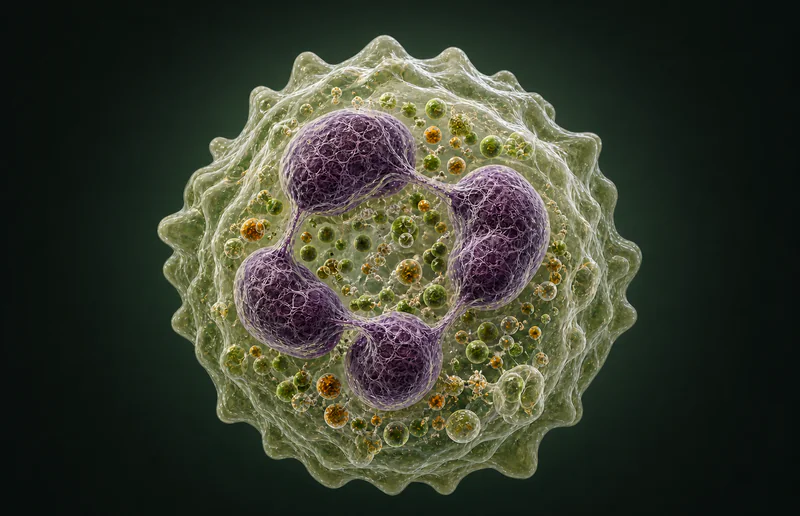
- Neutrophil — another rapid responder recruited to sites of damage.
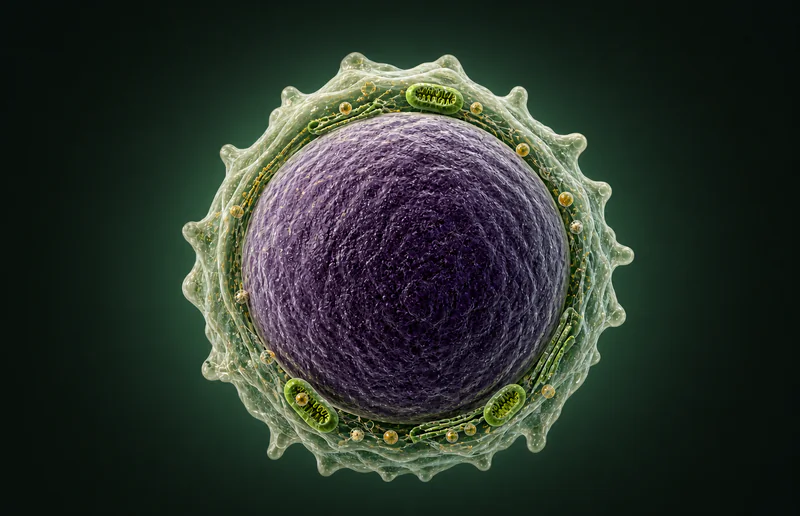
- Nucleus — notably absent, which is why a platelet cannot divide.
Common misconceptions
- "A platelet is a small cell." It is a fragment of a cell (a megakaryocyte), with no nucleus and no ability to divide. Calling it a cell is a common but losable error.
- "Platelets form the whole clot." They form the initial plug (primary hemostasis). The durable clot needs the fibrin mesh from the coagulation cascade (secondary hemostasis) woven through it.
- "Platelets only matter when you're injured." They circulate constantly, and over-active platelets cause dangerous clots in intact vessels — the basis of most heart attacks and strokes.
- "Aspirin thins the blood." It does not change blood viscosity. It blocks thromboxane production so platelets aggregate less — a precise effect on one step of platelet activation, not a literal thinning.
References
- Guyton & Hall, Textbook of Medical Physiology, 13th ed., Ch. 37 (Hemostasis and Blood Coagulation).
- Marieb E.N. & Hoehn K., Human Anatomy & Physiology, 11th ed., Ch. 17 (Blood).
- Lodish H. et al., Molecular Cell Biology, 8th ed. — platelet activation and signaling.