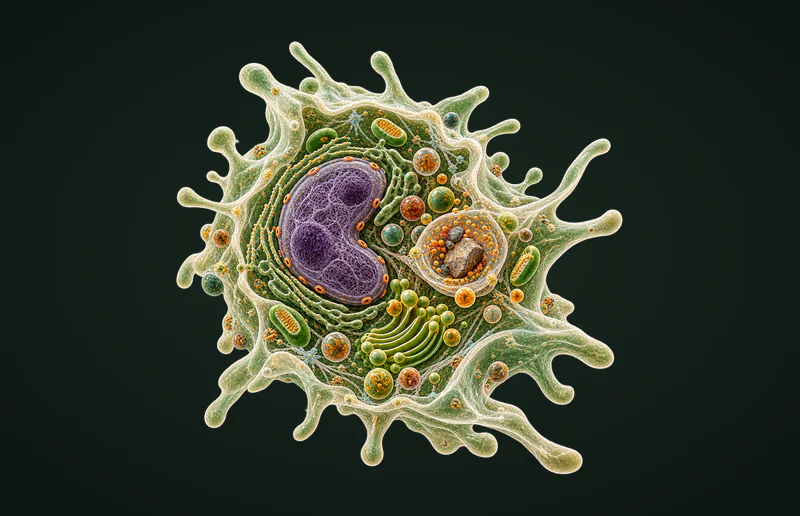
A macrophage is the immune system's heavy cleanup crew — a large, long-lived cell that crawls through tissue engulfing pathogens, dead cells, and debris, and then tells the rest of the immune system what it found.
The name is Greek for "big eater," and it earns it: a single macrophage can engulf and digest more than a hundred bacteria in its lifetime. They sit in nearly every tissue, often for months, and many even get tissue-specific names — Kupffer cells in the liver, alveolar macrophages in the lung, microglia in the brain, osteoclasts in bone.
Structure
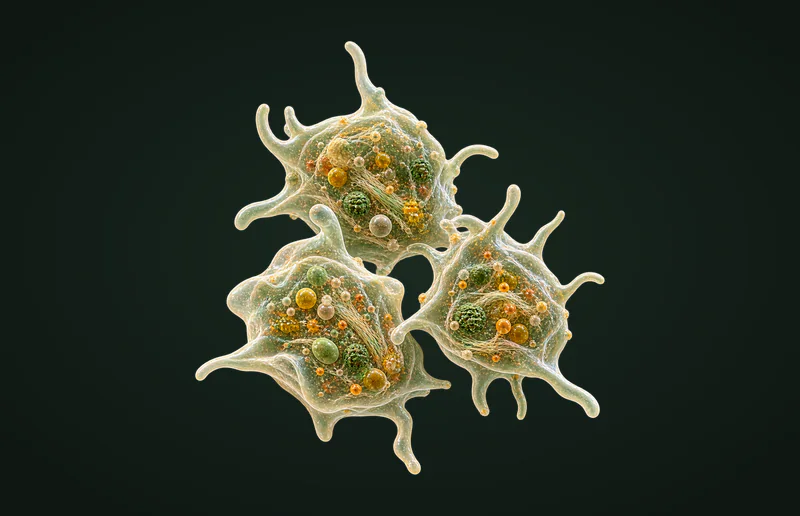
A macrophage is large (up to 20 μm across) and irregular, with no fixed shape — it remodels constantly as it crawls. Its most active features are its pseudopodia, flexible arms of cytoplasm it extends to reach out and wrap around a target. In the 3D model above, those reaching projections are the pseudopods, driven by the cytoskeleton pushing actin against the membrane.
Inside, it carries a kidney-shaped nucleus and an unusually large supply of lysosomes — the enzyme-filled sacs it uses to digest what it swallows. That heavy lysosome load, plus abundant mitochondria for the energy crawling and engulfing demand, is what lets it process so much material.
Macrophages develop from blood cells called monocytes, which leave the bloodstream by squeezing between the cells of a capillary wall (diapedesis), enter the tissue, and mature into the larger, settled macrophage. Some tissue macrophages are not replaced from blood at all — they seed during fetal development and renew on their own for life.
Function
The macrophage has two linked roles, and the link is the whole point.
First, it is a phagocyte. Receptors on its surface recognize either pathogen surfaces directly (pattern-recognition receptors such as Toll-like receptors) or antibody and complement "tags" coating a target, a recognition step called opsonization. The pseudopodia then surround the target, pull it inside into a vesicle called a phagosome, and that phagosome fuses with lysosomes to form a phagolysosome. Inside, acid, digestive enzymes, and a burst of reactive oxygen kill and recycle the catch. The macrophage clears not only invaders but the body's own worn-out cells and the spent neutrophils left after an infection.
Second — and this is what makes it more than a janitor — it is an antigen-presenting cell (APC). After digesting a pathogen, the macrophage loads fragments of it onto MHC class II molecules and displays them on its surface to helper T cells (lymphocytes). This hands the specific, adaptive immune system the information it needs to mount a targeted response. The macrophage is therefore the bridge between innate immunity (fast, general) and adaptive immunity (slow, specific).
Macrophages also release signaling molecules called cytokines — TNF-α, IL-1, IL-6 — that summon other immune cells, raise body temperature (fever), and drive inflammation. Their behavior is tunable: an "M1" activated macrophage is aggressive and pro-inflammatory, while an "M2" macrophage dials inflammation down and helps repair and rebuild tissue once the threat is cleared.
In the exam
- MCAT / USMLE: Macrophages are the textbook link between innate and adaptive immunity — they phagocytose (innate) and present antigen on MHC II to helper T cells (adaptive). Expect to identify them as one of the three professional APCs (with dendritic cells and B cells), and to recall that they arise from circulating monocytes.
- USMLE Step 1 pathology: Macrophages dominate chronic inflammation and form granulomas (e.g., in tuberculosis), where they fuse into giant cells and wall off what they cannot destroy. Lipid-laden "foam cells" in atherosclerotic plaques are also macrophages — a favorite cardiovascular link.
- AP Bio / IB HL: Lower-stakes here, but be ready to place the macrophage in the non-specific (innate) defenses and to distinguish it from the neutrophil: macrophage = large, long-lived, antigen-presenting; neutrophil = smaller, short-lived, first to arrive.
Related cells
- Neutrophil — the fast first responder a macrophage later cleans up after.
- Lymphocyte — the T cell that receives the antigen a macrophage presents.
- Lysosome — the organelle a macrophage relies on to digest its catch.
- Cytoskeleton — drives the pseudopodia it uses to crawl and engulf.
- Mitochondrion — fuels the constant motion and the oxidative burst.
Common misconceptions
- "Macrophages only eat pathogens." They also clear dead cells, debris, and spent neutrophils, and they actively rebuild tissue afterward — much of their work is housekeeping and repair, not killing.
- "Phagocytosis is the macrophage's only job." Its antigen presentation on MHC II is just as important; without it, the adaptive response against an engulfed pathogen would never get started.
- "Macrophages and neutrophils are the same." Macrophages are larger, longer-lived, present antigen, and can divide in tissue; neutrophils are short-lived single-use responders that die at the scene (forming pus).
- "All macrophages come from blood monocytes." Many tissue-resident macrophages — microglia, for instance — are seeded before birth and self-renew locally, independent of the bloodstream.
References
- Abbas, A.K., Lichtman, A.H. & Pillai, S. Cellular and Molecular Immunology, 9th ed. — Ch. 4 (Innate Immunity) & Ch. 6 (Antigen Presentation to T Lymphocytes).
- Alberts, B. et al. Molecular Biology of the Cell, 7th ed. — Ch. 24 (The Innate and Adaptive Immune Systems).
- Murphy, K. & Weaver, C. Janeway's Immunobiology, 9th ed. — Ch. 1 & 3 (macrophage origins and tissue-resident populations).