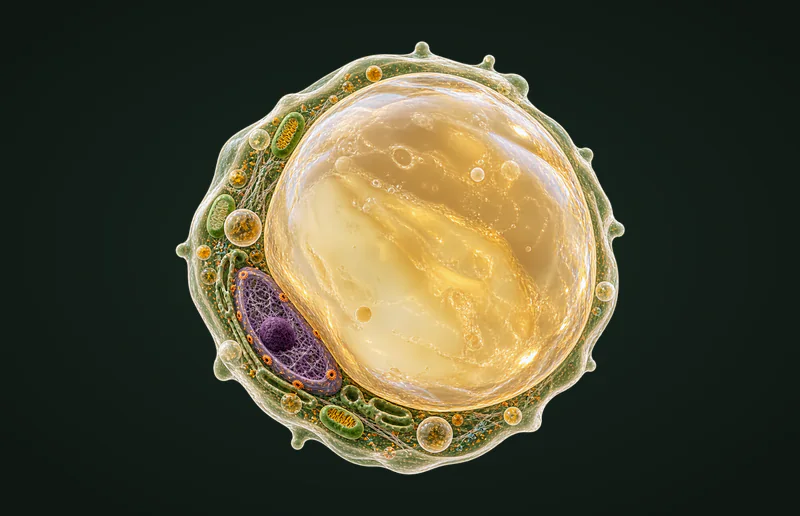
An adipocyte is a fat cell — a living storage tank so full of oil that a single droplet pushes everything else, including the nucleus, into a thin rim against the wall.
Adipocytes are the body's energy savings account. Fat stores about 9 kcal per gram, more than twice the ~4 kcal of carbohydrate or protein, and it stores that energy almost water-free, so the body banks its long-term reserves here rather than as bulky, hydrated glycogen.
Structure
A mature white adipocyte is dominated by one enormous lipid droplet of stored triglyceride, taking up roughly 90% of the cell's volume. The cell can swell to over 100 μm across — among the largest cells in the body — and shrink again as it empties. Everything else is squeezed to the edge: the nucleus is flattened against the cell membrane, and the thin sliver of remaining cytoplasm wraps around the droplet like the skin of a balloon. In the 3D model above, the single huge droplet with a nucleus shoved to one side is the signature look — pathologists call it a "signet ring."
The droplet is not just an oily blob. It is bounded by a monolayer of phospholipid studded with regulatory proteins called perilipins, which act as a locked lid: they keep lipid-digesting enzymes off the surface until hormonal signals tell them to step aside. Each adipocyte sits in a fine basement membrane and is wrapped by capillaries, because storing and releasing fuel only works if blood can reach the cell.
This is white adipose tissue, the main fat-storage type. A second type, brown adipose tissue, holds many small droplets (it is multilocular) and is packed with mitochondria — whose iron-rich cytochromes give it its color — for generating heat rather than storing fuel. A third, beige fat, can switch on brown-like behavior inside white depots when the body is cold.
Function
The white adipocyte's job is energy storage and release, and it is a two-way valve. After a meal, insulin activates lipoprotein lipase on the capillary wall, which frees fatty acids from circulating lipoproteins so the adipocyte can take them up and re-esterify them into triglyceride, swelling the droplet. When energy runs short — between meals, during exercise — hormones like adrenaline and glucagon trigger lipolysis: hormone-sensitive lipase and adipose triglyceride lipase break the triglyceride back down, and the cell releases free fatty acids and glycerol into the blood for other tissues to burn. Insulin is the "store" signal; catecholamines are the "spend" signal.
It is also far more than a passive tank. Adipose tissue insulates the body against heat loss and cushions organs against shock. And the adipocyte is a genuine endocrine organ: it secretes hormones called adipokines, most famously leptin, which reports to the hypothalamus how much fat is stored and dampens appetite — and adiponectin, which improves insulin sensitivity. This hormonal role is why body fat is tied to whole-body metabolism, fertility, and immune signaling, not just storage, and why leptin resistance is central to the biology of obesity.
The brown adipocyte does the opposite of storing. Its many mitochondria carry uncoupling protein 1 (UCP1, thermogenin), which lets protons leak back across the inner membrane without passing through ATP synthase — so the energy of the proton gradient escapes as heat instead of being captured as ATP. This non-shivering thermogenesis keeps newborns and hibernating mammals warm, and it is the same trick used by the mitochondrion's own heat machinery.
In the exam
- MCAT / USMLE: Know the white adipocyte as the triglyceride-storage cell with a single large lipid droplet and a peripheral, flattened nucleus, and its role as an endocrine cell secreting leptin and adiponectin. Triglyceride as the densest energy store (9 kcal/g) is a recurring metabolism fact.
- Distinguish white fat (energy storage, one big droplet, unilocular, few mitochondria) from brown fat (heat production, multilocular, mitochondria-rich, UCP1) — a frequent compare-and-contrast, and a favorite "which would you find more mitochondria in?" question.
- USMLE Step 1 / biochem: Trace lipolysis vs lipogenesis by hormone — insulin promotes storage (activates LPL, inhibits hormone-sensitive lipase); glucagon and adrenaline promote breakdown. The UCP1 mechanism is the classic "uncoupler" example alongside the poison 2,4-dinitrophenol.
- AP Bio / IB HL: Adipose tissue is cited as connective tissue and as a structure-fits-function case — the droplet maximizes storage volume per cell.
Related cells
- Mitochondrion — sparse in white fat, abundant in heat-generating brown fat, where UCP1 uncouples the proton gradient.
- Stem cell — adipocytes arise from mesenchymal (connective-tissue) stem cells that commit to the fat lineage.
- Nucleus — flattened against the membrane by the lipid droplet.
- Cell membrane — across which fatty acids move in and out.
- Macrophage — infiltrates expanding fat tissue and drives the low-grade inflammation linked to insulin resistance.
Common misconceptions
- "Fat cells are inert blobs." Adipocytes are metabolically active and secrete hormones like leptin and adiponectin — adipose tissue is a recognized endocrine organ.
- "You make new fat cells whenever you gain weight." In adults the existing adipocytes mostly enlarge by storing more lipid (hypertrophy); total cell number is fairly stable and is set largely in childhood and adolescence. New adipocytes form (hyperplasia) mainly when existing ones are maxed out.
- "All fat is the same." White fat stores energy, brown fat burns it for heat, and beige fat can switch between modes.
- "Leptin is a hunger hormone." Leptin signals fullness/energy stored — high leptin should reduce appetite. In obesity the brain stops responding (leptin resistance), so more fat does not curb intake.
References
- Guyton & Hall, Textbook of Medical Physiology, 13th ed., Ch. 68 (Lipid Metabolism).
- Lodish H. et al., Molecular Cell Biology, 8th ed., Ch. 16 (Cellular Energetics — uncoupling and thermogenesis).
- Rosen, E.D. & Spiegelman, B.M. "What we talk about when we talk about fat." Cell 156, 20-44 (2014).