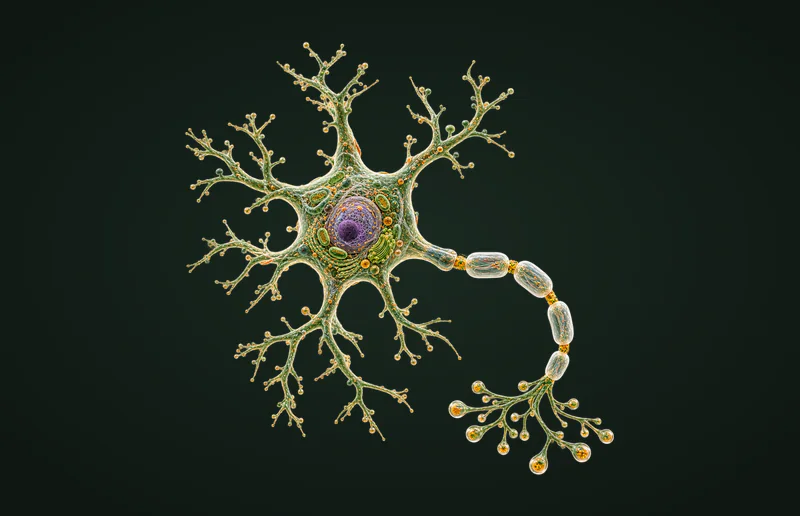
A myelinated axon is a nerve fiber wrapped in fatty insulation with regular gaps — a design that lets the electrical signal leap from gap to gap, multiplying its speed.
Myelin is why you can pull your hand off a hot stove in a fraction of a second. The fastest myelinated axons conduct at over 100 meters per second; an unmyelinated fiber of the same width crawls at one or two. Evolution's other trick for speed — a giant-diameter axon, like the squid's — works, but myelin gets the same result in a fiber a hundred times thinner.
Structure
The axon is the long output fiber of a neuron. In a myelinated axon, it is wrapped in segments of myelin sheath — many tight, concentric layers of cell membrane, roughly 80% lipid, that insulate it electrically. Each segment is a stretch of one glial cell's membrane spiraled around the axon dozens of times and squeezed nearly free of cytoplasm.
The myelin is laid down by helper (glial) cells: Schwann cells in the peripheral nervous system, each wrapping a single segment of one axon, and oligodendrocytes in the brain and spinal cord, each of which can myelinate segments on several different axons at once. Between segments are short bare gaps called Nodes of Ranvier, spaced about a millimeter apart, where the axon membrane is exposed to the extracellular fluid.
In the 3D model above, the repeating sausage-like wrappings are the myelin segments, and the pinches between them are the nodes. Look closely and the exposed membrane at each node is studded with channels — those are the voltage-gated sodium channels, clustered at densities far higher than anywhere under the myelin.
Function
Myelin speeds conduction through saltatory conduction — from the Latin saltare, "to jump." Two things make the jump possible.
First, the insulation stops current from leaking out across the wrapped stretches and lowers the membrane's capacitance, so the local current spreads passively down the inside of the axon very fast — but it fades with distance, which is why the gaps cannot be too far apart.
Second, the voltage-gated sodium channels are concentrated almost entirely at the Nodes of Ranvier. Because the action potential can only regenerate where those channels are, it cannot fire under the myelin at all. So the impulse depolarizes one node, the current rushes down the insulated internode, and the signal effectively jumps to the next node, where the channels fire it fresh. Rather than crawling continuously along every patch of membrane (as in an unmyelinated axon), the impulse hops node to node — far faster, and far cheaper, because only the tiny nodal patches need their ion gradients pumped back by the Na⁺/K⁺ pump.
This matters clinically. In multiple sclerosis (MS), the immune system attacks myelin in the central nervous system. As the insulation degrades, current leaks across the now-exposed internodes and the signal slows, scatters, or fails entirely — causing the weakness, numbness, and vision problems characteristic of the disease. In the peripheral version, Guillain-Barré syndrome, the same loss of myelin produces rapid-onset paralysis. Both are direct, if unwelcome, demonstrations of exactly what myelin does.
In the exam
- MCAT / USMLE: Saltatory conduction is the key term — know that voltage-gated sodium channels cluster at the Nodes of Ranvier and the impulse jumps node to node. Be able to state that both myelination and larger axon diameter increase conduction velocity, and explain why (less leak, lower capacitance; less internal resistance).
- USMLE Step 1: The myelinating cells are a classic compare-and-contrast — Schwann cell = one segment, PNS; oligodendrocyte = many segments on several axons, CNS. Pair this with demyelinating disease: MS in the CNS, Guillain-Barré in the PNS.
- AP Bio / IB HL: Expect a question giving conduction velocities for myelinated vs. unmyelinated fibers and asking you to account for the difference, or a diagram of a fiber asking you to label the nodes and the sheath.
Related cells
- Neuron — the cell whose axon this is.
- Cell membrane — myelin is many spiraled layers of glial cell membrane.
- Cytoskeleton — runs the length of the axon to transport cargo to and from the distant terminal.
- Skeletal muscle fiber — fast motor signals reach muscle via myelinated axons.
Common misconceptions
- "The action potential travels through the myelin." It cannot regenerate under the myelin at all — the sodium channels are at the bare Nodes of Ranvier, so the signal jumps between them.
- "Myelin makes the signal stronger." It makes the signal faster and more energy-efficient; the spike size is unchanged (it's still all-or-nothing).
- "One glial cell myelinates the whole axon." Many cells each wrap a single segment. A Schwann cell handles one internode; an oligodendrocyte wraps several internodes across different axons.
- "Myelin is just passive insulation, like rubber on a wire." The metaphor is close, but the speed-up also depends on the clustering of sodium channels at the nodes — insulation alone, without that channel arrangement, would not give saltatory conduction.
References
- Purves, D. et al. Neuroscience, 6th ed. — Ch. 3 (Voltage-Dependent Membrane Permeability) & Ch. 1 (glial cells).
- Kandel, E.R. et al. Principles of Neural Science, 5th ed. — Ch. 7 (The Conduction of the Action Potential).
- Guyton, A.C. & Hall, J.E. Textbook of Medical Physiology, 13th ed. — Ch. 5 (Membrane Potentials and Action Potentials; saltatory conduction).