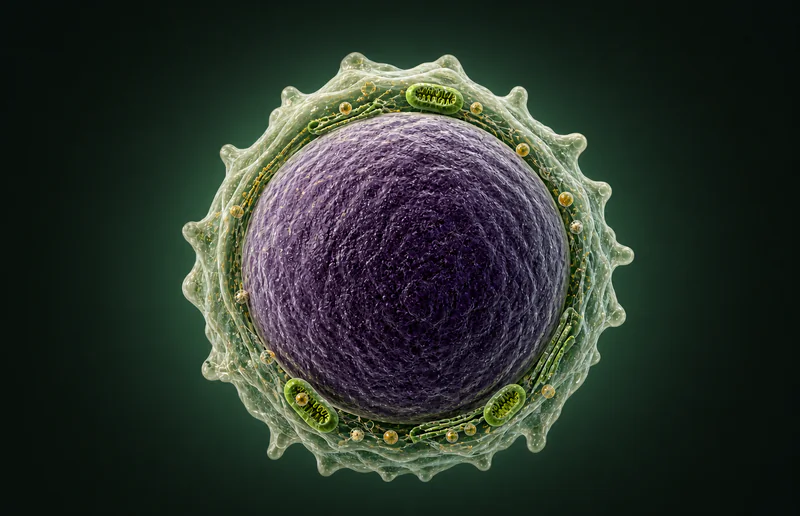
A lymphocyte is the brains of the immune system — the white blood cell that recognizes a specific pathogen, remembers it, and mounts a targeted response. It is why a vaccine works.
Lymphocytes make up about a quarter of your white blood cells. Unlike the brute-force neutrophil, a lymphocyte is precise — each one is tuned to a single molecular target, and the body keeps billions of differently-tuned versions on hand.
Structure
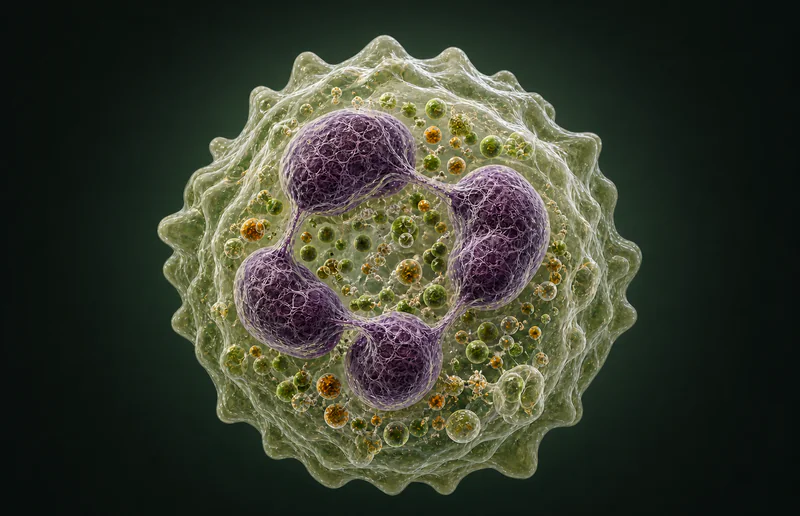
A lymphocyte is small and unassuming, dominated by one feature: a very large, round nucleus that fills almost the whole cell, leaving only a thin rim of cytoplasm. In the 3D model above, that oversized nucleus is the giveaway.
The big nucleus reflects the cell's job. It is packed with densely coiled (heterochromatic) DNA — a resting lymphocyte is mostly archive, holding the genetic instructions to build antibodies and signaling proteins on demand. The thin cytoplasm carries the basics, including mitochondria for energy, but few of the antimicrobial granules that fill a neutrophil.
Telling them apart is the catch: lymphocytes look almost identical down a light microscope whether they are B cells or T cells. The difference is molecular, not visual: each type carries different surface receptor proteins, and labs tell them apart with antibody stains against markers like CD4, CD8, and CD19, not by shape. Each lymphocyte also displays many copies of one uniquely-shaped antigen receptor, generated earlier by a controlled gene-shuffling process called V(D)J recombination.
Function
Lymphocytes run adaptive immunity — the targeted, memory-forming arm of immune defense. There are two main lineages:
- B cells make antibodies — Y-shaped proteins that lock onto a specific antigen, tagging the pathogen for destruction, clumping pathogens together, or neutralizing toxins directly. This is humoral immunity, defense carried in body fluids.
- T cells come in flavors. Helper T cells (CD4) coordinate the whole response, releasing cytokines that activate B cells and other immune cells. Cytotoxic T cells (CD8) kill the body's own cells once a virus has hijacked them, recognizing infected cells by the fragments they display on MHC molecules. This is cell-mediated immunity.
The defining trick is specificity plus memory. Each lymphocyte recognizes one particular molecular shape (an antigen). When a lymphocyte meets its match, it undergoes clonal selection — it divides rapidly into an army of identical clones, most becoming short-lived effector cells that fight now.
A fraction become long-lived memory cells. The next time that pathogen appears, those memory cells respond faster, in greater number, and with higher-affinity antibodies — the secondary response. That is exactly what a vaccine trains: it shows the immune system a harmless piece of a pathogen so memory lymphocytes are armed in advance, with no illness required.
This precision has a dark side. If lymphocytes that react to the body's own tissues are not removed during development (a process called self-tolerance), the result is autoimmune disease.
In the exam
- AP Bio (Unit 7 / immune-response topics): Distinguish adaptive immunity (lymphocytes — specific, slower on first exposure, memory-forming) from innate immunity (neutrophils, macrophages — fast, non-specific, no memory). A common graph question asks you to compare the primary and secondary antibody-response curves and explain why the second is faster and larger (memory cells).
- IB HL: Know the clonal selection model and that antibody specificity comes from the variable region. "Explain how a vaccine produces long-term immunity" is a recurring extended-response prompt — the answer must mention antigen, specific lymphocyte activation, clonal expansion, and memory cells.
- MCAT / USMLE: Helper T (CD4) versus cytotoxic T (CD8), MHC class I versus class II, antibody structure, and the basis of immunological memory are high-yield. The classic linked question is HIV, which infects and depletes CD4 helper T cells — collapsing the coordination of the entire adaptive response, which is why a single cell type matters so much.
Related cells
- Neutrophil — innate immunity's fast, non-specific first responder.
- Macrophage — presents antigens on MHC molecules that activate helper T cells.
- Nucleus — its dominance defines the lymphocyte's appearance.
- Stem cell — lymphocytes arise from bone-marrow hematopoietic stem cells.
- Mitochondrion — powers the rapid division of clonal expansion.
Common misconceptions
- "All white blood cells just eat bacteria." Lymphocytes mostly do not phagocytose. They recognize specific antigens and respond by making antibodies (B cells) or killing infected cells (cytotoxic T cells); helper T cells fight nothing directly and instead direct others.
- "B and T cells look different." Under a standard light microscope they look alike. They are distinguished by surface markers, not morphology.
- "Memory cells fight the infection." Memory cells wait in reserve. They accelerate the next encounter — the effector cells do the fighting now.
- "Antibodies kill pathogens directly." Usually not. Antibodies tag, clump, or neutralize; the actual killing is then done by phagocytes, the complement system, or cytotoxic cells. Neutralizing a toxin is the main exception where the antibody alone does the job.
References
- Abbas et al., Cellular and Molecular Immunology, 9th ed., Ch. 1 (Properties and Overview of Immune Responses).
- Reece et al., Campbell Biology, 11th ed., Ch. 43 (The Immune System).
- Alberts B. et al., Molecular Biology of the Cell, 7th ed., Ch. 24 (The Adaptive Immune System).