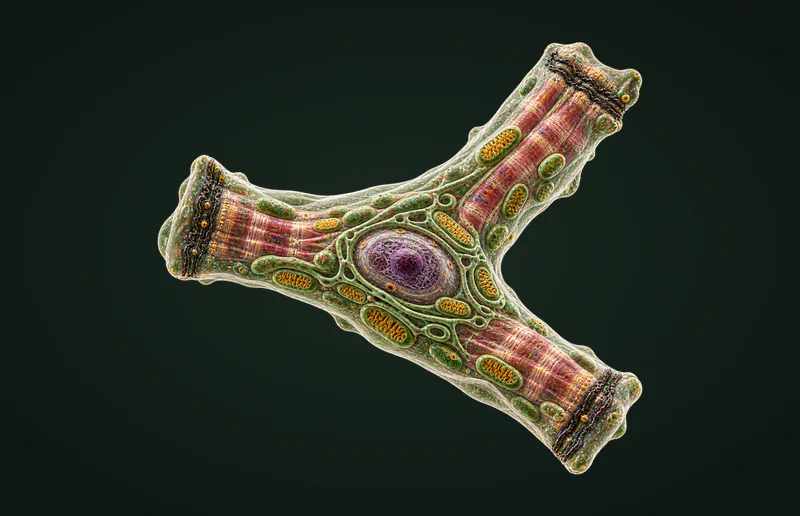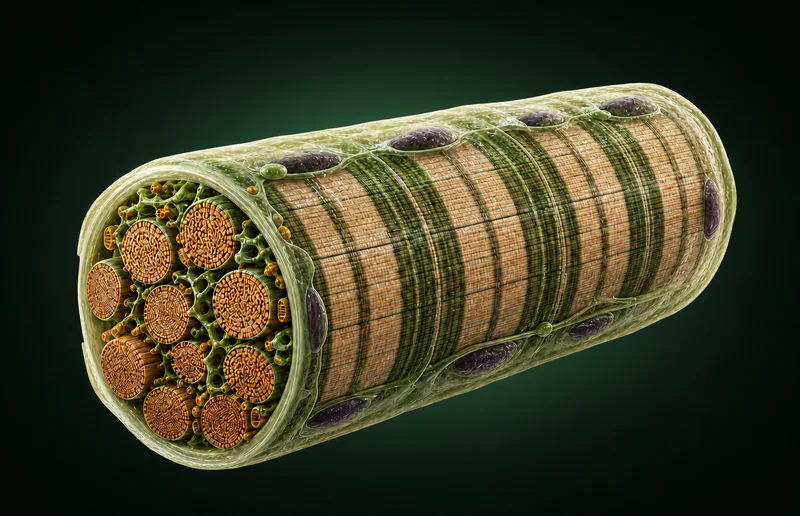
A skeletal muscle fiber is a single muscle cell built like a contracting cable — long, striped, and packed with the protein machinery that lets it shorten on command and move your bones.
These cells are huge by cellular standards: a single fiber can run the whole length of a muscle, up to 30 cm, and carries not one nucleus but hundreds.
Structure
A skeletal muscle fiber is long, cylindrical, and multinucleated — it forms when many precursor cells (myoblasts) fuse, pooling their nuclei just under the membrane so that protein synthesis is distributed along the whole length. In the 3D model above, the lengthwise stripes give it away.
Those stripes — the striations — come from its internal order:
- The fiber is filled with myofibrils, long contractile rods running its full length.
- Each myofibril is a chain of repeating units called sarcomeres, the actual engines of contraction. The sarcomere runs from one Z line to the next.
- A sarcomere is built from overlapping thin filaments (actin) anchored at the Z lines and thick filaments (myosin) in the center. Their regular overlap creates the banded look: the dark A band (the full length of the thick filaments) and the lighter I band (thin filament only), which is why the fiber appears striped.
Surrounding the myofibrils is a specialized smooth endoplasmic reticulum — the sarcoplasmic reticulum (SR) — that stores calcium. Plunging inward from the surface membrane are T-tubules, narrow tunnels that carry the electrical signal deep into the fiber so every myofibril gets the trigger at once. Slow-twitch fibers also carry dense mitochondria and the oxygen-binding protein myoglobin, which gives "red" muscle its color.
Function
Skeletal muscle contracts by the sliding filament mechanism, and it begins with a nerve signal.
A motor neuron releases acetylcholine at the neuromuscular junction, depolarizing the fiber's membrane. That depolarization races down the T-tubules and tells the sarcoplasmic reticulum to dump calcium into the cytoplasm — the step called excitation-contraction coupling. The calcium binds troponin, which shifts tropomyosin off the actin filament and uncovers the myosin-binding sites.
Now the cross-bridge cycle runs: a myosin head, already cocked with energy from a split ATP, binds the exposed actin, then pivots in a power stroke that pulls the thin filament toward the sarcomere's center. A fresh ATP binds the head to release it; ATP hydrolysis re-cocks it; and it grabs the next site along. Repeat the cycle thousands of times across every sarcomere and the whole fiber shortens, pulling on the bone it attaches to. The filaments themselves do not shrink — they slide past each other, narrowing the I band while the A band stays constant. When the signal stops, calcium is pumped back into the SR, tropomyosin re-covers the sites, and the fiber relaxes.
Skeletal muscle is voluntary and striated: you consciously control it, and its ordered sarcomeres make it striped. Because each fiber fires fully or not at all, the body grades whole-muscle force two ways — by recruiting more fibers (motor units) and by firing them faster, which sums individual twitches into a smooth, sustained contraction called tetanus.
In the exam
- AP Bio / MCAT / USMLE: The sliding filament theory is essential and tested in order — calcium release → troponin binds Ca²⁺ → tropomyosin shifts → myosin binds actin → power stroke → ATP detaches the head → re-cock. Know that filaments slide (they do not shorten), and that ATP is required both for the power stroke and for myosin release.
- USMLE Step 1: Rigor mortis is the classic application — with no ATP after death, myosin heads stay locked on actin and the muscle stiffens. Also expect band-change questions: during contraction the I band and H zone shrink while the A band is unchanged.
- IB HL / A-Level: Be precise about excitation-contraction coupling — acetylcholine at the neuromuscular junction → membrane depolarization → down the T-tubules → SR releases calcium. A common trap asks for the source of the calcium (the SR, not the blood).
Related cells
- Cardiac muscle cell — also striated, but involuntary, branched, and electrically coupled.
- Neuron — the motor neuron whose acetylcholine triggers the fiber.
- Mitochondrion — supplies the ATP every cross-bridge cycle needs.
- Endoplasmic reticulum — its muscle form, the sarcoplasmic reticulum, stores the calcium.
- Nucleus — present in the hundreds in a single fused fiber.
Common misconceptions
- "The filaments shorten during contraction." They do not change length — they slide past each other, narrowing the sarcomere while the filaments stay the same size.
- "Muscle works without ATP." ATP is needed both for the power stroke and to detach myosin from actin afterward — without it, the heads stay bound and the muscle stiffens (rigor).
- "A muscle fiber has one nucleus." It has many, because it forms from fused precursor cells; the nuclei sit at the periphery, just under the membrane.
- "Calcium for contraction comes from the blood." In skeletal muscle the trigger calcium is released from the internal sarcoplasmic reticulum, not imported from outside the cell — a key difference from cardiac muscle, which relies partly on extracellular calcium.
References
- Guyton, A.C. & Hall, J.E. Textbook of Medical Physiology, 13th ed. — Ch. 6 (Contraction of Skeletal Muscle) & Ch. 7 (Excitation-Contraction Coupling).
- Marieb, E.N. & Hoehn, K. Human Anatomy & Physiology, 11th ed. — Ch. 9 (Muscles and Muscle Tissue).
- College Board AP Biology Course and Exam Description (2025) — Unit 4 (Cell Communication; muscle as a signaling target).