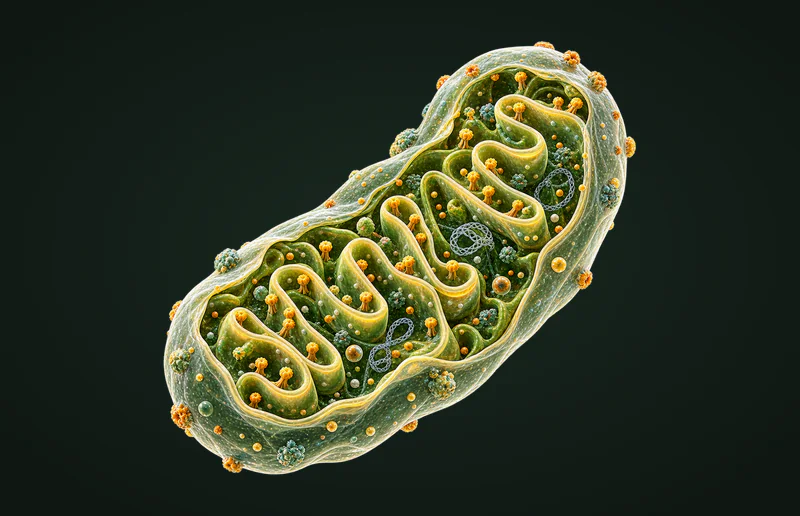
A lysosome is the cell's recycling and demolition crew — a membrane bag full of digestive enzymes that breaks down worn-out parts, captured invaders, and surplus molecules into reusable building blocks.
Lysosomes are found mainly in animal cells. They are small (about 0.1–1.2 μm) and variable, because their size and contents change depending on what they happen to be digesting at the moment. A single cell may hold hundreds, and the count climbs in professional eaters like the macrophage.
Structure
A lysosome is simple by design: a single membrane enclosing roughly 50 different hydrolytic enzymes — proteases, lipases, nucleases, phosphatases, and glycosidases that between them can dismantle almost any biological molecule.
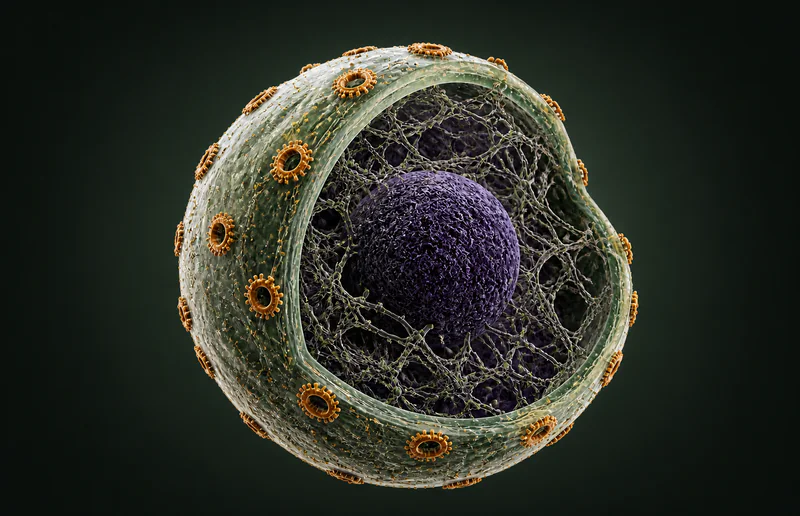
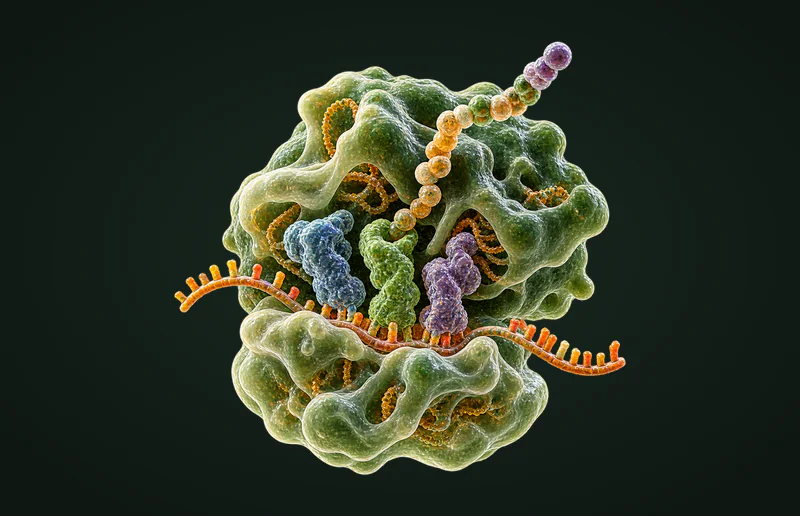
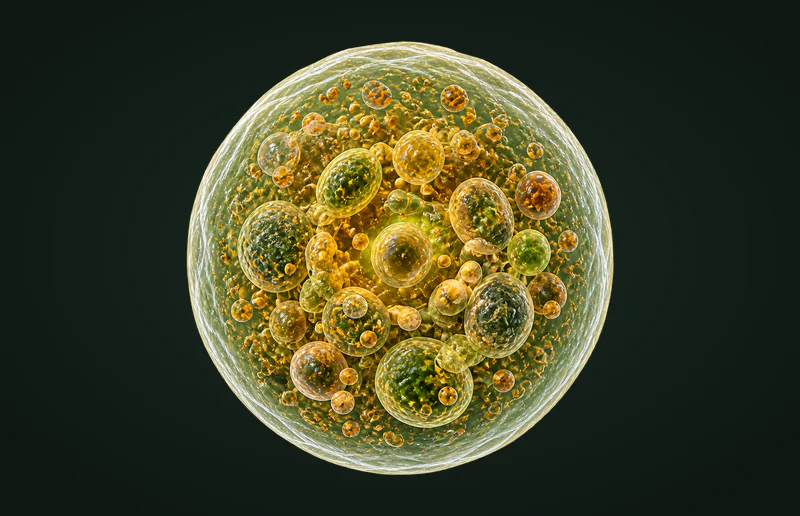
The key trick is pH. The enzymes are acid hydrolases, tuned to work best at about pH 4.5–5.0, well below the cytosol's near-neutral 7.2. A vacuolar H⁺-ATPase (V-ATPase) studded in the membrane burns ATP to pump protons inward, holding the interior acidic. In the 3D model above, the bounding membrane is the protective shell, and the dense interior represents the packed enzyme cargo.
This pH gap is a built-in safety feature. If a lysosome leaks, its enzymes spill into the near-neutral cytosol where they are largely inactive — so a small leak does not dissolve the cell. The membrane's own inner face is also coated with heavily glycosylated proteins (a glycocalyx) that physically shields it from its own enzymes.
Lysosomes are not all identical. A freshly delivered primary lysosome carries enzymes but no substrate yet; once it fuses with material to be digested, it becomes a secondary lysosome or phagolysosome where the actual breakdown happens.
Function
Lysosomes carry out intracellular digestion, fed by three main routes:
- Phagocytosis — a macrophage or neutrophil engulfs a bacterium into a phagosome, then fuses it with a lysosome to destroy the prey.
- Autophagy — the cell wraps a worn-out organelle (a spent mitochondrion, say) in a double membrane called an autophagosome and delivers it to a lysosome for recycling.
- Endocytosis — molecules and receptors brought in from outside are routed through endosomes that mature into, or fuse with, lysosomes.
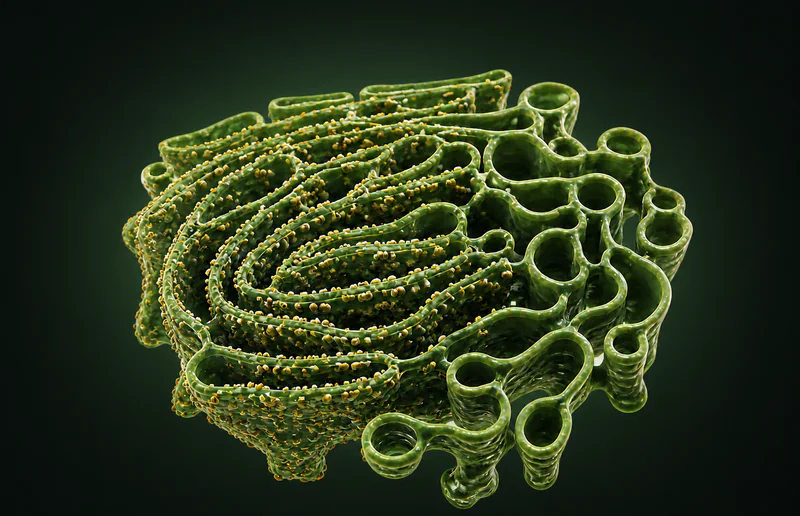
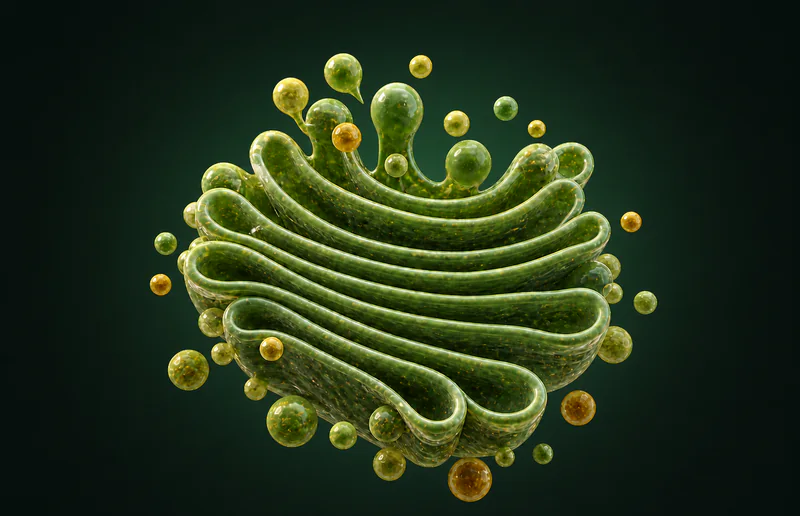
The enzymes themselves are made on the rough endoplasmic reticulum, then tagged in the Golgi apparatus with a mannose-6-phosphate (M6P) "ship-to-lysosome" address label. M6P receptors in the Golgi capture the tagged enzymes and bud them off in vesicles bound for the lysosome. The receptor then recycles back to the Golgi to do it again.
When digestion is done, the small products — amino acids, sugars, fatty acids, nucleotides — are exported back to the cytosol through membrane transporters and reused. Indigestible leftovers stay behind as a residual body; in long-lived cells like neurons, this accumulates over decades as the brown "age pigment" lipofuscin.
In the exam
Lysosome questions reward you for tracing pathways and reasoning about pH, not just memorizing a definition.
- AP Bio (Unit 2, Cell Structure & Function): Know lysosomes as the site of hydrolysis and recycling, and be able to trace the secretory pathway — enzymes made on the rough ER, tagged in the Golgi, shipped in vesicles. The acidic-interior safety logic ("why doesn't the cell digest itself?") is a recurring free-response reasoning prompt.
- IB HL: Connect lysosomes to phagocytosis in white blood cells, and to apoptosis, where controlled enzyme release helps dismantle a doomed cell. Distinguish hydrolysis (lysosome) from oxidation (peroxisome).
- MCAT: The M6P tagging pathway is a classic mechanism question. A pedigree-style or biochemistry stem may describe I-cell disease (mucolipidosis II), where a missing M6P-tagging enzyme means lysosomal enzymes are secreted instead of delivered — so cells fill with undigested material.
- USMLE Step 1: Lysosomal storage diseases come up reliably. Tay-Sachs (hexosaminidase A deficiency, cherry-red macula), Gaucher (glucocerebrosidase), and Pompe (acid maltase, a glycogen storage problem) all trace back to one missing acid hydrolase.
Related cells
- Golgi apparatus — tags lysosomal enzymes with mannose-6-phosphate and packages them.
- Endoplasmic reticulum — where the digestive enzymes are first synthesized.
- Macrophage — relies on lysosomes to destroy engulfed pathogens.
- Peroxisome — the other small organelle students confuse with the lysosome; it oxidizes rather than hydrolyzes.
- Animal cell — see the lysosome among the other organelles.
Common misconceptions
- "Lysosome enzymes would dissolve the whole cell if released." Only briefly and locally — at the cytosol's neutral pH the acid hydrolases are mostly inactive, which is the entire point of the acidic interior. Massive, simultaneous rupture is another matter, but a single leak is not catastrophic.
- "Plants have lysosomes too." Plant cells generally use the central vacuole for the same digestive role, with its own acidic, enzyme-rich interior.
- "Lysosomes only destroy invaders." Most of their work is housekeeping — recycling the cell's own old organelles and proteins through autophagy. Defense is the smaller share of the job.
- "The lysosome makes its own enzymes." It doesn't — like the peroxisome it has no DNA or ribosomes. Its enzymes are imported from the ER–Golgi pathway.
References
- Alberts B. et al. Molecular Biology of the Cell, 6th ed. — Chapter 13: Intracellular Vesicular Traffic.
- Lodish H. et al. Molecular Cell Biology, 8th ed. — Chapter 14 (Vesicular Traffic, Secretion, and Endocytosis).
- College Board AP Biology Course and Exam Description (2025) — Unit 2 (Cell Structure and Function).